

210
T. Casagrande do Nascimento et al.
The phycocyanins are blue while the phycoerythrins are pink and they differ
structurally from each other by replacing the CH 3 –CH 2 group with CH = CH 2 ,
being the absorption maximums at 540–570 nm and 610–620 nm for phycocyanin
and phycoerythrin, respectively (Román et al. 2002; Spolaore et al. 2006).
The main application of these compounds is as a natural dye in the food industry,
however, an increasing number of investigations have shown their health-promoting
properties and wide range of pharmaceutical applications, mainly phycocyanin (Bhat
and Madyastha 2000; Begum et al. 2015; Rodrigues et al. 2015; Jung et al. 2016;
Sangeetha et al. 2017; Patel et al. 2018). According to Estrada et al. (2001), the
increase in hydroxyl radical inhibition related to the increase of phycobilin content
demonstrates the antioxidant capacity of these compounds. This biological activity
has been linked to the structure’s chromophore, which acts as a powerful scavenger
of ROS suggesting SET as the primary mechanism involved in the same way as
carotenoids and chlorophylls (see Fig. 9.3) (Bhat and Madyastha 2000).
Another type of bioactive compounds present in microalgae are the phenolic
compounds. Although their determination is not frequent, phenolic compounds
(including phenolic acids and flavonoids) are also present in microalgae biomass
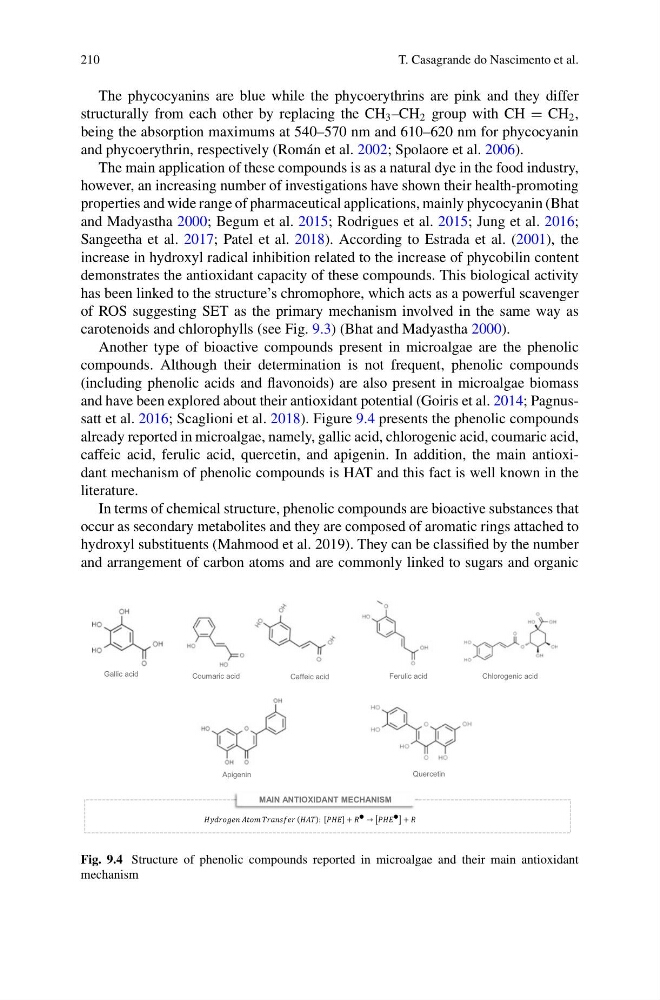
and have been explored about their antioxidant potential (Goiris et al. 2014; Pagnussatt et al. 2016; Scaglioni et al. 2018). Figure 9.4 presents the phenolic compounds
already reported in microalgae, namely, gallic acid, chlorogenic acid, coumaric acid,
caffeic acid, ferulic acid, quercetin, and apigenin. In addition, the main antioxidant mechanism of phenolic compounds is HAT and this fact is well known in the
literature.
In terms of chemical structure, phenolic compounds are bioactive substances that
occur as secondary metabolites and they are composed of aromatic rings attached to
hydroxyl substituents (Mahmood et al. 2019). They can be classified by the number
and arrangement of carbon atoms and are commonly linked to sugars and organic
MAIN ANTIOXIDANT MECHANISM
Gallic acid
Coumaric acid
Quercetin
Caffeic acid
Chlorogenic acid
Ferulic acid
Apigenin
Fig. 9.4 Structure of phenolic compounds reported in microalgae and their main antioxidant
mechanism
T. Casagrande do Nascimento et al.
The phycocyanins are blue while the phycoerythrins are pink and they differ
structurally from each other by replacing the CH 3 –CH 2 group with CH = CH 2 ,
being the absorption maximums at 540–570 nm and 610–620 nm for phycocyanin
and phycoerythrin, respectively (Román et al. 2002; Spolaore et al. 2006).
The main application of these compounds is as a natural dye in the food industry,
however, an increasing number of investigations have shown their health-promoting
properties and wide range of pharmaceutical applications, mainly phycocyanin (Bhat
and Madyastha 2000; Begum et al. 2015; Rodrigues et al. 2015; Jung et al. 2016;
Sangeetha et al. 2017; Patel et al. 2018). According to Estrada et al. (2001), the
increase in hydroxyl radical inhibition related to the increase of phycobilin content
demonstrates the antioxidant capacity of these compounds. This biological activity
has been linked to the structure’s chromophore, which acts as a powerful scavenger
of ROS suggesting SET as the primary mechanism involved in the same way as
carotenoids and chlorophylls (see Fig. 9.3) (Bhat and Madyastha 2000).
Another type of bioactive compounds present in microalgae are the phenolic
compounds. Although their determination is not frequent, phenolic compounds
(including phenolic acids and flavonoids) are also present in microalgae biomass
and have been explored about their antioxidant potential (Goiris et al. 2014; Pagnussatt et al. 2016; Scaglioni et al. 2018). Figure 9.4 presents the phenolic compounds
already reported in microalgae, namely, gallic acid, chlorogenic acid, coumaric acid,
caffeic acid, ferulic acid, quercetin, and apigenin. In addition, the main antioxidant mechanism of phenolic compounds is HAT and this fact is well known in the
literature.
In terms of chemical structure, phenolic compounds are bioactive substances that
occur as secondary metabolites and they are composed of aromatic rings attached to
hydroxyl substituents (Mahmood et al. 2019). They can be classified by the number
and arrangement of carbon atoms and are commonly linked to sugars and organic
MAIN ANTIOXIDANT MECHANISM
Gallic acid
Coumaric acid
Quercetin
Caffeic acid
Chlorogenic acid
Ferulic acid
Apigenin
Fig. 9.4 Structure of phenolic compounds reported in microalgae and their main antioxidant
mechanism