

138
I. Viera and M. Roca
Table 6.3 HPLC methods for chlorophyll analysis from phytoplankton
Authors
Column type Particle size
(μm)
Time
(min)
Mobile phases
Detectors
Wright et al.
(1991)
C18
5
20
A: methanol:
ammonium acetate.
B: acetonitrile:water
C: ethyl acetate
DAD
Fluor a
Garrido and
Zapata (1997)
C18
5
25
A: methanol:
acetonitrile: aqueous
pyridine
B:acetone
DAD
Fluor
Zapata et al.
(2000)
C8
3.5
40
A: methanol:
acetonitrile: aqueous
pyridine
B: methanol:
acetonitrile: acetone
DAD
Fluor
Van Heukelem
and Thomas
(2001)
C8
3.5
30
A: methanol:
tetrabutylammonium
acetate
B: methanol
DAD
Jayaraman et al.
(2011)
C16
5
40
A: methanol.
B: acetonitrile
C: ammonium acetate
DAD
Fluor
Sanz et al.
(2015)
C18
3
40
A: methanol:
ammonium acetate.
B: ethanol
DAD
Zhang et al.
(2016)
C8
1.8
15
A: ammonium acetate
B: acetonitrile
C: methanol
DAD
Suzuki et al.
(2015)
C8
1.8
7
A: methanol:
tetrabutylammonium
acetate
B: methanol
DAD
Fluor
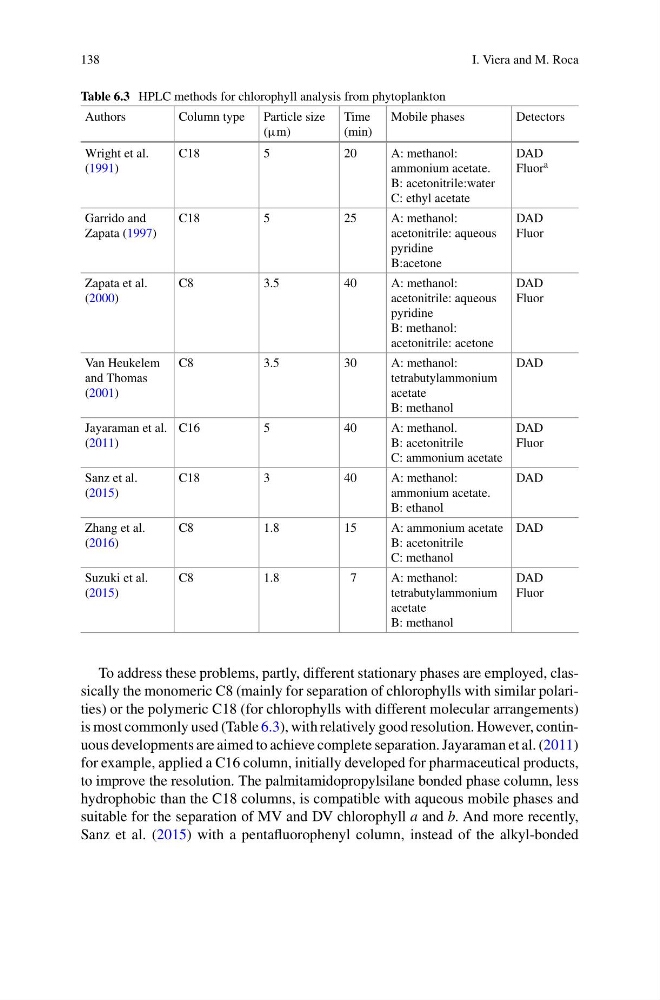
To address these problems, partly, different stationary phases are employed, classically the monomeric C8 (mainly for separation of chlorophylls with similar polarities) or the polymeric C18 (for chlorophylls with different molecular arrangements)
is most commonly used (Table 6.3), with relatively good resolution. However, continuous developments are aimed to achieve complete separation. Jayaraman et al. (2011)
for example, applied a C16 column, initially developed for pharmaceutical products,
to improve the resolution. The palmitamidopropylsilane bonded phase column, less
hydrophobic than the C18 columns, is compatible with aqueous mobile phases and
suitable for the separation of MV and DV chlorophyll a and b. And more recently,
Sanz et al. (2015) with a pentafluorophenyl column, instead of the alkyl-bonded
I. Viera and M. Roca
Table 6.3 HPLC methods for chlorophyll analysis from phytoplankton
Authors
Column type Particle size
(μm)
Time
(min)
Mobile phases
Detectors
Wright et al.
(1991)
C18
5
20
A: methanol:
ammonium acetate.
B: acetonitrile:water
C: ethyl acetate
DAD
Fluor a
Garrido and
Zapata (1997)
C18
5
25
A: methanol:
acetonitrile: aqueous
pyridine
B:acetone
DAD
Fluor
Zapata et al.
(2000)
C8
3.5
40
A: methanol:
acetonitrile: aqueous
pyridine
B: methanol:
acetonitrile: acetone
DAD
Fluor
Van Heukelem
and Thomas
(2001)
C8
3.5
30
A: methanol:
tetrabutylammonium
acetate
B: methanol
DAD
Jayaraman et al.
(2011)
C16
5
40
A: methanol.
B: acetonitrile
C: ammonium acetate
DAD
Fluor
Sanz et al.
(2015)
C18
3
40
A: methanol:
ammonium acetate.
B: ethanol
DAD
Zhang et al.
(2016)
C8
1.8
15
A: ammonium acetate
B: acetonitrile
C: methanol
DAD
Suzuki et al.
(2015)
C8
1.8
7
A: methanol:
tetrabutylammonium
acetate
B: methanol
DAD
Fluor
To address these problems, partly, different stationary phases are employed, classically the monomeric C8 (mainly for separation of chlorophylls with similar polarities) or the polymeric C18 (for chlorophylls with different molecular arrangements)
is most commonly used (Table 6.3), with relatively good resolution. However, continuous developments are aimed to achieve complete separation. Jayaraman et al. (2011)
for example, applied a C16 column, initially developed for pharmaceutical products,
to improve the resolution. The palmitamidopropylsilane bonded phase column, less
hydrophobic than the C18 columns, is compatible with aqueous mobile phases and
suitable for the separation of MV and DV chlorophyll a and b. And more recently,
Sanz et al. (2015) with a pentafluorophenyl column, instead of the alkyl-bonded