

132
I. Viera and M. Roca
be found at C-8 (ethyl, n-propyl or iso-butyl), C-12 (ethyl or methyl group), and C17
3 (farnesyl and other alcohols) (Fig. 6.4). All present a characteristic hydroxyethyl
at C-3 and bacteriochlorophyll e an additional formyl group at C-7.
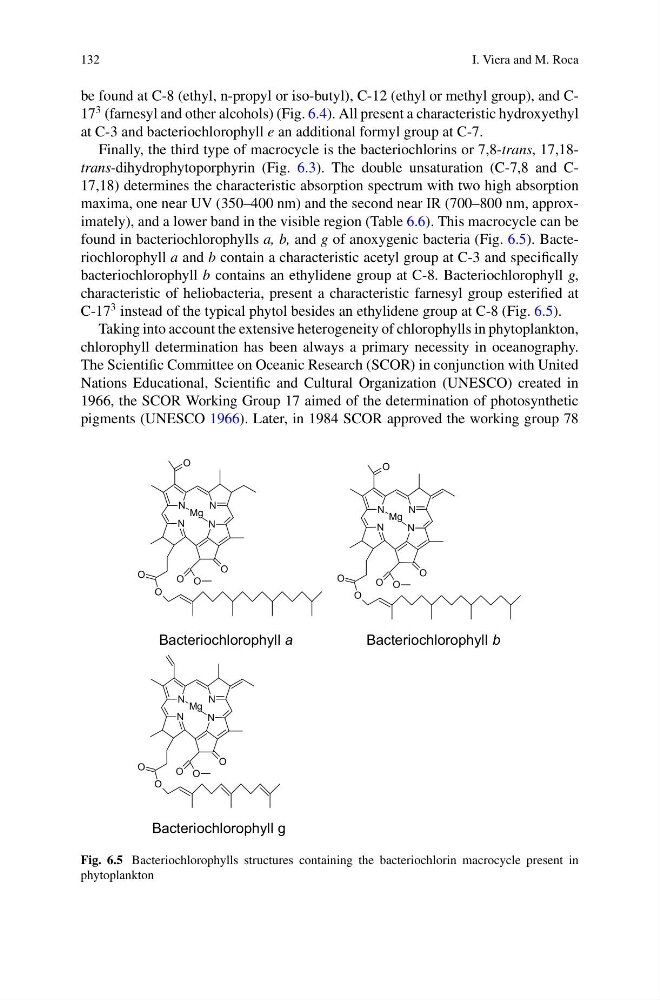
Finally, the third type of macrocycle is the bacteriochlorins or 7,8-trans, 17,18trans-dihydrophytoporphyrin (Fig. 6.3). The double unsaturation (C-7,8 and C17,18) determines the characteristic absorption spectrum with two high absorption
maxima, one near UV (350–400 nm) and the second near IR (700–800 nm, approximately), and a lower band in the visible region (Table 6.6). This macrocycle can be
found in bacteriochlorophylls a, b, and g of anoxygenic bacteria (Fig. 6.5). Bacteriochlorophyll a and b contain a characteristic acetyl group at C-3 and specifically
bacteriochlorophyll b contains an ethylidene group at C-8. Bacteriochlorophyll g,
characteristic of heliobacteria, present a characteristic farnesyl group esterified at
C-17
3 instead of the typical phytol besides an ethylidene group at C-8 (Fig. 6.5).
Taking into account the extensive heterogeneity of chlorophylls in phytoplankton,
chlorophyll determination has been always a primary necessity in oceanography.
The Scientific Committee on Oceanic Research (SCOR) in conjunction with United
Nations Educational, Scientific and Cultural Organization (UNESCO) created in
1966, the SCOR Working Group 17 aimed of the determination of photosynthetic
pigments (UNESCO 1966). Later, in 1984 SCOR approved the working group 78
N
N
N
N
O
O
O
O
O
O
Mg
Bacteriochlorophyll a
N
N
N
N
O
O
O
O
O
O
Mg
Bacteriochlorophyll b
Bacteriochlorophyll g
N
N
N
N
O
O
O
O
O
Mg
Fig. 6.5 Bacteriochlorophylls structures containing the bacteriochlorin macrocycle present in
phytoplankton
I. Viera and M. Roca
be found at C-8 (ethyl, n-propyl or iso-butyl), C-12 (ethyl or methyl group), and C17
3 (farnesyl and other alcohols) (Fig. 6.4). All present a characteristic hydroxyethyl
at C-3 and bacteriochlorophyll e an additional formyl group at C-7.
Finally, the third type of macrocycle is the bacteriochlorins or 7,8-trans, 17,18trans-dihydrophytoporphyrin (Fig. 6.3). The double unsaturation (C-7,8 and C17,18) determines the characteristic absorption spectrum with two high absorption
maxima, one near UV (350–400 nm) and the second near IR (700–800 nm, approximately), and a lower band in the visible region (Table 6.6). This macrocycle can be
found in bacteriochlorophylls a, b, and g of anoxygenic bacteria (Fig. 6.5). Bacteriochlorophyll a and b contain a characteristic acetyl group at C-3 and specifically
bacteriochlorophyll b contains an ethylidene group at C-8. Bacteriochlorophyll g,
characteristic of heliobacteria, present a characteristic farnesyl group esterified at
C-17
3 instead of the typical phytol besides an ethylidene group at C-8 (Fig. 6.5).
Taking into account the extensive heterogeneity of chlorophylls in phytoplankton,
chlorophyll determination has been always a primary necessity in oceanography.
The Scientific Committee on Oceanic Research (SCOR) in conjunction with United
Nations Educational, Scientific and Cultural Organization (UNESCO) created in
1966, the SCOR Working Group 17 aimed of the determination of photosynthetic
pigments (UNESCO 1966). Later, in 1984 SCOR approved the working group 78
N
N
N
N
O
O
O
O
O
O
Mg
Bacteriochlorophyll a
N
N
N
N
O
O
O
O
O
O
Mg
Bacteriochlorophyll b
Bacteriochlorophyll g
N
N
N
N
O
O
O
O
O
Mg
Fig. 6.5 Bacteriochlorophylls structures containing the bacteriochlorin macrocycle present in
phytoplankton