

6 Analytical Protocols in Chlorophyll Analysis
131
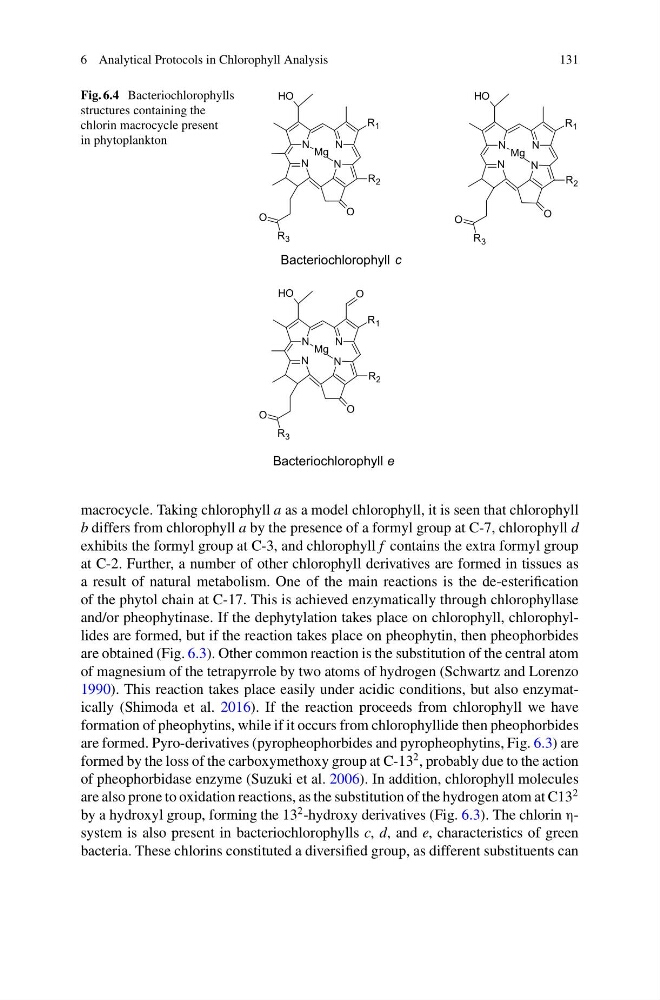
Fig. 6.4 Bacteriochlorophylls
structures containing the
chlorin macrocycle present
in phytoplankton
Bacteriochlorophyll c
Bacteriochlorophyll e
N
N
N
N
R 1
R 2
O
Mg
O
H
O
R 3
O
N
N
N
N
R 1
R 2
O
Mg
O
H
O
R 3
N
N
N
N
R 1
R 2
O
Mg
O
H
O
R 3
macrocycle. Taking chlorophyll a as a model chlorophyll, it is seen that chlorophyll
b differs from chlorophyll a by the presence of a formyl group at C-7, chlorophyll d
exhibits the formyl group at C-3, and chlorophyll f contains the extra formyl group
at C-2. Further, a number of other chlorophyll derivatives are formed in tissues as
a result of natural metabolism. One of the main reactions is the de-esterification
of the phytol chain at C-17. This is achieved enzymatically through chlorophyllase
and/or pheophytinase. If the dephytylation takes place on chlorophyll, chlorophyllides are formed, but if the reaction takes place on pheophytin, then pheophorbides
are obtained (Fig. 6.3). Other common reaction is the substitution of the central atom
of magnesium of the tetrapyrrole by two atoms of hydrogen (Schwartz and Lorenzo
1990). This reaction takes place easily under acidic conditions, but also enzymatically (Shimoda et al. 2016). If the reaction proceeds from chlorophyll we have
formation of pheophytins, while if it occurs from chlorophyllide then pheophorbides
are formed. Pyro-derivatives (pyropheophorbides and pyropheophytins, Fig. 6.3) are
formed by the loss of the carboxymethoxy group at C-13
2 , probably due to the action
of pheophorbidase enzyme (Suzuki et al. 2006). In addition, chlorophyll molecules
are also prone to oxidation reactions, as the substitution of the hydrogen atom at C13
2
by a hydroxyl group, forming the 13
2 -hydroxy derivatives (Fig. 6.3). The chlorin ηsystem is also present in bacteriochlorophylls c, d, and e, characteristics of green
bacteria. These chlorins constituted a diversified group, as different substituents can
131
Fig. 6.4 Bacteriochlorophylls
structures containing the
chlorin macrocycle present
in phytoplankton
Bacteriochlorophyll c
Bacteriochlorophyll e
N
N
N
N
R 1
R 2
O
Mg
O
H
O
R 3
O
N
N
N
N
R 1
R 2
O
Mg
O
H
O
R 3
N
N
N
N
R 1
R 2
O
Mg
O
H
O
R 3
macrocycle. Taking chlorophyll a as a model chlorophyll, it is seen that chlorophyll
b differs from chlorophyll a by the presence of a formyl group at C-7, chlorophyll d
exhibits the formyl group at C-3, and chlorophyll f contains the extra formyl group
at C-2. Further, a number of other chlorophyll derivatives are formed in tissues as
a result of natural metabolism. One of the main reactions is the de-esterification
of the phytol chain at C-17. This is achieved enzymatically through chlorophyllase
and/or pheophytinase. If the dephytylation takes place on chlorophyll, chlorophyllides are formed, but if the reaction takes place on pheophytin, then pheophorbides
are obtained (Fig. 6.3). Other common reaction is the substitution of the central atom
of magnesium of the tetrapyrrole by two atoms of hydrogen (Schwartz and Lorenzo
1990). This reaction takes place easily under acidic conditions, but also enzymatically (Shimoda et al. 2016). If the reaction proceeds from chlorophyll we have
formation of pheophytins, while if it occurs from chlorophyllide then pheophorbides
are formed. Pyro-derivatives (pyropheophorbides and pyropheophytins, Fig. 6.3) are
formed by the loss of the carboxymethoxy group at C-13
2 , probably due to the action
of pheophorbidase enzyme (Suzuki et al. 2006). In addition, chlorophyll molecules
are also prone to oxidation reactions, as the substitution of the hydrogen atom at C13
2
by a hydroxyl group, forming the 13
2 -hydroxy derivatives (Fig. 6.3). The chlorin ηsystem is also present in bacteriochlorophylls c, d, and e, characteristics of green
bacteria. These chlorins constituted a diversified group, as different substituents can