

5 Carotenoid Overproduction in Microalgae: Biochemical …
105
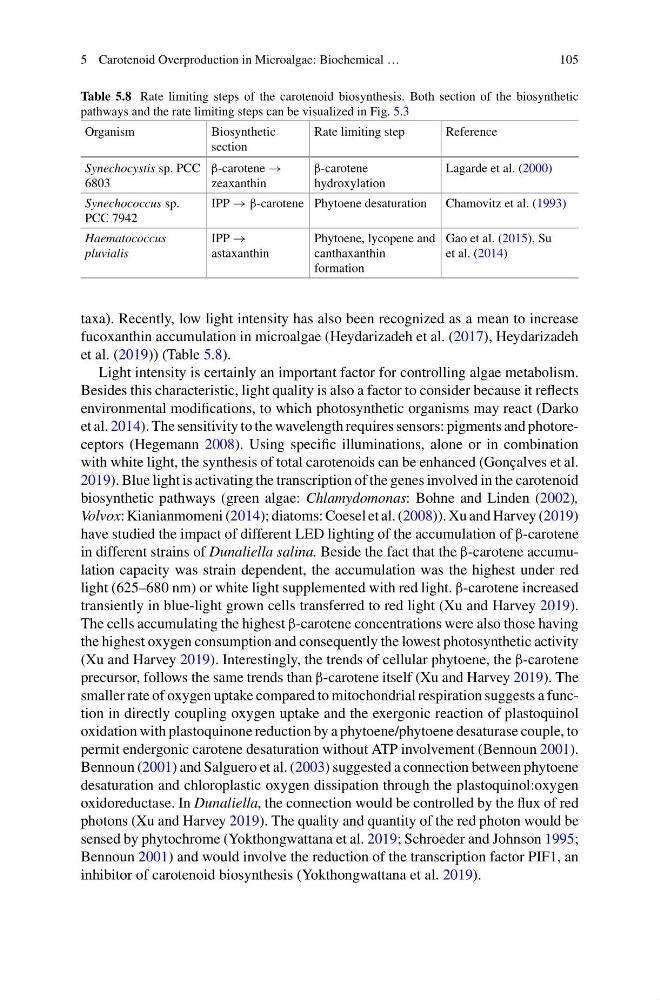
Table 5.8 Rate limiting steps of the carotenoid biosynthesis. Both section of the biosynthetic
pathways and the rate limiting steps can be visualized in Fig. 5.3
Organism
Biosynthetic
section
Rate limiting step
Reference
Synechocystis sp. PCC
6803
β-carotene →
zeaxanthin
β-carotene
hydroxylation
Lagarde et al. (2000)
Synechococcus sp.
PCC 7942
IPP → β-carotene Phytoene desaturation Chamovitz et al. (1993)
Haematococcus
pluvialis
IPP →
astaxanthin
Phytoene, lycopene and
canthaxanthin
formation
Gao et al. (2015), Su
et al. (2014)
taxa). Recently, low light intensity has also been recognized as a mean to increase
fucoxanthin accumulation in microalgae (Heydarizadeh et al. (2017), Heydarizadeh
et al. (2019)) (Table 5.8).
Light intensity is certainly an important factor for controlling algae metabolism.
Besides this characteristic, light quality is also a factor to consider because it reflects
environmental modifications, to which photosynthetic organisms may react (Darko
et al. 2014). The sensitivity to the wavelength requires sensors: pigments and photoreceptors (Hegemann 2008). Using specific illuminations, alone or in combination
with white light, the synthesis of total carotenoids can be enhanced (Gonçalves et al.
2019). Blue light is activating the transcription of the genes involved in the carotenoid
biosynthetic pathways (green algae: Chlamydomonas: Bohne and Linden (2002),
Volvox: Kianianmomeni (2014); diatoms: Coesel et al. (2008)). Xu and Harvey (2019)
have studied the impact of different LED lighting of the accumulation of β-carotene
in different strains of Dunaliella salina. Beside the fact that the β-carotene accumulation capacity was strain dependent, the accumulation was the highest under red
light (625–680 nm) or white light supplemented with red light. β-carotene increased
transiently in blue-light grown cells transferred to red light (Xu and Harvey 2019).
The cells accumulating the highest β-carotene concentrations were also those having
the highest oxygen consumption and consequently the lowest photosynthetic activity
(Xu and Harvey 2019). Interestingly, the trends of cellular phytoene, the β-carotene
precursor, follows the same trends than β-carotene itself (Xu and Harvey 2019). The
smaller rate of oxygen uptake compared to mitochondrial respiration suggests a function in directly coupling oxygen uptake and the exergonic reaction of plastoquinol
oxidation with plastoquinone reduction by a phytoene/phytoene desaturase couple, to
permit endergonic carotene desaturation without ATP involvement (Bennoun 2001).
Bennoun (2001) and Salguero et al. (2003) suggested a connection between phytoene
desaturation and chloroplastic oxygen dissipation through the plastoquinol:oxygen
oxidoreductase. In Dunaliella, the connection would be controlled by the flux of red
photons (Xu and Harvey 2019). The quality and quantity of the red photon would be
sensed by phytochrome (Yokthongwattana et al. 2019; Schroeder and Johnson 1995;
Bennoun 2001) and would involve the reduction of the transcription factor PIF1, an
inhibitor of carotenoid biosynthesis (Yokthongwattana et al. 2019).
105
Table 5.8 Rate limiting steps of the carotenoid biosynthesis. Both section of the biosynthetic
pathways and the rate limiting steps can be visualized in Fig. 5.3
Organism
Biosynthetic
section
Rate limiting step
Reference
Synechocystis sp. PCC
6803
β-carotene →
zeaxanthin
β-carotene
hydroxylation
Lagarde et al. (2000)
Synechococcus sp.
PCC 7942
IPP → β-carotene Phytoene desaturation Chamovitz et al. (1993)
Haematococcus
pluvialis
IPP →
astaxanthin
Phytoene, lycopene and
canthaxanthin
formation
Gao et al. (2015), Su
et al. (2014)
taxa). Recently, low light intensity has also been recognized as a mean to increase
fucoxanthin accumulation in microalgae (Heydarizadeh et al. (2017), Heydarizadeh
et al. (2019)) (Table 5.8).
Light intensity is certainly an important factor for controlling algae metabolism.
Besides this characteristic, light quality is also a factor to consider because it reflects
environmental modifications, to which photosynthetic organisms may react (Darko
et al. 2014). The sensitivity to the wavelength requires sensors: pigments and photoreceptors (Hegemann 2008). Using specific illuminations, alone or in combination
with white light, the synthesis of total carotenoids can be enhanced (Gonçalves et al.
2019). Blue light is activating the transcription of the genes involved in the carotenoid
biosynthetic pathways (green algae: Chlamydomonas: Bohne and Linden (2002),
Volvox: Kianianmomeni (2014); diatoms: Coesel et al. (2008)). Xu and Harvey (2019)
have studied the impact of different LED lighting of the accumulation of β-carotene
in different strains of Dunaliella salina. Beside the fact that the β-carotene accumulation capacity was strain dependent, the accumulation was the highest under red
light (625–680 nm) or white light supplemented with red light. β-carotene increased
transiently in blue-light grown cells transferred to red light (Xu and Harvey 2019).
The cells accumulating the highest β-carotene concentrations were also those having
the highest oxygen consumption and consequently the lowest photosynthetic activity
(Xu and Harvey 2019). Interestingly, the trends of cellular phytoene, the β-carotene
precursor, follows the same trends than β-carotene itself (Xu and Harvey 2019). The
smaller rate of oxygen uptake compared to mitochondrial respiration suggests a function in directly coupling oxygen uptake and the exergonic reaction of plastoquinol
oxidation with plastoquinone reduction by a phytoene/phytoene desaturase couple, to
permit endergonic carotene desaturation without ATP involvement (Bennoun 2001).
Bennoun (2001) and Salguero et al. (2003) suggested a connection between phytoene
desaturation and chloroplastic oxygen dissipation through the plastoquinol:oxygen
oxidoreductase. In Dunaliella, the connection would be controlled by the flux of red
photons (Xu and Harvey 2019). The quality and quantity of the red photon would be
sensed by phytochrome (Yokthongwattana et al. 2019; Schroeder and Johnson 1995;
Bennoun 2001) and would involve the reduction of the transcription factor PIF1, an
inhibitor of carotenoid biosynthesis (Yokthongwattana et al. 2019).