

104
M. Scarsini et al.
in these conditions, the competition for light is reduced or absent, respectively, a
significant increase of the biomass productivity is allowed (Abreu et al. 2012).
5.4.1.4 Light Quantity and Light Quality for Enhancing Carotenoid
Production
In the natural environment water evaporation i.e. a decrease of the height of the water
column, is often accompanied by salt precipitation and crystallization. Consequently,
light attenuation by the water column decreases (Kirk 1988) while the surface albedo
increases (Varela et al. 2015). The upregulation of PtCyp97b1 and PtCyp97b2 by HL
might be not as fast as psy, pds, zep, vde and vdl genes in the diatom Phaeodactylum
tricornutum (Coesel et al. 2008) but it exhibits a similar transitory response that the
P450 hydroxylase genes in the green algae Haematococcus pluvialis (Cui et al. 2014)
and Chlorella kessieri (Yu et al. 2014). Actually, HL induces a burst of ROS that
may trigger secondary carotenoid production such as astaxanthin (Zhekisheva et al.
2002; Lemoine and Schoefs 2010; Hong et al. 2015; Dom´ ınguez-Bocanegra et al.
2004) and is usually considered as a major factor triggering carotenoid production
by microalgae (Lamers et al. 2010). All the genes but ipi coding for the enzymes
involved in the MEP pathway are upregulated (Gwak et al. 2014). However, it is
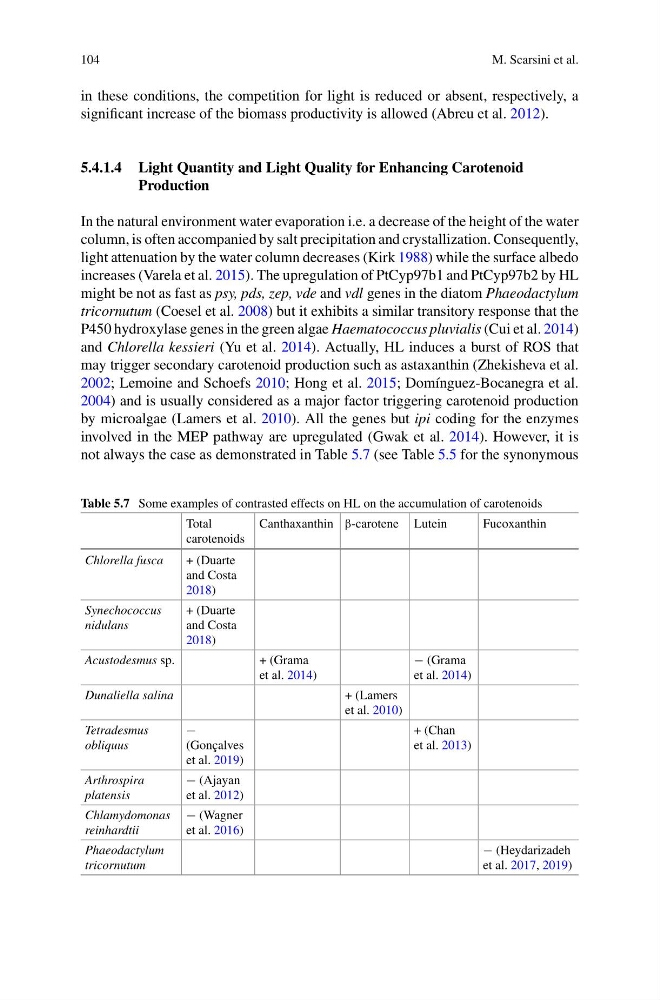
not always the case as demonstrated in Table 5.7 (see Table 5.5 for the synonymous
Table 5.7 Some examples of contrasted effects on HL on the accumulation of carotenoids
Total
carotenoids
Canthaxanthin β-carotene Lutein
Fucoxanthin
Chlorella fusca
+ (Duarte
and Costa
2018)
Synechococcus
nidulans
+ (Duarte
and Costa
2018)
Acustodesmus sp.
+ (Grama
et al. 2014)
− (Grama
et al. 2014)
Dunaliella salina
+ (Lamers
et al. 2010)
Tetradesmus
obliquus
−
(Gonçalves
et al. 2019)
+ (Chan
et al. 2013)
Arthrospira
platensis
− (Ajayan
et al. 2012)
Chlamydomonas
reinhardtii
− (Wagner
et al. 2016)
Phaeodactylum
tricornutum
− (Heydarizadeh
et al. 2017, 2019)
M. Scarsini et al.
in these conditions, the competition for light is reduced or absent, respectively, a
significant increase of the biomass productivity is allowed (Abreu et al. 2012).
5.4.1.4 Light Quantity and Light Quality for Enhancing Carotenoid
Production
In the natural environment water evaporation i.e. a decrease of the height of the water
column, is often accompanied by salt precipitation and crystallization. Consequently,
light attenuation by the water column decreases (Kirk 1988) while the surface albedo
increases (Varela et al. 2015). The upregulation of PtCyp97b1 and PtCyp97b2 by HL
might be not as fast as psy, pds, zep, vde and vdl genes in the diatom Phaeodactylum
tricornutum (Coesel et al. 2008) but it exhibits a similar transitory response that the
P450 hydroxylase genes in the green algae Haematococcus pluvialis (Cui et al. 2014)
and Chlorella kessieri (Yu et al. 2014). Actually, HL induces a burst of ROS that
may trigger secondary carotenoid production such as astaxanthin (Zhekisheva et al.
2002; Lemoine and Schoefs 2010; Hong et al. 2015; Dom´ ınguez-Bocanegra et al.
2004) and is usually considered as a major factor triggering carotenoid production
by microalgae (Lamers et al. 2010). All the genes but ipi coding for the enzymes
involved in the MEP pathway are upregulated (Gwak et al. 2014). However, it is
not always the case as demonstrated in Table 5.7 (see Table 5.5 for the synonymous
Table 5.7 Some examples of contrasted effects on HL on the accumulation of carotenoids
Total
carotenoids
Canthaxanthin β-carotene Lutein
Fucoxanthin
Chlorella fusca
+ (Duarte
and Costa
2018)
Synechococcus
nidulans
+ (Duarte
and Costa
2018)
Acustodesmus sp.
+ (Grama
et al. 2014)
− (Grama
et al. 2014)
Dunaliella salina
+ (Lamers
et al. 2010)
Tetradesmus
obliquus
−
(Gonçalves
et al. 2019)
+ (Chan
et al. 2013)
Arthrospira
platensis
− (Ajayan
et al. 2012)
Chlamydomonas
reinhardtii
− (Wagner
et al. 2016)
Phaeodactylum
tricornutum
− (Heydarizadeh
et al. 2017, 2019)