

98
M. Scarsini et al.
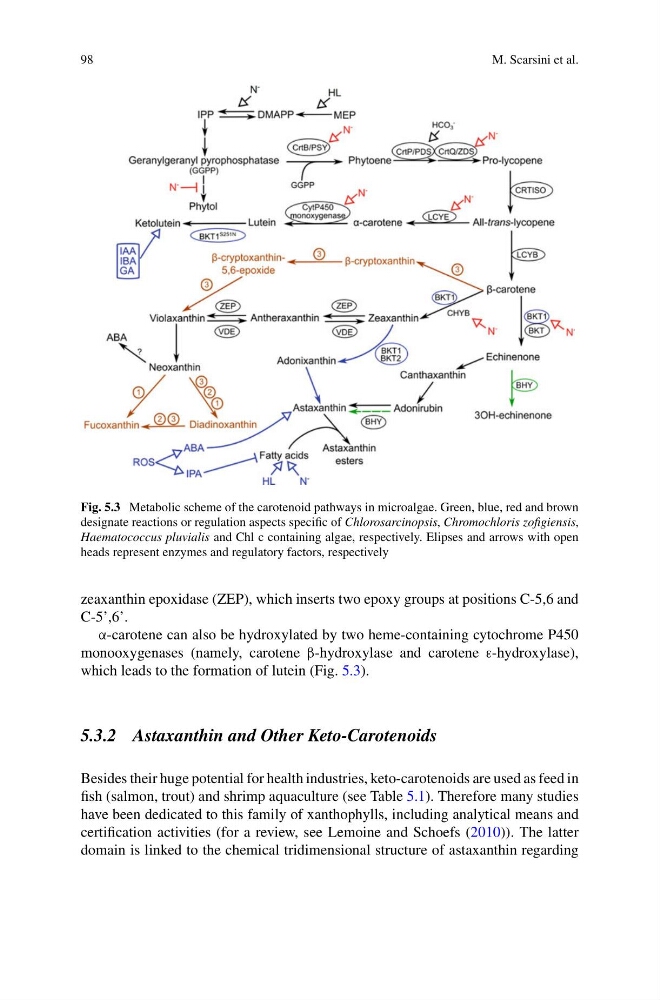
Fig. 5.3 Metabolic scheme of the carotenoid pathways in microalgae. Green, blue, red and brown
designate reactions or regulation aspects specific of Chlorosarcinopsis, Chromochloris zofigiensis,
Haematococcus pluvialis and Chl c containing algae, respectively. Elipses and arrows with open
heads represent enzymes and regulatory factors, respectively
zeaxanthin epoxidase (ZEP), which inserts two epoxy groups at positions C-5,6 and
C-5’,6’.
α-carotene can also be hydroxylated by two heme-containing cytochrome P450
monooxygenases (namely, carotene β-hydroxylase and carotene ε-hydroxylase),
which leads to the formation of lutein (Fig. 5.3).
5.3.2 Astaxanthin and Other Keto-Carotenoids
Besides their huge potential for health industries, keto-carotenoids are used as feed in
fish (salmon, trout) and shrimp aquaculture (see Table 5.1). Therefore many studies
have been dedicated to this family of xanthophylls, including analytical means and
certification activities (for a review, see Lemoine and Schoefs (2010)). The latter
domain is linked to the chemical tridimensional structure of astaxanthin regarding
M. Scarsini et al.
Fig. 5.3 Metabolic scheme of the carotenoid pathways in microalgae. Green, blue, red and brown
designate reactions or regulation aspects specific of Chlorosarcinopsis, Chromochloris zofigiensis,
Haematococcus pluvialis and Chl c containing algae, respectively. Elipses and arrows with open
heads represent enzymes and regulatory factors, respectively
zeaxanthin epoxidase (ZEP), which inserts two epoxy groups at positions C-5,6 and
C-5’,6’.
α-carotene can also be hydroxylated by two heme-containing cytochrome P450
monooxygenases (namely, carotene β-hydroxylase and carotene ε-hydroxylase),
which leads to the formation of lutein (Fig. 5.3).
5.3.2 Astaxanthin and Other Keto-Carotenoids
Besides their huge potential for health industries, keto-carotenoids are used as feed in
fish (salmon, trout) and shrimp aquaculture (see Table 5.1). Therefore many studies
have been dedicated to this family of xanthophylls, including analytical means and
certification activities (for a review, see Lemoine and Schoefs (2010)). The latter
domain is linked to the chemical tridimensional structure of astaxanthin regarding