

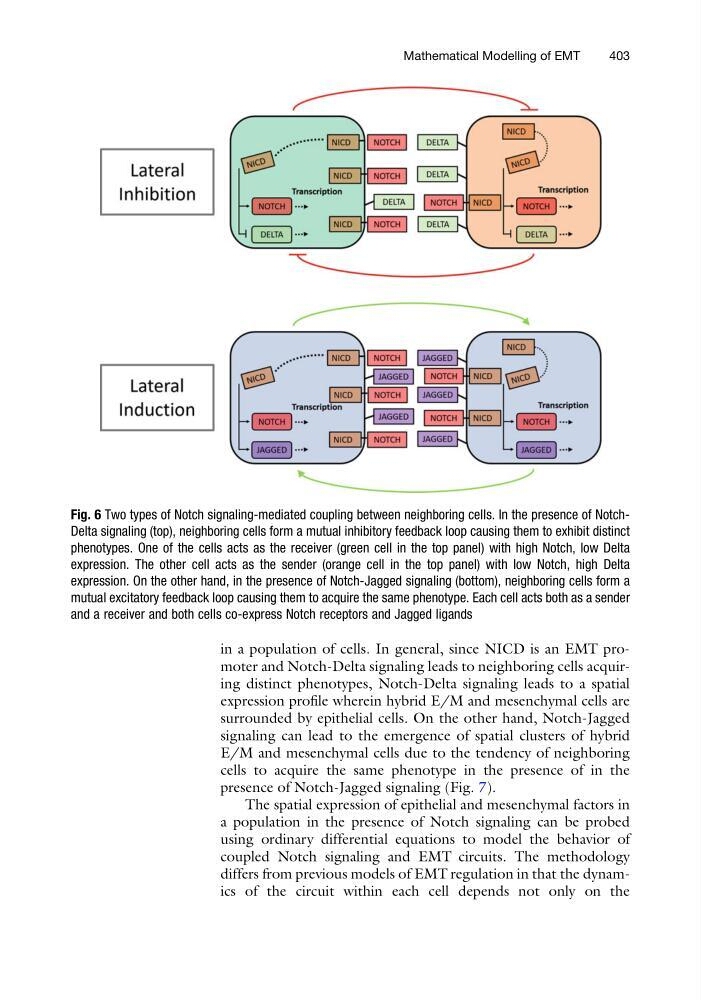
in a population of cells. In general, since NICD is an EMT promoter and Notch-Delta signaling leads to neighboring cells acquiring distinct phenotypes, Notch-Delta signaling leads to a spatial
expression profile wherein hybrid E/M and mesenchymal cells are
surrounded by epithelial cells. On the other hand, Notch-Jagged
signaling can lead to the emergence of spatial clusters of hybrid
E/M and mesenchymal cells due to the tendency of neighboring
cells to acquire the same phenotype in the presence of in the
presence of Notch-Jagged signaling (Fig. 7).
The spatial expression of epithelial and mesenchymal factors in
a population in the presence of Notch signaling can be probed
using ordinary differential equations to model the behavior of
coupled Notch signaling and EMT circuits. The methodology
differs from previous models of EMT regulation in that the dynamics of the circuit within each cell depends not only on the
Fig. 6 Two types of Notch signaling-mediated coupling between neighboring cells. In the presence of NotchDelta signaling (top), neighboring cells form a mutual inhibitory feedback loop causing them to exhibit distinct
phenotypes. One of the cells acts as the receiver (green cell in the top panel) with high Notch, low Delta
expression. The other cell acts as the sender (orange cell in the top panel) with low Notch, high Delta
expression. On the other hand, in the presence of Notch-Jagged signaling (bottom), neighboring cells form a
mutual excitatory feedback loop causing them to acquire the same phenotype. Each cell acts both as a sender
and a receiver and both cells co-express Notch receptors and Jagged ligands
Mathematical Modelling of EMT
403
expression profile wherein hybrid E/M and mesenchymal cells are
surrounded by epithelial cells. On the other hand, Notch-Jagged
signaling can lead to the emergence of spatial clusters of hybrid
E/M and mesenchymal cells due to the tendency of neighboring
cells to acquire the same phenotype in the presence of in the
presence of Notch-Jagged signaling (Fig. 7).
The spatial expression of epithelial and mesenchymal factors in
a population in the presence of Notch signaling can be probed
using ordinary differential equations to model the behavior of
coupled Notch signaling and EMT circuits. The methodology
differs from previous models of EMT regulation in that the dynamics of the circuit within each cell depends not only on the
Fig. 6 Two types of Notch signaling-mediated coupling between neighboring cells. In the presence of NotchDelta signaling (top), neighboring cells form a mutual inhibitory feedback loop causing them to exhibit distinct
phenotypes. One of the cells acts as the receiver (green cell in the top panel) with high Notch, low Delta
expression. The other cell acts as the sender (orange cell in the top panel) with low Notch, high Delta
expression. On the other hand, in the presence of Notch-Jagged signaling (bottom), neighboring cells form a
mutual excitatory feedback loop causing them to acquire the same phenotype. Each cell acts both as a sender
and a receiver and both cells co-express Notch receptors and Jagged ligands
Mathematical Modelling of EMT
403