

promotes the expression of ligands of the Jagged family. NotchDelta signaling leads to neighboring cells acquiring distinct phenotypes—the cell expressing high levels of the Notch receptor and low
levels of Delta ligands acts as the “sender” cell while the neighboring cell with low levels of Notch expression and high expression
levels of Delta ligands acts as the “receiver” cell [72] (“lateral
inhibition”; Fig. 6 (top panel)). Notch-Jagged signaling, on the
other hand, leads to neighboring cells acquiring the same phenotype which is characterized by the co-expression of Notch receptors
and Jagged ligands [73] (“lateral induction”; Fig. 6 (bottom
panel)).
The role of Notch signaling in EMT regulation arises from the
coupling between the Notch signaling machinery and the core
regulatory circuit that drives EMT (Fig. 7; top panel). miR-34
can posttranscriptionally inhibit the expression of Notch receptors
and that of Delta ligands. miR-200 similarly inhibits the expression
of Jagged ligands. Further, NICD promotes the expression of
SNAIL, thereby acting as an EMT promoter [4]. Due to the cross
talk between the Notch signaling and EMT circuits, the spatial
patterns that emerge from Notch signaling translate into spatial
patterning in the expression of epithelial and mesenchymal markers
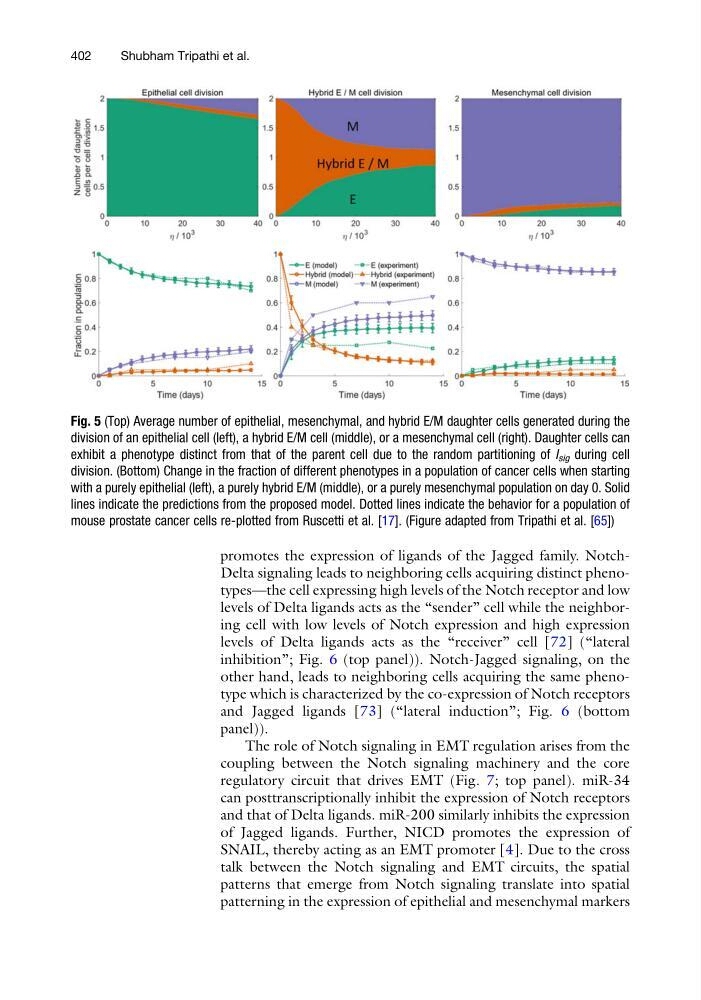
Fig. 5 (Top) Average number of epithelial, mesenchymal, and hybrid E/M daughter cells generated during the
division of an epithelial cell (left), a hybrid E/M cell (middle), or a mesenchymal cell (right). Daughter cells can
exhibit a phenotype distinct from that of the parent cell due to the random partitioning of I sig during cell
division. (Bottom) Change in the fraction of different phenotypes in a population of cancer cells when starting
with a purely epithelial (left), a purely hybrid E/M (middle), or a purely mesenchymal population on day 0. Solid
lines indicate the predictions from the proposed model. Dotted lines indicate the behavior for a population of
mouse prostate cancer cells re-plotted from Ruscetti et al. [17]. (Figure adapted from Tripathi et al. [65])
402
Shubham Tripathi et al.
levels of Delta ligands acts as the “sender” cell while the neighboring cell with low levels of Notch expression and high expression
levels of Delta ligands acts as the “receiver” cell [72] (“lateral
inhibition”; Fig. 6 (top panel)). Notch-Jagged signaling, on the
other hand, leads to neighboring cells acquiring the same phenotype which is characterized by the co-expression of Notch receptors
and Jagged ligands [73] (“lateral induction”; Fig. 6 (bottom
panel)).
The role of Notch signaling in EMT regulation arises from the
coupling between the Notch signaling machinery and the core
regulatory circuit that drives EMT (Fig. 7; top panel). miR-34
can posttranscriptionally inhibit the expression of Notch receptors
and that of Delta ligands. miR-200 similarly inhibits the expression
of Jagged ligands. Further, NICD promotes the expression of
SNAIL, thereby acting as an EMT promoter [4]. Due to the cross
talk between the Notch signaling and EMT circuits, the spatial
patterns that emerge from Notch signaling translate into spatial
patterning in the expression of epithelial and mesenchymal markers
Fig. 5 (Top) Average number of epithelial, mesenchymal, and hybrid E/M daughter cells generated during the
division of an epithelial cell (left), a hybrid E/M cell (middle), or a mesenchymal cell (right). Daughter cells can
exhibit a phenotype distinct from that of the parent cell due to the random partitioning of I sig during cell
division. (Bottom) Change in the fraction of different phenotypes in a population of cancer cells when starting
with a purely epithelial (left), a purely hybrid E/M (middle), or a purely mesenchymal population on day 0. Solid
lines indicate the predictions from the proposed model. Dotted lines indicate the behavior for a population of
mouse prostate cancer cells re-plotted from Ruscetti et al. [17]. (Figure adapted from Tripathi et al. [65])
402
Shubham Tripathi et al.