

a cell is simply removed from the population. The other is cell
division.
When a cell divides, the molecules present in the parent cell are
randomly partitioned among the daughter cells [53, 54, 64]. Thus,
each daughter cell receives a copy of the EMT regulatory circuit.
However, due to the random partitioning of molecules, the concentrations of a molecular species in the two daughter cells can be
different from each other and different from the concentration of
that species in the parent cell. Let I sig represent the multiple signaling pathways that converge onto the core EMT regulatory circuit.
We here consider noise in the partitioning of I sig as the dominant
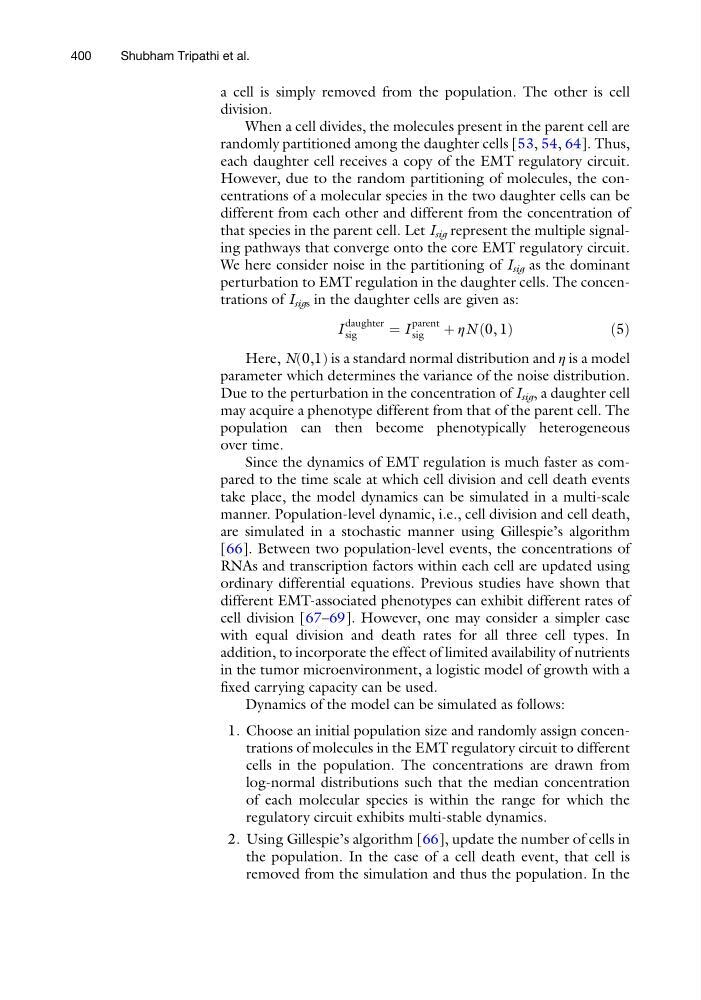
perturbation to EMT regulation in the daughter cells. The concentrations of I sigs in the daughter cells are given as:
I
daughter
sig
¼ I
parent
sig
þ ηN 0, 1
ð
Þ
ð5Þ
Here, N(0,1) is a standard normal distribution and η is a model
parameter which determines the variance of the noise distribution.
Due to the perturbation in the concentration of I sig , a daughter cell
may acquire a phenotype different from that of the parent cell. The
population can then become phenotypically heterogeneous
over time.
Since the dynamics of EMT regulation is much faster as compared to the time scale at which cell division and cell death events
take place, the model dynamics can be simulated in a multi-scale
manner. Population-level dynamic, i.e., cell division and cell death,
are simulated in a stochastic manner using Gillespie’s algorithm
[66]. Between two population-level events, the concentrations of
RNAs and transcription factors within each cell are updated using
ordinary differential equations. Previous studies have shown that
different EMT-associated phenotypes can exhibit different rates of
cell division [67–69]. However, one may consider a simpler case
with equal division and death rates for all three cell types. In
addition, to incorporate the effect of limited availability of nutrients
in the tumor microenvironment, a logistic model of growth with a
fixed carrying capacity can be used.
Dynamics of the model can be simulated as follows:
1. Choose an initial population size and randomly assign concentrations of molecules in the EMT regulatory circuit to different
cells in the population. The concentrations are drawn from
log-normal distributions such that the median concentration
of each molecular species is within the range for which the
regulatory circuit exhibits multi-stable dynamics.
2. Using Gillespie’s algorithm [66], update the number of cells in
the population. In the case of a cell death event, that cell is
removed from the simulation and thus the population. In the
400
Shubham Tripathi et al.
division.
When a cell divides, the molecules present in the parent cell are
randomly partitioned among the daughter cells [53, 54, 64]. Thus,
each daughter cell receives a copy of the EMT regulatory circuit.
However, due to the random partitioning of molecules, the concentrations of a molecular species in the two daughter cells can be
different from each other and different from the concentration of
that species in the parent cell. Let I sig represent the multiple signaling pathways that converge onto the core EMT regulatory circuit.
We here consider noise in the partitioning of I sig as the dominant
perturbation to EMT regulation in the daughter cells. The concentrations of I sigs in the daughter cells are given as:
I
daughter
sig
¼ I
parent
sig
þ ηN 0, 1
ð
Þ
ð5Þ
Here, N(0,1) is a standard normal distribution and η is a model
parameter which determines the variance of the noise distribution.
Due to the perturbation in the concentration of I sig , a daughter cell
may acquire a phenotype different from that of the parent cell. The
population can then become phenotypically heterogeneous
over time.
Since the dynamics of EMT regulation is much faster as compared to the time scale at which cell division and cell death events
take place, the model dynamics can be simulated in a multi-scale
manner. Population-level dynamic, i.e., cell division and cell death,
are simulated in a stochastic manner using Gillespie’s algorithm
[66]. Between two population-level events, the concentrations of
RNAs and transcription factors within each cell are updated using
ordinary differential equations. Previous studies have shown that
different EMT-associated phenotypes can exhibit different rates of
cell division [67–69]. However, one may consider a simpler case
with equal division and death rates for all three cell types. In
addition, to incorporate the effect of limited availability of nutrients
in the tumor microenvironment, a logistic model of growth with a
fixed carrying capacity can be used.
Dynamics of the model can be simulated as follows:
1. Choose an initial population size and randomly assign concentrations of molecules in the EMT regulatory circuit to different
cells in the population. The concentrations are drawn from
log-normal distributions such that the median concentration
of each molecular species is within the range for which the
regulatory circuit exhibits multi-stable dynamics.
2. Using Gillespie’s algorithm [66], update the number of cells in
the population. In the case of a cell death event, that cell is
removed from the simulation and thus the population. In the
400
Shubham Tripathi et al.