

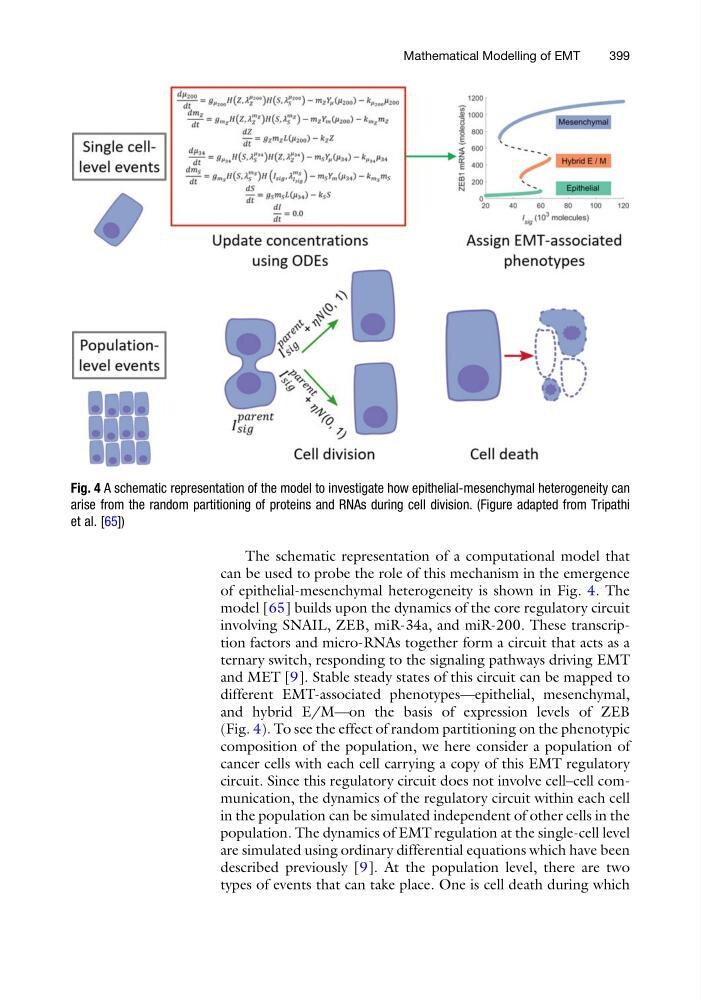
The schematic representation of a computational model that
can be used to probe the role of this mechanism in the emergence
of epithelial-mesenchymal heterogeneity is shown in Fig. 4. The
model [65] builds upon the dynamics of the core regulatory circuit
involving SNAIL, ZEB, miR-34a, and miR-200. These transcription factors and micro-RNAs together form a circuit that acts as a
ternary switch, responding to the signaling pathways driving EMT
and MET [9]. Stable steady states of this circuit can be mapped to
different EMT-associated phenotypes—epithelial, mesenchymal,
and hybrid E/M—on the basis of expression levels of ZEB
(Fig. 4). To see the effect of random partitioning on the phenotypic
composition of the population, we here consider a population of
cancer cells with each cell carrying a copy of this EMT regulatory
circuit. Since this regulatory circuit does not involve cell–cell communication, the dynamics of the regulatory circuit within each cell
in the population can be simulated independent of other cells in the
population. The dynamics of EMT regulation at the single-cell level
are simulated using ordinary differential equations which have been
described previously [9]. At the population level, there are two
types of events that can take place. One is cell death during which
Fig. 4 A schematic representation of the model to investigate how epithelial-mesenchymal heterogeneity can
arise from the random partitioning of proteins and RNAs during cell division. (Figure adapted from Tripathi
et al. [65])
Mathematical Modelling of EMT
399
can be used to probe the role of this mechanism in the emergence
of epithelial-mesenchymal heterogeneity is shown in Fig. 4. The
model [65] builds upon the dynamics of the core regulatory circuit
involving SNAIL, ZEB, miR-34a, and miR-200. These transcription factors and micro-RNAs together form a circuit that acts as a
ternary switch, responding to the signaling pathways driving EMT
and MET [9]. Stable steady states of this circuit can be mapped to
different EMT-associated phenotypes—epithelial, mesenchymal,
and hybrid E/M—on the basis of expression levels of ZEB
(Fig. 4). To see the effect of random partitioning on the phenotypic
composition of the population, we here consider a population of
cancer cells with each cell carrying a copy of this EMT regulatory
circuit. Since this regulatory circuit does not involve cell–cell communication, the dynamics of the regulatory circuit within each cell
in the population can be simulated independent of other cells in the
population. The dynamics of EMT regulation at the single-cell level
are simulated using ordinary differential equations which have been
described previously [9]. At the population level, there are two
types of events that can take place. One is cell death during which
Fig. 4 A schematic representation of the model to investigate how epithelial-mesenchymal heterogeneity can
arise from the random partitioning of proteins and RNAs during cell division. (Figure adapted from Tripathi
et al. [65])
Mathematical Modelling of EMT
399