

While multiple signaling pathways have been implicated in
controlling EMT and MET, the activities of many of these pathways
converge onto a small set of core regulatory players. This set
includes the master regulators such as SNAI1, miR-34, miR-200,
and ZEB1 [8, 61]. The effects of different signals modulating EMT
and MET can thus be modeled as perturbations to the kinetics of
this smaller core regulatory circuit. These perturbations can vary
from cell-to-cell, thus representing the differing internal and external signaling states of tumor cells in a population.
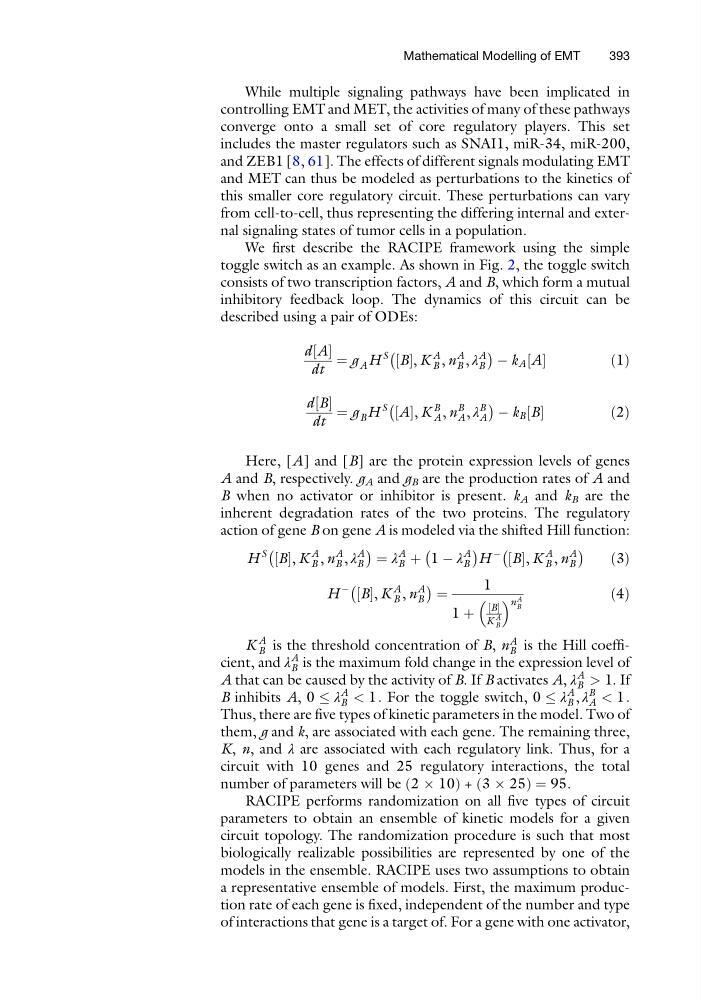
We first describe the RACIPE framework using the simple
toggle switch as an example. As shown in Fig. 2, the toggle switch
consists of two transcription factors, A and B, which form a mutual
inhibitory feedback loop. The dynamics of this circuit can be
described using a pair of ODEs:
d A
½
dt
¼ g A H
S B
½ , K
A
B , n
A
B , λ
A
B
À
Á À k A A
½
ð1Þ
d B
½
dt
¼ g B H
S A
½ , K
B
A , n
B
A , λ
B
A
À
Á À k B B
½
ð2Þ
Here, [A] and [B] are the protein expression levels of genes
A and B, respectively. g A and g B are the production rates of A and
B when no activator or inhibitor is present. k A and k B are the
inherent degradation rates of the two proteins. The regulatory
action of gene B on gene A is modeled via the shifted Hill function:
H
S B
½ , K
A
B , n
A
B , λ
A
B
À
Á ¼ λ
A
B þ 1 À λ
A
B
À
Á
H
À B
½ , K
A
B , n
A
B
À
Á
ð3Þ
H
À B
½ , K
A
B , n
A
B
À
Á ¼
1
1 þ
B
½
K
A
B
n A
B
ð4Þ
K
A
B is the threshold concentration of B, n
A
B is the Hill coefficient, and λ
A
B is the maximum fold change in the expression level of
A that can be caused by the activity of B. If B activates A, λ
A
B > 1. If
B inhibits A, 0 λ
A
B < 1. For the toggle switch, 0 λ
A
B , λ
B
A < 1.
Thus, there are five types of kinetic parameters in the model. Two of
them, g and k, are associated with each gene. The remaining three,
K, n, and λ are associated with each regulatory link. Thus, for a
circuit with 10 genes and 25 regulatory interactions, the total
number of parameters will be (2 Â 10) + (3 Â 25) ¼ 95.
RACIPE performs randomization on all five types of circuit
parameters to obtain an ensemble of kinetic models for a given
circuit topology. The randomization procedure is such that most
biologically realizable possibilities are represented by one of the
models in the ensemble. RACIPE uses two assumptions to obtain
a representative ensemble of models. First, the maximum production rate of each gene is fixed, independent of the number and type
of interactions that gene is a target of. For a gene with one activator,
Mathematical Modelling of EMT
393
controlling EMT and MET, the activities of many of these pathways
converge onto a small set of core regulatory players. This set
includes the master regulators such as SNAI1, miR-34, miR-200,
and ZEB1 [8, 61]. The effects of different signals modulating EMT
and MET can thus be modeled as perturbations to the kinetics of
this smaller core regulatory circuit. These perturbations can vary
from cell-to-cell, thus representing the differing internal and external signaling states of tumor cells in a population.
We first describe the RACIPE framework using the simple
toggle switch as an example. As shown in Fig. 2, the toggle switch
consists of two transcription factors, A and B, which form a mutual
inhibitory feedback loop. The dynamics of this circuit can be
described using a pair of ODEs:
d A
½
dt
¼ g A H
S B
½ , K
A
B , n
A
B , λ
A
B
À
Á À k A A
½
ð1Þ
d B
½
dt
¼ g B H
S A
½ , K
B
A , n
B
A , λ
B
A
À
Á À k B B
½
ð2Þ
Here, [A] and [B] are the protein expression levels of genes
A and B, respectively. g A and g B are the production rates of A and
B when no activator or inhibitor is present. k A and k B are the
inherent degradation rates of the two proteins. The regulatory
action of gene B on gene A is modeled via the shifted Hill function:
H
S B
½ , K
A
B , n
A
B , λ
A
B
À
Á ¼ λ
A
B þ 1 À λ
A
B
À
Á
H
À B
½ , K
A
B , n
A
B
À
Á
ð3Þ
H
À B
½ , K
A
B , n
A
B
À
Á ¼
1
1 þ
B
½
K
A
B
n A
B
ð4Þ
K
A
B is the threshold concentration of B, n
A
B is the Hill coefficient, and λ
A
B is the maximum fold change in the expression level of
A that can be caused by the activity of B. If B activates A, λ
A
B > 1. If
B inhibits A, 0 λ
A
B < 1. For the toggle switch, 0 λ
A
B , λ
B
A < 1.
Thus, there are five types of kinetic parameters in the model. Two of
them, g and k, are associated with each gene. The remaining three,
K, n, and λ are associated with each regulatory link. Thus, for a
circuit with 10 genes and 25 regulatory interactions, the total
number of parameters will be (2 Â 10) + (3 Â 25) ¼ 95.
RACIPE performs randomization on all five types of circuit
parameters to obtain an ensemble of kinetic models for a given
circuit topology. The randomization procedure is such that most
biologically realizable possibilities are represented by one of the
models in the ensemble. RACIPE uses two assumptions to obtain
a representative ensemble of models. First, the maximum production rate of each gene is fixed, independent of the number and type
of interactions that gene is a target of. For a gene with one activator,
Mathematical Modelling of EMT
393