

likelihood estimation, and Markov chain Monte Carlo methods. Since, in practice, it is rare to have sufficient data for a
specific system under study, a commonly adopted practice is to
estimate the many parameters based on data from different
labs, different cell lines, or cells from different tissues. However, even results from the same cell line can be quantitatively
different due to factors such as differences in cell generation,
reagent vendors, or even batches. Besides, dynamical parameters such as mRNA turnover rates can differ by orders of
magnitude for cells under different conditions. An emerging
trend is to collect data from one lab or under the same experimental settings [29], similar to what has been adopted in some
large consortiums like ENCODE. Furthermore, instead of
using only the best-fit parameter set, one may use an ensemble
of model parameters to make model predictions. Zhang et al.
[26] adopted such an integrated modeling-quantitative measurement procedure and an ensemble-based approach has been
developed previously [30, 31]. Another model ensemble
method is discussed in the next section.
4. Specify initial conditions (e.g., initial concentrations of various
species) that reflect the experimental setup. For example, if one
models cell response after adding TGF-β at time 0, one may
first make a rough estimation of the initial concentrations, then
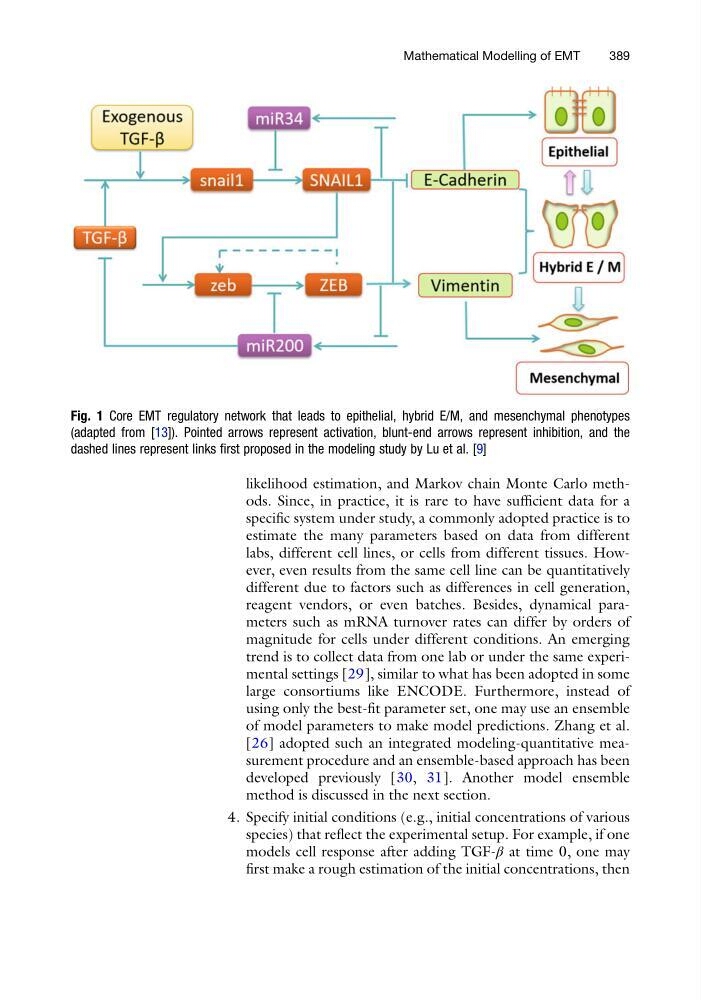
Fig. 1 Core EMT regulatory network that leads to epithelial, hybrid E/M, and mesenchymal phenotypes
(adapted from [13]). Pointed arrows represent activation, blunt-end arrows represent inhibition, and the
dashed lines represent links first proposed in the modeling study by Lu et al. [9]
Mathematical Modelling of EMT
389
specific system under study, a commonly adopted practice is to
estimate the many parameters based on data from different
labs, different cell lines, or cells from different tissues. However, even results from the same cell line can be quantitatively
different due to factors such as differences in cell generation,
reagent vendors, or even batches. Besides, dynamical parameters such as mRNA turnover rates can differ by orders of
magnitude for cells under different conditions. An emerging
trend is to collect data from one lab or under the same experimental settings [29], similar to what has been adopted in some
large consortiums like ENCODE. Furthermore, instead of
using only the best-fit parameter set, one may use an ensemble
of model parameters to make model predictions. Zhang et al.
[26] adopted such an integrated modeling-quantitative measurement procedure and an ensemble-based approach has been
developed previously [30, 31]. Another model ensemble
method is discussed in the next section.
4. Specify initial conditions (e.g., initial concentrations of various
species) that reflect the experimental setup. For example, if one
models cell response after adding TGF-β at time 0, one may
first make a rough estimation of the initial concentrations, then
Fig. 1 Core EMT regulatory network that leads to epithelial, hybrid E/M, and mesenchymal phenotypes
(adapted from [13]). Pointed arrows represent activation, blunt-end arrows represent inhibition, and the
dashed lines represent links first proposed in the modeling study by Lu et al. [9]
Mathematical Modelling of EMT
389