

3. Resuspend cells in 1.5 mL ice cold MACS buffer, add 6 μL
(1:250) rat anti-ECAD primary antibody and incubate on ice
for 15 min. Vortex every 5 min.
4. Centrifuge cells at 300 RCF for 5 min at 4
C.
5. Wash cells by adding 1.5 mL MACS buffer and centrifuge at
300 RCF for 5 min. Aspirate supernatant and repeat.
6. Resuspend cells in 80 μL of MACS buffer per 10
7 cells.
7. Add 20 μL anti-Rat IgG Microbeads per 10
7 cells.
8. Mix well and incubate for 15 min. Vortex every 5 min.
9. OPTIONAL: Add 1.4 mL of MACS buffer and 7.5 μL (1:200)
APC donkey anti-rat secondary antibody and incubate on ice
for 15 min in the dark. Vortex every 5 min (see Note 11).
10. Centrifuge cells at 300 RCF for 5 min at 4
C.
11. Wash cells by adding 1.5 mL MACS buffer and centrifuge at
300 RCF for 5 min. Aspirate supernatant and repeat.
12. Resuspend in 500 μL MACS buffer. Remove 50 μL a small
aliquot for a pre-MACS column control if confirming by flow
cytometry.
13. Place a LS column in a magnetic field of a suitable MACS
separator (QuadroMACS separator if multiple columns are
being used simultaneously).
14. Prepare LS column by adding 3 mL MACS buffer. All columns
are flow stopped and therefore do not run dry. Discard the
effluent and change collection tube.
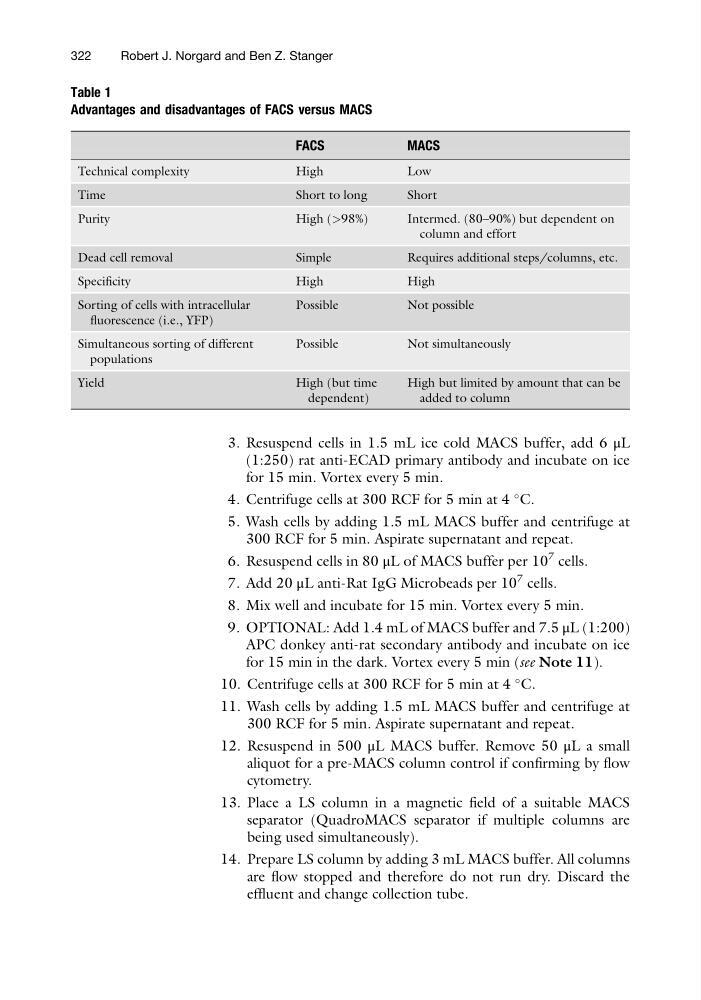
Table 1
Advantages and disadvantages of FACS versus MACS
FACS
MACS
Technical complexity
High
Low
Time
Short to long
Short
Purity
High (>98%)
Intermed. (80–90%) but dependent on
column and effort
Dead cell removal
Simple
Requires additional steps/columns, etc.
Specificity
High
High
Sorting of cells with intracellular
fluorescence (i.e., YFP)
Possible
Not possible
Simultaneous sorting of different
populations
Possible
Not simultaneously
Yield
High (but time
dependent)
High but limited by amount that can be
added to column
322
Robert J. Norgard and Ben Z. Stanger
(1:250) rat anti-ECAD primary antibody and incubate on ice
for 15 min. Vortex every 5 min.
4. Centrifuge cells at 300 RCF for 5 min at 4
C.
5. Wash cells by adding 1.5 mL MACS buffer and centrifuge at
300 RCF for 5 min. Aspirate supernatant and repeat.
6. Resuspend cells in 80 μL of MACS buffer per 10
7 cells.
7. Add 20 μL anti-Rat IgG Microbeads per 10
7 cells.
8. Mix well and incubate for 15 min. Vortex every 5 min.
9. OPTIONAL: Add 1.4 mL of MACS buffer and 7.5 μL (1:200)
APC donkey anti-rat secondary antibody and incubate on ice
for 15 min in the dark. Vortex every 5 min (see Note 11).
10. Centrifuge cells at 300 RCF for 5 min at 4
C.
11. Wash cells by adding 1.5 mL MACS buffer and centrifuge at
300 RCF for 5 min. Aspirate supernatant and repeat.
12. Resuspend in 500 μL MACS buffer. Remove 50 μL a small
aliquot for a pre-MACS column control if confirming by flow
cytometry.
13. Place a LS column in a magnetic field of a suitable MACS
separator (QuadroMACS separator if multiple columns are
being used simultaneously).
14. Prepare LS column by adding 3 mL MACS buffer. All columns
are flow stopped and therefore do not run dry. Discard the
effluent and change collection tube.
Table 1
Advantages and disadvantages of FACS versus MACS
FACS
MACS
Technical complexity
High
Low
Time
Short to long
Short
Purity
High (>98%)
Intermed. (80–90%) but dependent on
column and effort
Dead cell removal
Simple
Requires additional steps/columns, etc.
Specificity
High
High
Sorting of cells with intracellular
fluorescence (i.e., YFP)
Possible
Not possible
Simultaneous sorting of different
populations
Possible
Not simultaneously
Yield
High (but time
dependent)
High but limited by amount that can be
added to column
322
Robert J. Norgard and Ben Z. Stanger