

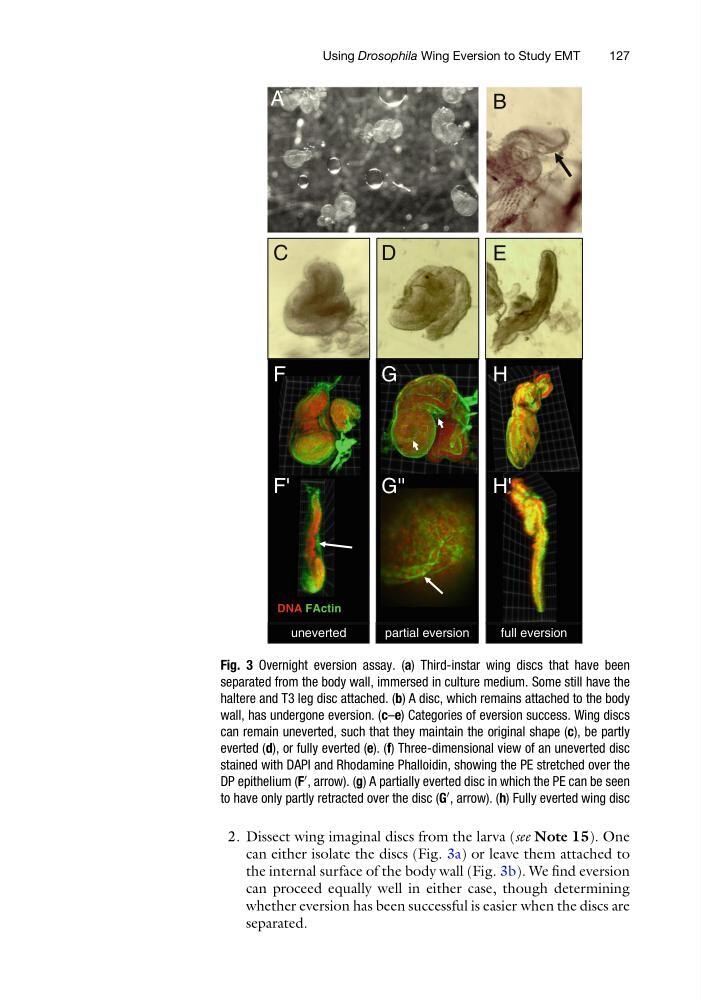
2. Dissect wing imaginal discs from the larva (see Note 15). One
can either isolate the discs (Fig. 3a) or leave them attached to
the internal surface of the body wall (Fig. 3b). We find eversion
can proceed equally well in either case, though determining
whether eversion has been successful is easier when the discs are
separated.
uneverted
partial eversion
full eversion
F
G
G''
H
F'
H'
A
B
C
D
E
DNA FActin
Fig. 3 Overnight eversion assay. (a) Third-instar wing discs that have been
separated from the body wall, immersed in culture medium. Some still have the
haltere and T3 leg disc attached. (b) A disc, which remains attached to the body
wall, has undergone eversion. (c–e) Categories of eversion success. Wing discs
can remain uneverted, such that they maintain the original shape (c), be partly
everted (d), or fully everted (e). (f) Three-dimensional view of an uneverted disc
stained with DAPI and Rhodamine Phalloidin, showing the PE stretched over the
DP epithelium (F
0 , arrow). (g) A partially everted disc in which the PE can be seen
to have only partly retracted over the disc (G
0 , arrow). (h) Fully everted wing disc
Using Drosophila Wing Eversion to Study EMT
127
can either isolate the discs (Fig. 3a) or leave them attached to
the internal surface of the body wall (Fig. 3b). We find eversion
can proceed equally well in either case, though determining
whether eversion has been successful is easier when the discs are
separated.
uneverted
partial eversion
full eversion
F
G
G''
H
F'
H'
A
B
C
D
E
DNA FActin
Fig. 3 Overnight eversion assay. (a) Third-instar wing discs that have been
separated from the body wall, immersed in culture medium. Some still have the
haltere and T3 leg disc attached. (b) A disc, which remains attached to the body
wall, has undergone eversion. (c–e) Categories of eversion success. Wing discs
can remain uneverted, such that they maintain the original shape (c), be partly
everted (d), or fully everted (e). (f) Three-dimensional view of an uneverted disc
stained with DAPI and Rhodamine Phalloidin, showing the PE stretched over the
DP epithelium (F
0 , arrow). (g) A partially everted disc in which the PE can be seen
to have only partly retracted over the disc (G
0 , arrow). (h) Fully everted wing disc
Using Drosophila Wing Eversion to Study EMT
127