

4 RA Signaling in Limb Development and Regeneration …
95
The Effects of Excess RA
RA has concentration-dependent effects on teleost fin duplications and deletions.
For example, overproduction of RA in the gir zebrafish mutant leads to an absence
of pectoral fins (a finding that suggests too much RA is detrimental). In contrast,
different concentrations of RA applied to water inhabited by teleost embryos during
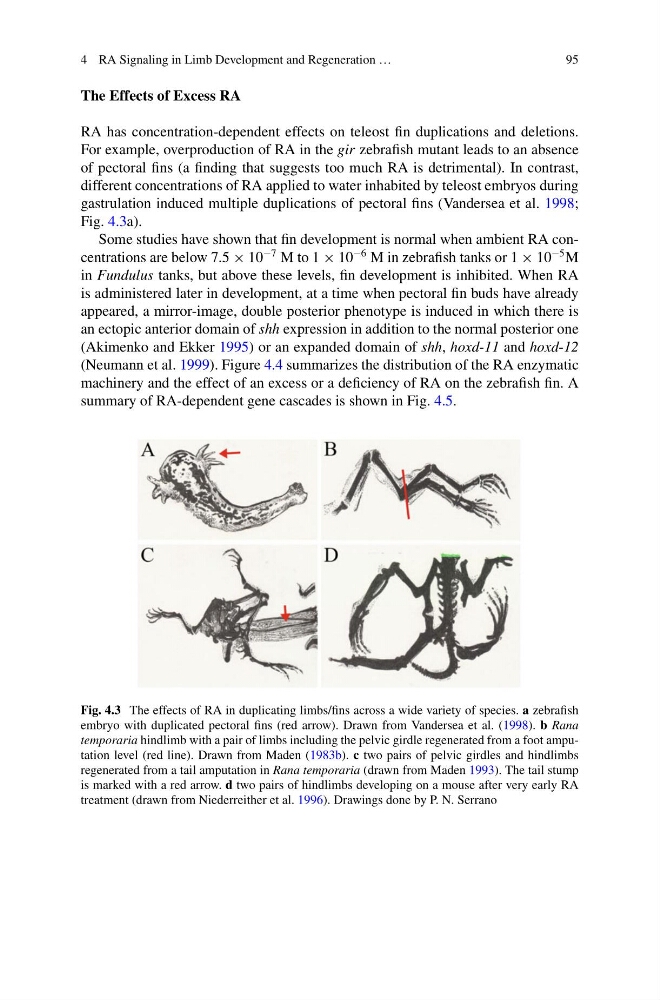
gastrulation induced multiple duplications of pectoral fins (Vandersea et al. 1998;
Fig. 4.3a).
Some studies have shown that fin development is normal when ambient RA concentrations are below 7.5 × 10
−7 M to 1 × 10
−6 M in zebrafish tanks or 1 × 10
−5 M
in Fundulus tanks, but above these levels, fin development is inhibited. When RA
is administered later in development, at a time when pectoral fin buds have already
appeared, a mirror-image, double posterior phenotype is induced in which there is
an ectopic anterior domain of shh expression in addition to the normal posterior one
(Akimenko and Ekker 1995) or an expanded domain of shh, hoxd-11 and hoxd-12
(Neumann et al. 1999). Figure 4.4 summarizes the distribution of the RA enzymatic
machinery and the effect of an excess or a deficiency of RA on the zebrafish fin. A
summary of RA-dependent gene cascades is shown in Fig. 4.5.
Fig. 4.3 The effects of RA in duplicating limbs/fins across a wide variety of species. a zebrafish
embryo with duplicated pectoral fins (red arrow). Drawn from Vandersea et al. (1998). b Rana
temporaria hindlimb with a pair of limbs including the pelvic girdle regenerated from a foot amputation level (red line). Drawn from Maden (1983b). c two pairs of pelvic girdles and hindlimbs
regenerated from a tail amputation in Rana temporaria (drawn from Maden 1993). The tail stump
is marked with a red arrow. d two pairs of hindlimbs developing on a mouse after very early RA
treatment (drawn from Niederreither et al. 1996). Drawings done by P. N. Serrano
95
The Effects of Excess RA
RA has concentration-dependent effects on teleost fin duplications and deletions.
For example, overproduction of RA in the gir zebrafish mutant leads to an absence
of pectoral fins (a finding that suggests too much RA is detrimental). In contrast,
different concentrations of RA applied to water inhabited by teleost embryos during
gastrulation induced multiple duplications of pectoral fins (Vandersea et al. 1998;
Fig. 4.3a).
Some studies have shown that fin development is normal when ambient RA concentrations are below 7.5 × 10
−7 M to 1 × 10
−6 M in zebrafish tanks or 1 × 10
−5 M
in Fundulus tanks, but above these levels, fin development is inhibited. When RA
is administered later in development, at a time when pectoral fin buds have already
appeared, a mirror-image, double posterior phenotype is induced in which there is
an ectopic anterior domain of shh expression in addition to the normal posterior one
(Akimenko and Ekker 1995) or an expanded domain of shh, hoxd-11 and hoxd-12
(Neumann et al. 1999). Figure 4.4 summarizes the distribution of the RA enzymatic
machinery and the effect of an excess or a deficiency of RA on the zebrafish fin. A
summary of RA-dependent gene cascades is shown in Fig. 4.5.
Fig. 4.3 The effects of RA in duplicating limbs/fins across a wide variety of species. a zebrafish
embryo with duplicated pectoral fins (red arrow). Drawn from Vandersea et al. (1998). b Rana
temporaria hindlimb with a pair of limbs including the pelvic girdle regenerated from a foot amputation level (red line). Drawn from Maden (1983b). c two pairs of pelvic girdles and hindlimbs
regenerated from a tail amputation in Rana temporaria (drawn from Maden 1993). The tail stump
is marked with a red arrow. d two pairs of hindlimbs developing on a mouse after very early RA
treatment (drawn from Niederreither et al. 1996). Drawings done by P. N. Serrano