

2 Atomically Precise Nanoclusters as Electrocatalysts
51
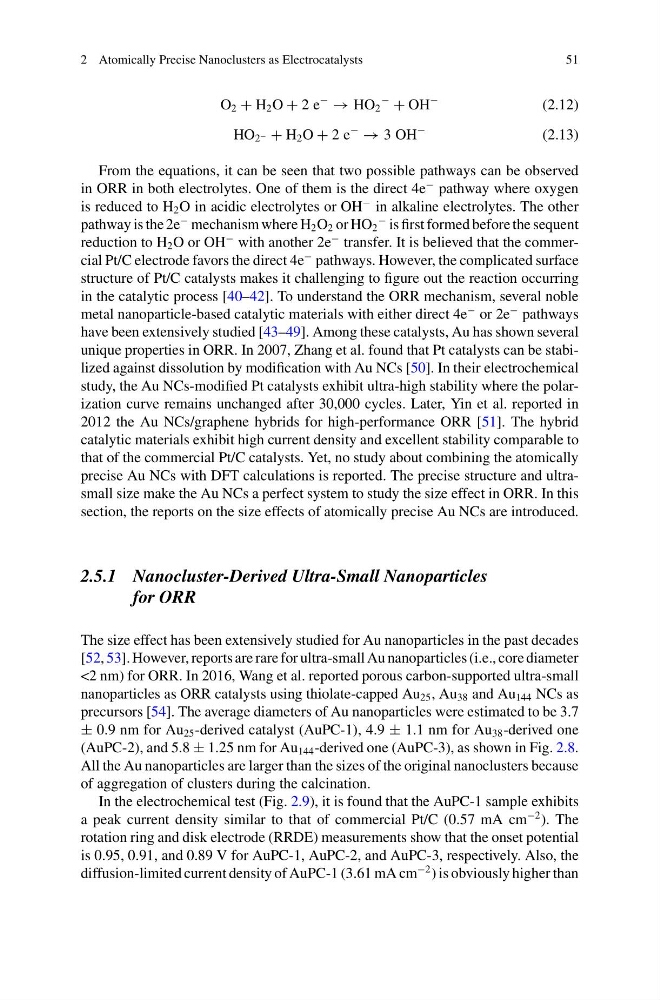
O 2 + H 2 O + 2 e
−
→ HO 2
−
+ OH
−
(2.12)
HO 2 − + H 2 O + 2 e
−
→ 3 OH
−
(2.13)
From the equations, it can be seen that two possible pathways can be observed
in ORR in both electrolytes. One of them is the direct 4e
− pathway where oxygen
is reduced to H 2 O in acidic electrolytes or OH
− in alkaline electrolytes. The other
pathway is the 2e
− mechanism where H 2 O 2 or HO 2
− is first formed before the sequent
reduction to H 2 O or OH
− with another 2e
− transfer. It is believed that the commercial Pt/C electrode favors the direct 4e
− pathways. However, the complicated surface
structure of Pt/C catalysts makes it challenging to figure out the reaction occurring
in the catalytic process [40–42]. To understand the ORR mechanism, several noble
metal nanoparticle-based catalytic materials with either direct 4e
− or 2e
− pathways
have been extensively studied [43–49]. Among these catalysts, Au has shown several
unique properties in ORR. In 2007, Zhang et al. found that Pt catalysts can be stabilized against dissolution by modification with Au NCs [50]. In their electrochemical
study, the Au NCs-modified Pt catalysts exhibit ultra-high stability where the polarization curve remains unchanged after 30,000 cycles. Later, Yin et al. reported in
2012 the Au NCs/graphene hybrids for high-performance ORR [51]. The hybrid
catalytic materials exhibit high current density and excellent stability comparable to
that of the commercial Pt/C catalysts. Yet, no study about combining the atomically
precise Au NCs with DFT calculations is reported. The precise structure and ultrasmall size make the Au NCs a perfect system to study the size effect in ORR. In this
section, the reports on the size effects of atomically precise Au NCs are introduced.
2.5.1 Nanocluster-Derived Ultra-Small Nanoparticles
for ORR
The size effect has been extensively studied for Au nanoparticles in the past decades
[52, 53]. However, reports are rare for ultra-small Au nanoparticles (i.e., core diameter
<2 nm) for ORR. In 2016, Wang et al. reported porous carbon-supported ultra-small
nanoparticles as ORR catalysts using thiolate-capped Au 25 , Au 38 and Au 144 NCs as
precursors [54]. The average diameters of Au nanoparticles were estimated to be 3.7
± 0.9 nm for Au 25 -derived catalyst (AuPC-1), 4.9 ± 1.1 nm for Au 38 -derived one
(AuPC-2), and 5.8 ± 1.25 nm for Au 144 -derived one (AuPC-3), as shown in Fig. 2.8.
All the Au nanoparticles are larger than the sizes of the original nanoclusters because
of aggregation of clusters during the calcination.
In the electrochemical test (Fig. 2.9), it is found that the AuPC-1 sample exhibits
a peak current density similar to that of commercial Pt/C (0.57 mA cm
−2 ). The
rotation ring and disk electrode (RRDE) measurements show that the onset potential
is 0.95, 0.91, and 0.89 V for AuPC-1, AuPC-2, and AuPC-3, respectively. Also, the
diffusion-limited current density of AuPC-1 (3.61 mA cm
−2 ) is obviously higher than
51
O 2 + H 2 O + 2 e
−
→ HO 2
−
+ OH
−
(2.12)
HO 2 − + H 2 O + 2 e
−
→ 3 OH
−
(2.13)
From the equations, it can be seen that two possible pathways can be observed
in ORR in both electrolytes. One of them is the direct 4e
− pathway where oxygen
is reduced to H 2 O in acidic electrolytes or OH
− in alkaline electrolytes. The other
pathway is the 2e
− mechanism where H 2 O 2 or HO 2
− is first formed before the sequent
reduction to H 2 O or OH
− with another 2e
− transfer. It is believed that the commercial Pt/C electrode favors the direct 4e
− pathways. However, the complicated surface
structure of Pt/C catalysts makes it challenging to figure out the reaction occurring
in the catalytic process [40–42]. To understand the ORR mechanism, several noble
metal nanoparticle-based catalytic materials with either direct 4e
− or 2e
− pathways
have been extensively studied [43–49]. Among these catalysts, Au has shown several
unique properties in ORR. In 2007, Zhang et al. found that Pt catalysts can be stabilized against dissolution by modification with Au NCs [50]. In their electrochemical
study, the Au NCs-modified Pt catalysts exhibit ultra-high stability where the polarization curve remains unchanged after 30,000 cycles. Later, Yin et al. reported in
2012 the Au NCs/graphene hybrids for high-performance ORR [51]. The hybrid
catalytic materials exhibit high current density and excellent stability comparable to
that of the commercial Pt/C catalysts. Yet, no study about combining the atomically
precise Au NCs with DFT calculations is reported. The precise structure and ultrasmall size make the Au NCs a perfect system to study the size effect in ORR. In this
section, the reports on the size effects of atomically precise Au NCs are introduced.
2.5.1 Nanocluster-Derived Ultra-Small Nanoparticles
for ORR
The size effect has been extensively studied for Au nanoparticles in the past decades
[52, 53]. However, reports are rare for ultra-small Au nanoparticles (i.e., core diameter
<2 nm) for ORR. In 2016, Wang et al. reported porous carbon-supported ultra-small
nanoparticles as ORR catalysts using thiolate-capped Au 25 , Au 38 and Au 144 NCs as
precursors [54]. The average diameters of Au nanoparticles were estimated to be 3.7
± 0.9 nm for Au 25 -derived catalyst (AuPC-1), 4.9 ± 1.1 nm for Au 38 -derived one
(AuPC-2), and 5.8 ± 1.25 nm for Au 144 -derived one (AuPC-3), as shown in Fig. 2.8.
All the Au nanoparticles are larger than the sizes of the original nanoclusters because
of aggregation of clusters during the calcination.
In the electrochemical test (Fig. 2.9), it is found that the AuPC-1 sample exhibits
a peak current density similar to that of commercial Pt/C (0.57 mA cm
−2 ). The
rotation ring and disk electrode (RRDE) measurements show that the onset potential
is 0.95, 0.91, and 0.89 V for AuPC-1, AuPC-2, and AuPC-3, respectively. Also, the
diffusion-limited current density of AuPC-1 (3.61 mA cm
−2 ) is obviously higher than