

2 Atomically Precise Nanoclusters as Electrocatalysts
45
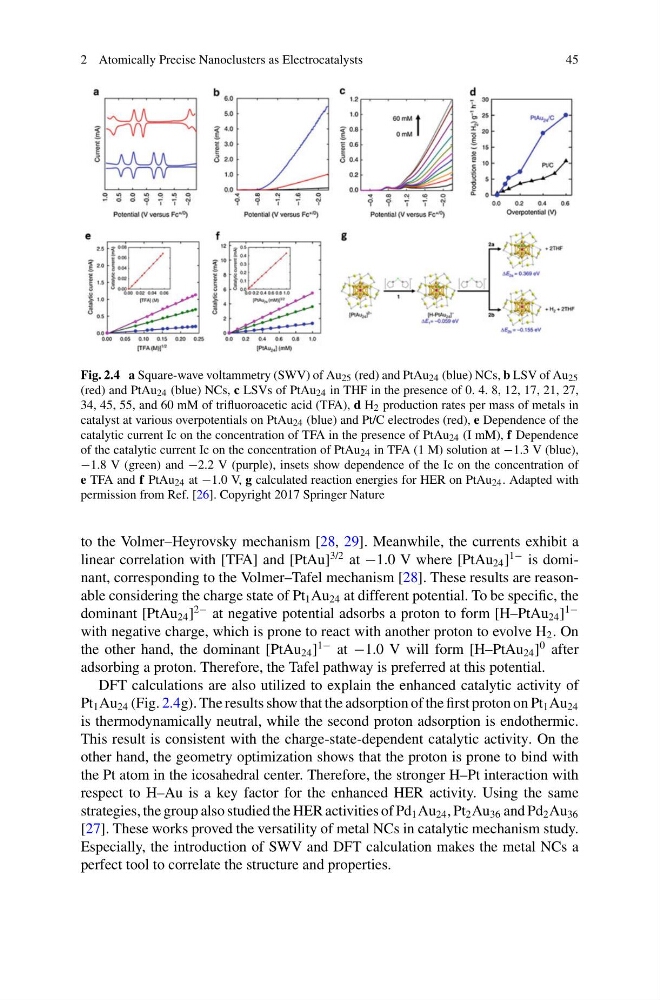
Fig. 2.4 a Square-wave voltammetry (SWV) of Au 25 (red) and PtAu 24 (blue) NCs, b LSV of Au 25
(red) and PtAu 24 (blue) NCs, c LSVs of PtAu 24 in THF in the presence of 0. 4. 8, 12, 17, 21, 27,
34, 45, 55, and 60 mM of trifluoroacetic acid (TFA), d H 2 production rates per mass of metals in
catalyst at various overpotentials on PtAu 24 (blue) and Pt/C electrodes (red), e Dependence of the
catalytic current Ic on the concentration of TFA in the presence of PtAu 24 (I mM), f Dependence
of the catalytic current Ic on the concentration of PtAu 24 in TFA (1 M) solution at −1.3 V (blue),
−1.8 V (green) and −2.2 V (purple), insets show dependence of the Ic on the concentration of
e TFA and f PtAu 24 at −1.0 V, g calculated reaction energies for HER on PtAu 24 . Adapted with
permission from Ref. [26]. Copyright 2017 Springer Nature
to the Volmer–Heyrovsky mechanism [28, 29]. Meanwhile, the currents exhibit a
linear correlation with [TFA] and [PtAu]
3/2 at −1.0 V where [PtAu 24 ]
1− is dominant, corresponding to the Volmer–Tafel mechanism [28]. These results are reasonable considering the charge state of Pt 1 Au 24 at different potential. To be specific, the
dominant [PtAu 24 ]
2− at negative potential adsorbs a proton to form [H–PtAu 24 ]
1−
with negative charge, which is prone to react with another proton to evolve H 2 . On
the other hand, the dominant [PtAu 24 ]
1− at −1.0 V will form [H–PtAu 24 ]
0 after
adsorbing a proton. Therefore, the Tafel pathway is preferred at this potential.
DFT calculations are also utilized to explain the enhanced catalytic activity of
Pt 1 Au 24 (Fig. 2.4g). The results show that the adsorption of the first proton on Pt 1 Au 24
is thermodynamically neutral, while the second proton adsorption is endothermic.
This result is consistent with the charge-state-dependent catalytic activity. On the
other hand, the geometry optimization shows that the proton is prone to bind with
the Pt atom in the icosahedral center. Therefore, the stronger H–Pt interaction with
respect to H–Au is a key factor for the enhanced HER activity. Using the same
strategies, the group also studied the HER activities of Pd 1 Au 24 , Pt 2 Au 36 and Pd 2 Au 36
[27]. These works proved the versatility of metal NCs in catalytic mechanism study.
Especially, the introduction of SWV and DFT calculation makes the metal NCs a
perfect tool to correlate the structure and properties.
45
Fig. 2.4 a Square-wave voltammetry (SWV) of Au 25 (red) and PtAu 24 (blue) NCs, b LSV of Au 25
(red) and PtAu 24 (blue) NCs, c LSVs of PtAu 24 in THF in the presence of 0. 4. 8, 12, 17, 21, 27,
34, 45, 55, and 60 mM of trifluoroacetic acid (TFA), d H 2 production rates per mass of metals in
catalyst at various overpotentials on PtAu 24 (blue) and Pt/C electrodes (red), e Dependence of the
catalytic current Ic on the concentration of TFA in the presence of PtAu 24 (I mM), f Dependence
of the catalytic current Ic on the concentration of PtAu 24 in TFA (1 M) solution at −1.3 V (blue),
−1.8 V (green) and −2.2 V (purple), insets show dependence of the Ic on the concentration of
e TFA and f PtAu 24 at −1.0 V, g calculated reaction energies for HER on PtAu 24 . Adapted with
permission from Ref. [26]. Copyright 2017 Springer Nature
to the Volmer–Heyrovsky mechanism [28, 29]. Meanwhile, the currents exhibit a
linear correlation with [TFA] and [PtAu]
3/2 at −1.0 V where [PtAu 24 ]
1− is dominant, corresponding to the Volmer–Tafel mechanism [28]. These results are reasonable considering the charge state of Pt 1 Au 24 at different potential. To be specific, the
dominant [PtAu 24 ]
2− at negative potential adsorbs a proton to form [H–PtAu 24 ]
1−
with negative charge, which is prone to react with another proton to evolve H 2 . On
the other hand, the dominant [PtAu 24 ]
1− at −1.0 V will form [H–PtAu 24 ]
0 after
adsorbing a proton. Therefore, the Tafel pathway is preferred at this potential.
DFT calculations are also utilized to explain the enhanced catalytic activity of
Pt 1 Au 24 (Fig. 2.4g). The results show that the adsorption of the first proton on Pt 1 Au 24
is thermodynamically neutral, while the second proton adsorption is endothermic.
This result is consistent with the charge-state-dependent catalytic activity. On the
other hand, the geometry optimization shows that the proton is prone to bind with
the Pt atom in the icosahedral center. Therefore, the stronger H–Pt interaction with
respect to H–Au is a key factor for the enhanced HER activity. Using the same
strategies, the group also studied the HER activities of Pd 1 Au 24 , Pt 2 Au 36 and Pd 2 Au 36
[27]. These works proved the versatility of metal NCs in catalytic mechanism study.
Especially, the introduction of SWV and DFT calculation makes the metal NCs a
perfect tool to correlate the structure and properties.