

44
S. Li and R. Jin
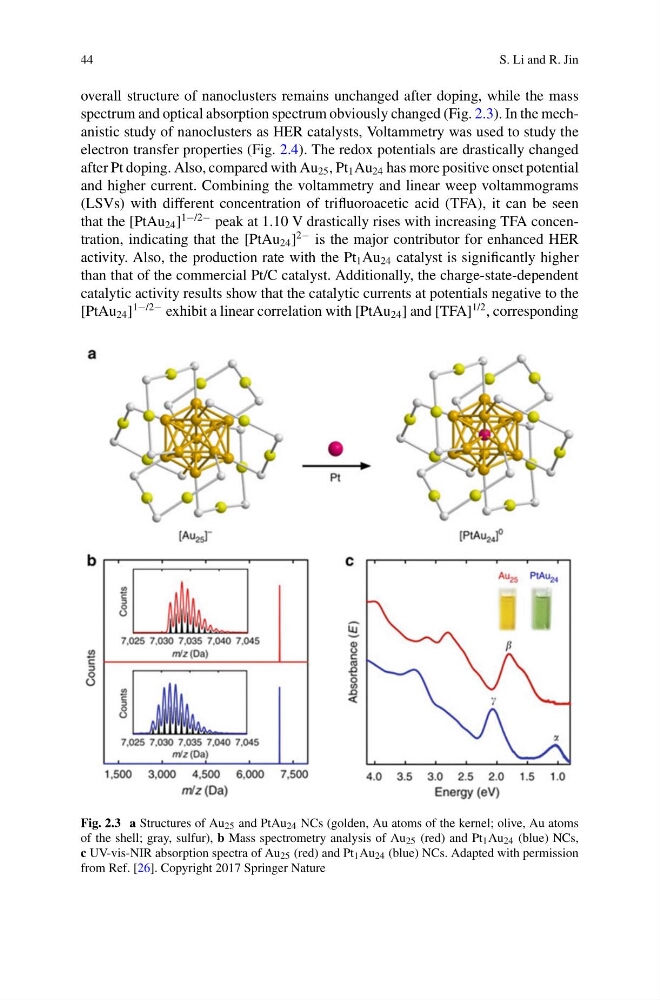
overall structure of nanoclusters remains unchanged after doping, while the mass
spectrum and optical absorption spectrum obviously changed (Fig. 2.3). In the mechanistic study of nanoclusters as HER catalysts, Voltammetry was used to study the
electron transfer properties (Fig. 2.4). The redox potentials are drastically changed
after Pt doping. Also, compared with Au 25 , Pt 1 Au 24 has more positive onset potential
and higher current. Combining the voltammetry and linear weep voltammograms
(LSVs) with different concentration of trifluoroacetic acid (TFA), it can be seen
that the [PtAu 24 ]
1−/2− peak at 1.10 V drastically rises with increasing TFA concentration, indicating that the [PtAu 24 ]
2− is the major contributor for enhanced HER
activity. Also, the production rate with the Pt 1 Au 24 catalyst is significantly higher
than that of the commercial Pt/C catalyst. Additionally, the charge-state-dependent
catalytic activity results show that the catalytic currents at potentials negative to the
[PtAu 24 ]
1−/2− exhibit a linear correlation with [PtAu 24 ] and [TFA]
1/2 , corresponding
Fig. 2.3 a Structures of Au 25 and PtAu 24 NCs (golden, Au atoms of the kernel; olive, Au atoms
of the shell; gray, sulfur), b Mass spectrometry analysis of Au 25 (red) and Pt 1 Au 24 (blue) NCs,
c UV-vis-NIR absorption spectra of Au 25 (red) and Pt 1 Au 24 (blue) NCs. Adapted with permission
from Ref. [26]. Copyright 2017 Springer Nature
S. Li and R. Jin
overall structure of nanoclusters remains unchanged after doping, while the mass
spectrum and optical absorption spectrum obviously changed (Fig. 2.3). In the mechanistic study of nanoclusters as HER catalysts, Voltammetry was used to study the
electron transfer properties (Fig. 2.4). The redox potentials are drastically changed
after Pt doping. Also, compared with Au 25 , Pt 1 Au 24 has more positive onset potential
and higher current. Combining the voltammetry and linear weep voltammograms
(LSVs) with different concentration of trifluoroacetic acid (TFA), it can be seen
that the [PtAu 24 ]
1−/2− peak at 1.10 V drastically rises with increasing TFA concentration, indicating that the [PtAu 24 ]
2− is the major contributor for enhanced HER
activity. Also, the production rate with the Pt 1 Au 24 catalyst is significantly higher
than that of the commercial Pt/C catalyst. Additionally, the charge-state-dependent
catalytic activity results show that the catalytic currents at potentials negative to the
[PtAu 24 ]
1−/2− exhibit a linear correlation with [PtAu 24 ] and [TFA]
1/2 , corresponding
Fig. 2.3 a Structures of Au 25 and PtAu 24 NCs (golden, Au atoms of the kernel; olive, Au atoms
of the shell; gray, sulfur), b Mass spectrometry analysis of Au 25 (red) and Pt 1 Au 24 (blue) NCs,
c UV-vis-NIR absorption spectra of Au 25 (red) and Pt 1 Au 24 (blue) NCs. Adapted with permission
from Ref. [26]. Copyright 2017 Springer Nature