

11 Selective Hydrogenation of Aldehydes and Ketones
367
11.4.1 Unsupported Pt NPs
Large octahedral and cubic, water-soluble Pt NPs and bimetallic PtNi 2 NPs (12 nm
size) were synthesized in a closed vessel from their acetylacetonates in benzylalcohol
at 150 °C with PVP or oleylamine as the stabilizer [45]. They were used for the
hydrogenation of various substrates, among them benzalacetone (4-phenyl-3-buten2-one). Interestingly, only the alkene bond of the enone was hydrogenated under
mild conditions (THF, 1 bar H 2 , room temperature). The PVP capped particles were
most active and PtNi 2 NPs were six times more active than monometallic ones. In
addition, the particles with (1,1,1) facets exposed were the most active.
Liu and co-workers prepared small Pt NPs (1 nm) stabilized also by PVP by
microwave or conventional heating, which showed low selectivity in the hydrogenation of unsaturated aldehydes, (ethanol/water, 60 °C, 40 bar H 2 ). Interestingly, addition of Fe
3+ ions to the reaction mixture raised the selectivities to remarkably high
values [46] (Crotonaldehyde 0 → 84%, Citronellal 31 → 100%, Cinnamaldehyde
24 → 89%). The authors did not comment on this effect; it seems that an oxidized
surface switches the selectivity from alkene to aldehyde hydrogenation. Indeed,
the non-modified Pt NPs were very active catalysts for 1-heptene and cyclohexene
hydrogenation.
Pt NPs surrounded by oleylamine were generated from Pt(acac) 2 via reduction with tetrabutylammonium borohydride. In addition, PtSn NPs incorporating
Sn(0) and partly covered by SnO 2 were prepared the same way in the presence of
SnCl 2 · 2H 2 O [47]. In the CAL to COL reaction the selectivity to unsaturated alcohol
increases substantially (92%) at high tin content (25 °C, 1 bar H 2 , butanol). The
authors proposed that Pt serves for the generation of hydrides, while Sn ions activate
the aldehyde.
Large Pt NPs (6 nm size) protected by 3,3
-thiodipropionic acid [bis(2carboxyethyl) sulphide] showed low activity and good selectivity (83%) in the CAL
to COL hydrogenation [48]. In this instance, the ligand reduces catalytic activity.
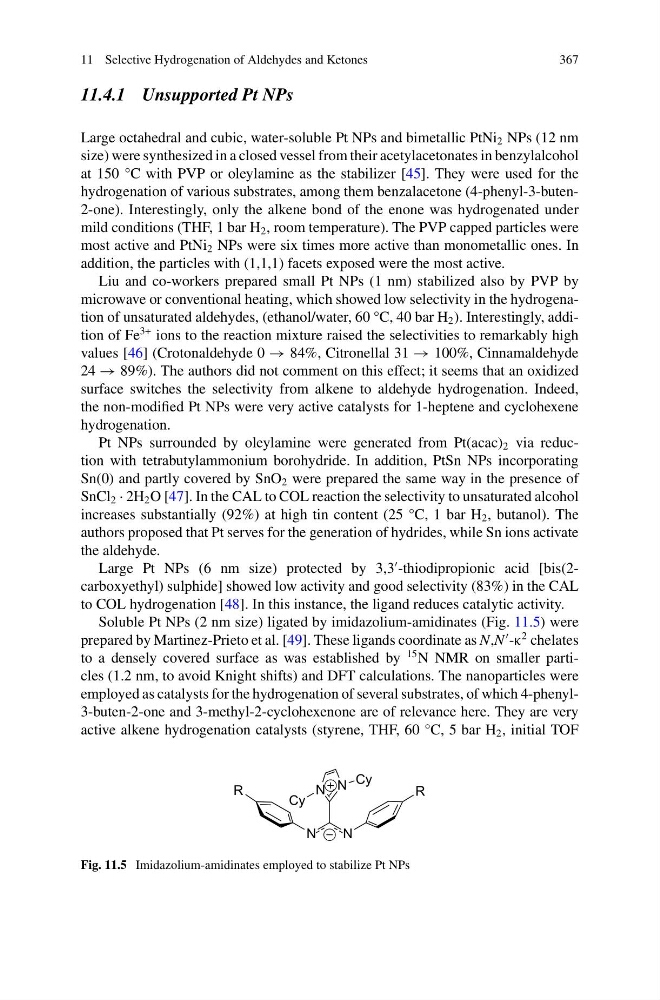
Soluble Pt NPs (2 nm size) ligated by imidazolium-amidinates (Fig. 11.5) were
prepared by Martinez-Prieto et al. [49]. These ligands coordinate as N,N
-κ
2 chelates
to a densely covered surface as was established by
15 N NMR on smaller particles (1.2 nm, to avoid Knight shifts) and DFT calculations. The nanoparticles were
employed as catalysts for the hydrogenation of several substrates, of which 4-phenyl3-buten-2-one and 3-methyl-2-cyclohexenone are of relevance here. They are very
active alkene hydrogenation catalysts (styrene, THF, 60 °C, 5 bar H 2 , initial TOF
N
N
R
R
N
N
Cy
Cy
Fig. 11.5 Imidazolium-amidinates employed to stabilize Pt NPs
367
11.4.1 Unsupported Pt NPs
Large octahedral and cubic, water-soluble Pt NPs and bimetallic PtNi 2 NPs (12 nm
size) were synthesized in a closed vessel from their acetylacetonates in benzylalcohol
at 150 °C with PVP or oleylamine as the stabilizer [45]. They were used for the
hydrogenation of various substrates, among them benzalacetone (4-phenyl-3-buten2-one). Interestingly, only the alkene bond of the enone was hydrogenated under
mild conditions (THF, 1 bar H 2 , room temperature). The PVP capped particles were
most active and PtNi 2 NPs were six times more active than monometallic ones. In
addition, the particles with (1,1,1) facets exposed were the most active.
Liu and co-workers prepared small Pt NPs (1 nm) stabilized also by PVP by
microwave or conventional heating, which showed low selectivity in the hydrogenation of unsaturated aldehydes, (ethanol/water, 60 °C, 40 bar H 2 ). Interestingly, addition of Fe
3+ ions to the reaction mixture raised the selectivities to remarkably high
values [46] (Crotonaldehyde 0 → 84%, Citronellal 31 → 100%, Cinnamaldehyde
24 → 89%). The authors did not comment on this effect; it seems that an oxidized
surface switches the selectivity from alkene to aldehyde hydrogenation. Indeed,
the non-modified Pt NPs were very active catalysts for 1-heptene and cyclohexene
hydrogenation.
Pt NPs surrounded by oleylamine were generated from Pt(acac) 2 via reduction with tetrabutylammonium borohydride. In addition, PtSn NPs incorporating
Sn(0) and partly covered by SnO 2 were prepared the same way in the presence of
SnCl 2 · 2H 2 O [47]. In the CAL to COL reaction the selectivity to unsaturated alcohol
increases substantially (92%) at high tin content (25 °C, 1 bar H 2 , butanol). The
authors proposed that Pt serves for the generation of hydrides, while Sn ions activate
the aldehyde.
Large Pt NPs (6 nm size) protected by 3,3
-thiodipropionic acid [bis(2carboxyethyl) sulphide] showed low activity and good selectivity (83%) in the CAL
to COL hydrogenation [48]. In this instance, the ligand reduces catalytic activity.
Soluble Pt NPs (2 nm size) ligated by imidazolium-amidinates (Fig. 11.5) were
prepared by Martinez-Prieto et al. [49]. These ligands coordinate as N,N
-κ
2 chelates
to a densely covered surface as was established by
15 N NMR on smaller particles (1.2 nm, to avoid Knight shifts) and DFT calculations. The nanoparticles were
employed as catalysts for the hydrogenation of several substrates, of which 4-phenyl3-buten-2-one and 3-methyl-2-cyclohexenone are of relevance here. They are very
active alkene hydrogenation catalysts (styrene, THF, 60 °C, 5 bar H 2 , initial TOF
N
N
R
R
N
N
Cy
Cy
Fig. 11.5 Imidazolium-amidinates employed to stabilize Pt NPs