

11 Selective Hydrogenation of Aldehydes and Ketones
365
in the hydrogenation of acrolein than those shown by the analogous monometallic
system with the same particle size. The Pd atoms were dispersed and isolated as
single atoms in the AgNPs, providing active sites that reduce the energy barrier
for hydrogen dissociation, as was supported by DFT studies. Such calculations also
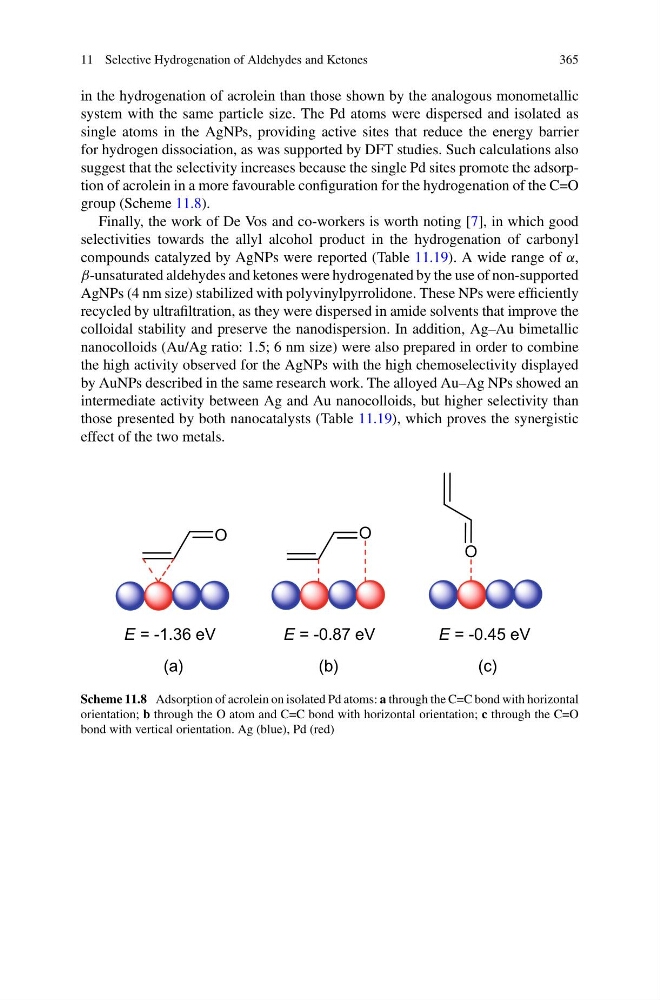
suggest that the selectivity increases because the single Pd sites promote the adsorption of acrolein in a more favourable configuration for the hydrogenation of the C=O
group (Scheme 11.8).
Finally, the work of De Vos and co-workers is worth noting [7], in which good
selectivities towards the allyl alcohol product in the hydrogenation of carbonyl
compounds catalyzed by AgNPs were reported (Table 11.19). A wide range of α,
β-unsaturated aldehydes and ketones were hydrogenated by the use of non-supported
AgNPs (4 nm size) stabilized with polyvinylpyrrolidone. These NPs were efficiently
recycled by ultrafiltration, as they were dispersed in amide solvents that improve the
colloidal stability and preserve the nanodispersion. In addition, Ag–Au bimetallic
nanocolloids (Au/Ag ratio: 1.5; 6 nm size) were also prepared in order to combine
the high activity observed for the AgNPs with the high chemoselectivity displayed
by AuNPs described in the same research work. The alloyed Au–Ag NPs showed an
intermediate activity between Ag and Au nanocolloids, but higher selectivity than
those presented by both nanocatalysts (Table 11.19), which proves the synergistic
effect of the two metals.
O
O
O
(a)
(b)
(c)
E = -1.36 eV
E = -0.87 eV
E = -0.45 eV
Scheme 11.8 Adsorption of acrolein on isolated Pd atoms: a through the C=C bond with horizontal
orientation; b through the O atom and C=C bond with horizontal orientation; c through the C=O
bond with vertical orientation. Ag (blue), Pd (red)
365
in the hydrogenation of acrolein than those shown by the analogous monometallic
system with the same particle size. The Pd atoms were dispersed and isolated as
single atoms in the AgNPs, providing active sites that reduce the energy barrier
for hydrogen dissociation, as was supported by DFT studies. Such calculations also
suggest that the selectivity increases because the single Pd sites promote the adsorption of acrolein in a more favourable configuration for the hydrogenation of the C=O
group (Scheme 11.8).
Finally, the work of De Vos and co-workers is worth noting [7], in which good
selectivities towards the allyl alcohol product in the hydrogenation of carbonyl
compounds catalyzed by AgNPs were reported (Table 11.19). A wide range of α,
β-unsaturated aldehydes and ketones were hydrogenated by the use of non-supported
AgNPs (4 nm size) stabilized with polyvinylpyrrolidone. These NPs were efficiently
recycled by ultrafiltration, as they were dispersed in amide solvents that improve the
colloidal stability and preserve the nanodispersion. In addition, Ag–Au bimetallic
nanocolloids (Au/Ag ratio: 1.5; 6 nm size) were also prepared in order to combine
the high activity observed for the AgNPs with the high chemoselectivity displayed
by AuNPs described in the same research work. The alloyed Au–Ag NPs showed an
intermediate activity between Ag and Au nanocolloids, but higher selectivity than
those presented by both nanocatalysts (Table 11.19), which proves the synergistic
effect of the two metals.
O
O
O
(a)
(b)
(c)
E = -1.36 eV
E = -0.87 eV
E = -0.45 eV
Scheme 11.8 Adsorption of acrolein on isolated Pd atoms: a through the C=C bond with horizontal
orientation; b through the O atom and C=C bond with horizontal orientation; c through the C=O
bond with vertical orientation. Ag (blue), Pd (red)