

330
J. A. Delgado and C. Godard
R 1
R 2
R 1
R 2
R 1
R 2
X
Au
CeO 2
R 1 = Ph, R 2 = H
X = 99%, S C=C = 100%
R 1 = CH 3 (CH 2 ) 7 , R 2 = H
X = 96%, S C=C = 100%
HAuCl 4 + Ce(NO 3 ) 3
1. NaOH, EtOH
2. Calcination,
200 ºC
O
OH
C 9 H 19
5
+
IGEPAL CO-520
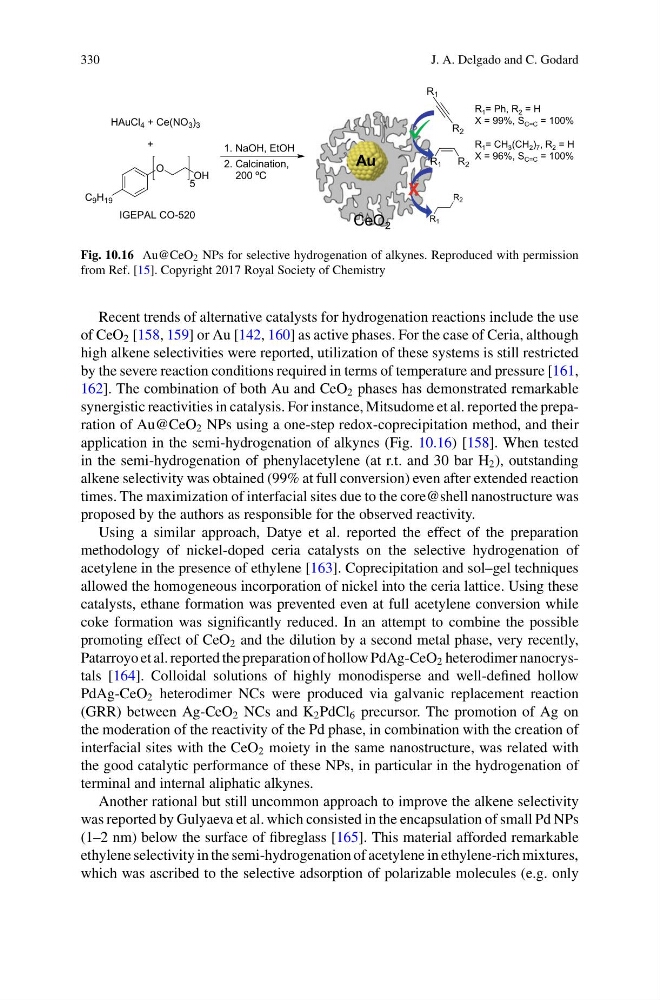
Fig. 10.16 Au@CeO 2 NPs for selective hydrogenation of alkynes. Reproduced with permission
from Ref. [15]. Copyright 2017 Royal Society of Chemistry
Recent trends of alternative catalysts for hydrogenation reactions include the use
of CeO 2 [158, 159] or Au [142, 160] as active phases. For the case of Ceria, although
high alkene selectivities were reported, utilization of these systems is still restricted
by the severe reaction conditions required in terms of temperature and pressure [161,
162]. The combination of both Au and CeO 2 phases has demonstrated remarkable
synergistic reactivities in catalysis. For instance, Mitsudome et al. reported the preparation of Au@CeO 2 NPs using a one-step redox-coprecipitation method, and their
application in the semi-hydrogenation of alkynes (Fig. 10.16) [158]. When tested
in the semi-hydrogenation of phenylacetylene (at r.t. and 30 bar H 2 ), outstanding
alkene selectivity was obtained (99% at full conversion) even after extended reaction
times. The maximization of interfacial sites due to the core@shell nanostructure was
proposed by the authors as responsible for the observed reactivity.
Using a similar approach, Datye et al. reported the effect of the preparation
methodology of nickel-doped ceria catalysts on the selective hydrogenation of
acetylene in the presence of ethylene [163]. Coprecipitation and sol–gel techniques
allowed the homogeneous incorporation of nickel into the ceria lattice. Using these
catalysts, ethane formation was prevented even at full acetylene conversion while
coke formation was significantly reduced. In an attempt to combine the possible
promoting effect of CeO 2 and the dilution by a second metal phase, very recently,
Patarroyo et al. reported the preparation of hollow PdAg-CeO 2 heterodimer nanocrystals [164]. Colloidal solutions of highly monodisperse and well-defined hollow
PdAg-CeO 2 heterodimer NCs were produced via galvanic replacement reaction
(GRR) between Ag-CeO 2 NCs and K 2 PdCl 6 precursor. The promotion of Ag on
the moderation of the reactivity of the Pd phase, in combination with the creation of
interfacial sites with the CeO 2 moiety in the same nanostructure, was related with
the good catalytic performance of these NPs, in particular in the hydrogenation of
terminal and internal aliphatic alkynes.
Another rational but still uncommon approach to improve the alkene selectivity
was reported by Gulyaeva et al. which consisted in the encapsulation of small Pd NPs
(1–2 nm) below the surface of fibreglass [165]. This material afforded remarkable
ethylene selectivity in the semi-hydrogenation of acetylene in ethylene-rich mixtures,
which was ascribed to the selective adsorption of polarizable molecules (e.g. only
J. A. Delgado and C. Godard
R 1
R 2
R 1
R 2
R 1
R 2
X
Au
CeO 2
R 1 = Ph, R 2 = H
X = 99%, S C=C = 100%
R 1 = CH 3 (CH 2 ) 7 , R 2 = H
X = 96%, S C=C = 100%
HAuCl 4 + Ce(NO 3 ) 3
1. NaOH, EtOH
2. Calcination,
200 ºC
O
OH
C 9 H 19
5
+
IGEPAL CO-520
Fig. 10.16 Au@CeO 2 NPs for selective hydrogenation of alkynes. Reproduced with permission
from Ref. [15]. Copyright 2017 Royal Society of Chemistry
Recent trends of alternative catalysts for hydrogenation reactions include the use
of CeO 2 [158, 159] or Au [142, 160] as active phases. For the case of Ceria, although
high alkene selectivities were reported, utilization of these systems is still restricted
by the severe reaction conditions required in terms of temperature and pressure [161,
162]. The combination of both Au and CeO 2 phases has demonstrated remarkable
synergistic reactivities in catalysis. For instance, Mitsudome et al. reported the preparation of Au@CeO 2 NPs using a one-step redox-coprecipitation method, and their
application in the semi-hydrogenation of alkynes (Fig. 10.16) [158]. When tested
in the semi-hydrogenation of phenylacetylene (at r.t. and 30 bar H 2 ), outstanding
alkene selectivity was obtained (99% at full conversion) even after extended reaction
times. The maximization of interfacial sites due to the core@shell nanostructure was
proposed by the authors as responsible for the observed reactivity.
Using a similar approach, Datye et al. reported the effect of the preparation
methodology of nickel-doped ceria catalysts on the selective hydrogenation of
acetylene in the presence of ethylene [163]. Coprecipitation and sol–gel techniques
allowed the homogeneous incorporation of nickel into the ceria lattice. Using these
catalysts, ethane formation was prevented even at full acetylene conversion while
coke formation was significantly reduced. In an attempt to combine the possible
promoting effect of CeO 2 and the dilution by a second metal phase, very recently,
Patarroyo et al. reported the preparation of hollow PdAg-CeO 2 heterodimer nanocrystals [164]. Colloidal solutions of highly monodisperse and well-defined hollow
PdAg-CeO 2 heterodimer NCs were produced via galvanic replacement reaction
(GRR) between Ag-CeO 2 NCs and K 2 PdCl 6 precursor. The promotion of Ag on
the moderation of the reactivity of the Pd phase, in combination with the creation of
interfacial sites with the CeO 2 moiety in the same nanostructure, was related with
the good catalytic performance of these NPs, in particular in the hydrogenation of
terminal and internal aliphatic alkynes.
Another rational but still uncommon approach to improve the alkene selectivity
was reported by Gulyaeva et al. which consisted in the encapsulation of small Pd NPs
(1–2 nm) below the surface of fibreglass [165]. This material afforded remarkable
ethylene selectivity in the semi-hydrogenation of acetylene in ethylene-rich mixtures,
which was ascribed to the selective adsorption of polarizable molecules (e.g. only