

10 Progress in the Selective Semi-hydrogenation of Alkynes …
329
10.5.5 Interplay Metal/Oxide and Encapsulation
The interface between an oxide and a metal revealed of paramount relevance in
several modern technologies, including microelectronics, electrodes for electrochemistry, corrosion protection and catalysis of supported or hybrid metal particles [154].
For several catalytic transformations, the metal/oxide interface was described as the
active site for catalysis. Phenomena such as charge transfer (from the oxide to the
metal or vice versa) as well as surface strain (due to differences in their crystalline
lattices) give rise to highly active interface sites with distinctive catalytic properties
[155].
A remarkable example evidencing the highly specific reactivities that might arise
by interactions between metal particles with oxides (e.g. support carrier) was reported
by Yang et al. [156]. A multi-walled carbon nanotubes (MWCNT) supported Fe 3 O 4 –
Cu 2 O–Pd nanocomposite, prepared by the deposition of CuNPs and Fe 3 O 4 on the
MWCNTs followed by in situ galvanic substitution between Cu atoms and PdCl 4
2+
resulted in active and highly selective catalysts in the semi-hydrogenation of terminal
alkynes, but unreactive when using internal alkynes. Control experiments demonstrated that Cu 2 O was essential for the prevention of the over-hydrogenation reaction
although no insights were given regarding the nature of the active sites. A few years
later, a step forward in the understanding of the nature of the Pd/Cu 2 O catalysts
was made by Zheng et al., who reported the preparation of atomically dispersed
Pd atoms supported on Cu 2 O and their evaluation in the semi-hydrogenation of
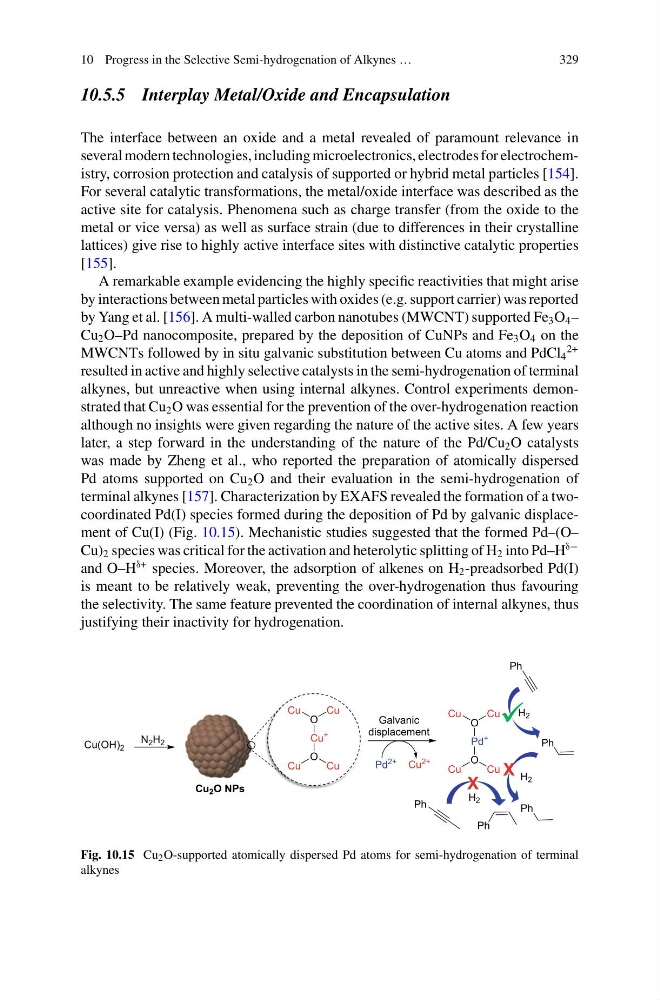
terminal alkynes [157]. Characterization by EXAFS revealed the formation of a twocoordinated Pd(I) species formed during the deposition of Pd by galvanic displacement of Cu(I) (Fig. 10.15). Mechanistic studies suggested that the formed Pd–(O–
Cu) 2 species was critical for the activation and heterolytic splitting of H 2 into Pd–H
δ−
and O–H
δ+ species. Moreover, the adsorption of alkenes on H 2 -preadsorbed Pd(I)
is meant to be relatively weak, preventing the over-hydrogenation thus favouring
the selectivity. The same feature prevented the coordination of internal alkynes, thus
justifying their inactivity for hydrogenation.
Cu
+
O
O
Cu
Cu
Cu
Cu
Pd
+
O
O
Cu
Cu
Cu
Cu
Pd
2+ Cu
2+
Galvanic
displacement
Ph
Ph
Ph
Ph
Ph
H 2
H 2
H 2
Cu(OH) 2
N 2 H 2
Cu 2 O NPs
X
X
Fig. 10.15 Cu 2 O-supported atomically dispersed Pd atoms for semi-hydrogenation of terminal
alkynes
329
10.5.5 Interplay Metal/Oxide and Encapsulation
The interface between an oxide and a metal revealed of paramount relevance in
several modern technologies, including microelectronics, electrodes for electrochemistry, corrosion protection and catalysis of supported or hybrid metal particles [154].
For several catalytic transformations, the metal/oxide interface was described as the
active site for catalysis. Phenomena such as charge transfer (from the oxide to the
metal or vice versa) as well as surface strain (due to differences in their crystalline
lattices) give rise to highly active interface sites with distinctive catalytic properties
[155].
A remarkable example evidencing the highly specific reactivities that might arise
by interactions between metal particles with oxides (e.g. support carrier) was reported
by Yang et al. [156]. A multi-walled carbon nanotubes (MWCNT) supported Fe 3 O 4 –
Cu 2 O–Pd nanocomposite, prepared by the deposition of CuNPs and Fe 3 O 4 on the
MWCNTs followed by in situ galvanic substitution between Cu atoms and PdCl 4
2+
resulted in active and highly selective catalysts in the semi-hydrogenation of terminal
alkynes, but unreactive when using internal alkynes. Control experiments demonstrated that Cu 2 O was essential for the prevention of the over-hydrogenation reaction
although no insights were given regarding the nature of the active sites. A few years
later, a step forward in the understanding of the nature of the Pd/Cu 2 O catalysts
was made by Zheng et al., who reported the preparation of atomically dispersed
Pd atoms supported on Cu 2 O and their evaluation in the semi-hydrogenation of
terminal alkynes [157]. Characterization by EXAFS revealed the formation of a twocoordinated Pd(I) species formed during the deposition of Pd by galvanic displacement of Cu(I) (Fig. 10.15). Mechanistic studies suggested that the formed Pd–(O–
Cu) 2 species was critical for the activation and heterolytic splitting of H 2 into Pd–H
δ−
and O–H
δ+ species. Moreover, the adsorption of alkenes on H 2 -preadsorbed Pd(I)
is meant to be relatively weak, preventing the over-hydrogenation thus favouring
the selectivity. The same feature prevented the coordination of internal alkynes, thus
justifying their inactivity for hydrogenation.
Cu
+
O
O
Cu
Cu
Cu
Cu
Pd
+
O
O
Cu
Cu
Cu
Cu
Pd
2+ Cu
2+
Galvanic
displacement
Ph
Ph
Ph
Ph
Ph
H 2
H 2
H 2
Cu(OH) 2
N 2 H 2
Cu 2 O NPs
X
X
Fig. 10.15 Cu 2 O-supported atomically dispersed Pd atoms for semi-hydrogenation of terminal
alkynes