

310
J. A. Delgado and C. Godard
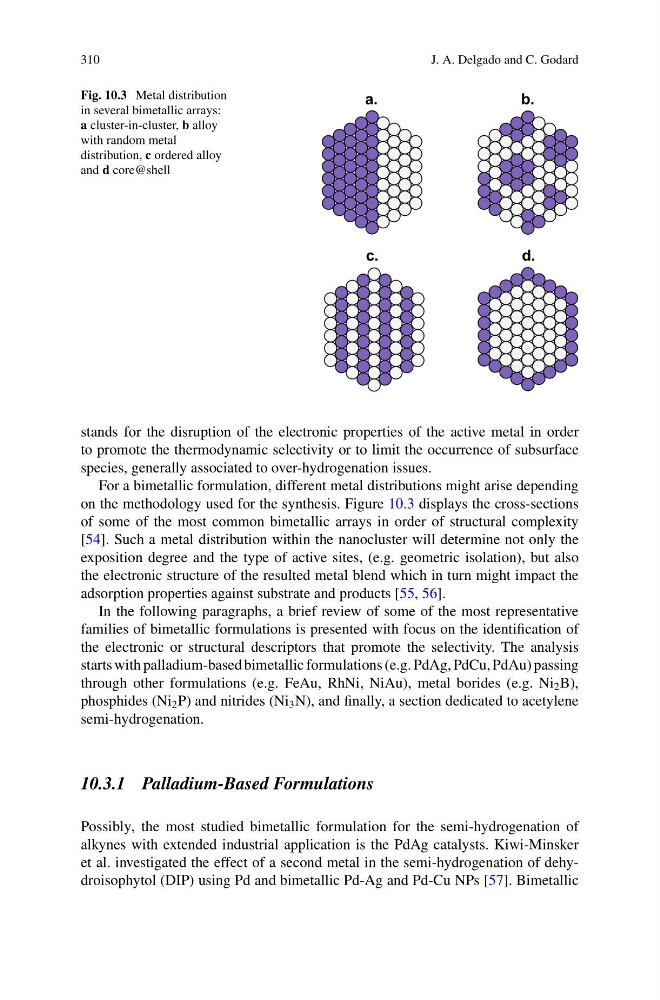
Fig. 10.3 Metal distribution
in several bimetallic arrays:
a cluster-in-cluster, b alloy
with random metal
distribution, c ordered alloy
and d core@shell
a.
b.
c.
d.
stands for the disruption of the electronic properties of the active metal in order
to promote the thermodynamic selectivity or to limit the occurrence of subsurface
species, generally associated to over-hydrogenation issues.
For a bimetallic formulation, different metal distributions might arise depending
on the methodology used for the synthesis. Figure 10.3 displays the cross-sections
of some of the most common bimetallic arrays in order of structural complexity
[54]. Such a metal distribution within the nanocluster will determine not only the
exposition degree and the type of active sites, (e.g. geometric isolation), but also
the electronic structure of the resulted metal blend which in turn might impact the
adsorption properties against substrate and products [55, 56].
In the following paragraphs, a brief review of some of the most representative
families of bimetallic formulations is presented with focus on the identification of
the electronic or structural descriptors that promote the selectivity. The analysis
starts with palladium-based bimetallic formulations (e.g. PdAg, PdCu, PdAu) passing
through other formulations (e.g. FeAu, RhNi, NiAu), metal borides (e.g. Ni 2 B),
phosphides (Ni 2 P) and nitrides (Ni 3 N), and finally, a section dedicated to acetylene
semi-hydrogenation.
10.3.1 Palladium-Based Formulations
Possibly, the most studied bimetallic formulation for the semi-hydrogenation of
alkynes with extended industrial application is the PdAg catalysts. Kiwi-Minsker
et al. investigated the effect of a second metal in the semi-hydrogenation of dehydroisophytol (DIP) using Pd and bimetallic Pd-Ag and Pd-Cu NPs [57]. Bimetallic
J. A. Delgado and C. Godard
Fig. 10.3 Metal distribution
in several bimetallic arrays:
a cluster-in-cluster, b alloy
with random metal
distribution, c ordered alloy
and d core@shell
a.
b.
c.
d.
stands for the disruption of the electronic properties of the active metal in order
to promote the thermodynamic selectivity or to limit the occurrence of subsurface
species, generally associated to over-hydrogenation issues.
For a bimetallic formulation, different metal distributions might arise depending
on the methodology used for the synthesis. Figure 10.3 displays the cross-sections
of some of the most common bimetallic arrays in order of structural complexity
[54]. Such a metal distribution within the nanocluster will determine not only the
exposition degree and the type of active sites, (e.g. geometric isolation), but also
the electronic structure of the resulted metal blend which in turn might impact the
adsorption properties against substrate and products [55, 56].
In the following paragraphs, a brief review of some of the most representative
families of bimetallic formulations is presented with focus on the identification of
the electronic or structural descriptors that promote the selectivity. The analysis
starts with palladium-based bimetallic formulations (e.g. PdAg, PdCu, PdAu) passing
through other formulations (e.g. FeAu, RhNi, NiAu), metal borides (e.g. Ni 2 B),
phosphides (Ni 2 P) and nitrides (Ni 3 N), and finally, a section dedicated to acetylene
semi-hydrogenation.
10.3.1 Palladium-Based Formulations
Possibly, the most studied bimetallic formulation for the semi-hydrogenation of
alkynes with extended industrial application is the PdAg catalysts. Kiwi-Minsker
et al. investigated the effect of a second metal in the semi-hydrogenation of dehydroisophytol (DIP) using Pd and bimetallic Pd-Ag and Pd-Cu NPs [57]. Bimetallic