

294
A. Palazzolo et al.
H 2 N
N
H
O
NH 2
O
N
H
N
NH 2
O
OH
Deuterium labeling position
[X%] Isotopic enrichment
NH 2
O
OH
OH
OH
H 2 N
H
N
N
O
NH 2
H
N
O
OH
O
NH
H 2 N
NH
O
[99%]
[51%]
[18%]
[74%]
[81%]
[79%]
NH 2
O
OH
H 2 N
O
[99%]
[99%]
[97%]
[90%]
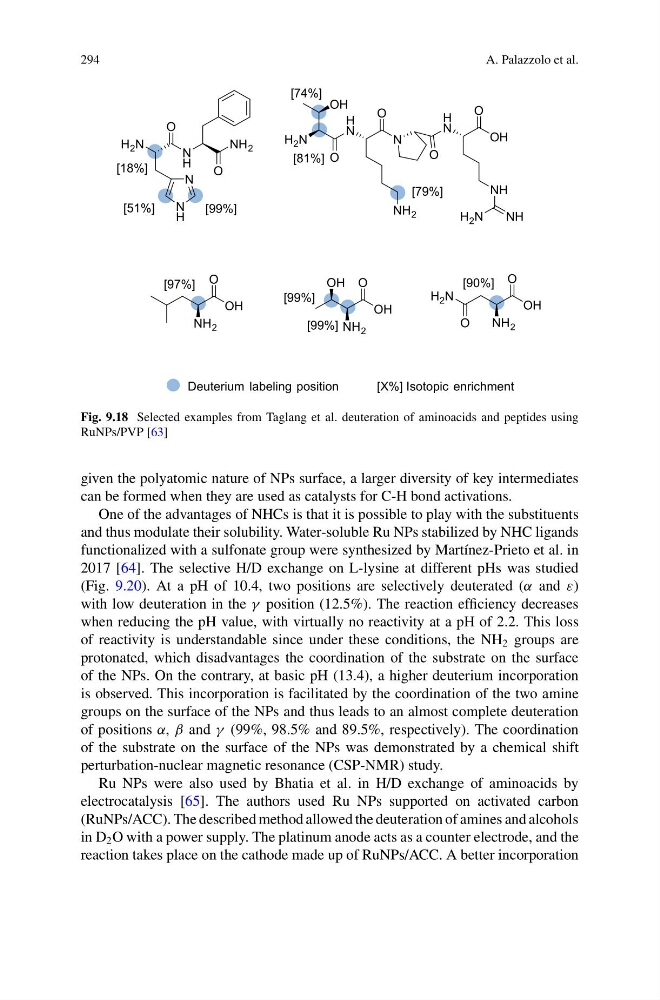
Fig. 9.18 Selected examples from Taglang et al. deuteration of aminoacids and peptides using
RuNPs/PVP [63]
given the polyatomic nature of NPs surface, a larger diversity of key intermediates
can be formed when they are used as catalysts for C-H bond activations.
One of the advantages of NHCs is that it is possible to play with the substituents
and thus modulate their solubility. Water-soluble Ru NPs stabilized by NHC ligands
functionalized with a sulfonate group were synthesized by Martínez-Prieto et al. in
2017 [64]. The selective H/D exchange on L-lysine at different pHs was studied
(Fig. 9.20). At a pH of 10.4, two positions are selectively deuterated (α and ε)
with low deuteration in the γ position (12.5%). The reaction efficiency decreases
when reducing the pH value, with virtually no reactivity at a pH of 2.2. This loss
of reactivity is understandable since under these conditions, the NH 2 groups are
protonated, which disadvantages the coordination of the substrate on the surface
of the NPs. On the contrary, at basic pH (13.4), a higher deuterium incorporation
is observed. This incorporation is facilitated by the coordination of the two amine
groups on the surface of the NPs and thus leads to an almost complete deuteration
of positions α, β and γ (99%, 98.5% and 89.5%, respectively). The coordination
of the substrate on the surface of the NPs was demonstrated by a chemical shift
perturbation-nuclear magnetic resonance (CSP-NMR) study.
Ru NPs were also used by Bhatia et al. in H/D exchange of aminoacids by
electrocatalysis [65]. The authors used Ru NPs supported on activated carbon
(RuNPs/ACC). The described method allowed the deuteration of amines and alcohols
in D 2 O with a power supply. The platinum anode acts as a counter electrode, and the
reaction takes place on the cathode made up of RuNPs/ACC. A better incorporation
A. Palazzolo et al.
H 2 N
N
H
O
NH 2
O
N
H
N
NH 2
O
OH
Deuterium labeling position
[X%] Isotopic enrichment
NH 2
O
OH
OH
OH
H 2 N
H
N
N
O
NH 2
H
N
O
OH
O
NH
H 2 N
NH
O
[99%]
[51%]
[18%]
[74%]
[81%]
[79%]
NH 2
O
OH
H 2 N
O
[99%]
[99%]
[97%]
[90%]
Fig. 9.18 Selected examples from Taglang et al. deuteration of aminoacids and peptides using
RuNPs/PVP [63]
given the polyatomic nature of NPs surface, a larger diversity of key intermediates
can be formed when they are used as catalysts for C-H bond activations.
One of the advantages of NHCs is that it is possible to play with the substituents
and thus modulate their solubility. Water-soluble Ru NPs stabilized by NHC ligands
functionalized with a sulfonate group were synthesized by Martínez-Prieto et al. in
2017 [64]. The selective H/D exchange on L-lysine at different pHs was studied
(Fig. 9.20). At a pH of 10.4, two positions are selectively deuterated (α and ε)
with low deuteration in the γ position (12.5%). The reaction efficiency decreases
when reducing the pH value, with virtually no reactivity at a pH of 2.2. This loss
of reactivity is understandable since under these conditions, the NH 2 groups are
protonated, which disadvantages the coordination of the substrate on the surface
of the NPs. On the contrary, at basic pH (13.4), a higher deuterium incorporation
is observed. This incorporation is facilitated by the coordination of the two amine
groups on the surface of the NPs and thus leads to an almost complete deuteration
of positions α, β and γ (99%, 98.5% and 89.5%, respectively). The coordination
of the substrate on the surface of the NPs was demonstrated by a chemical shift
perturbation-nuclear magnetic resonance (CSP-NMR) study.
Ru NPs were also used by Bhatia et al. in H/D exchange of aminoacids by
electrocatalysis [65]. The authors used Ru NPs supported on activated carbon
(RuNPs/ACC). The described method allowed the deuteration of amines and alcohols
in D 2 O with a power supply. The platinum anode acts as a counter electrode, and the
reaction takes place on the cathode made up of RuNPs/ACC. A better incorporation