

260
M. Camats et al.
NiNPs generated in water in the presence of appropriate surfactants (acting as stabilizers) and the Grignard reagent MeMgBr to activate the pre-catalyst ([NiCl 2 L n ],
where L is a (di)phosphine and n = 1 or 2), which were successfully applied in
Suzuki–Miyaura couplings [62]. Simultaneously, Han and coworkers reported Nicatalyzed carbonylative Suzuki-based reactions in PEG (Scheme 8.7) [135], process
leading to biaryl ketones, motif present in different types of compounds (drugs,
photosensitizers …). They compared the reactivity between preformed and in situ
generated NiNPs, evidencing that those formed in situ were more active, probably
because the latter are smaller, showing less aggregation that the preformed ones.
Authors carried out control tests (with Hg and CS 2 ) in order to prove the nature of
the catalytically active species (in the presence of these additives, the reaction did
not work), concluding that the activity observed agrees with a surface-like reactivity.
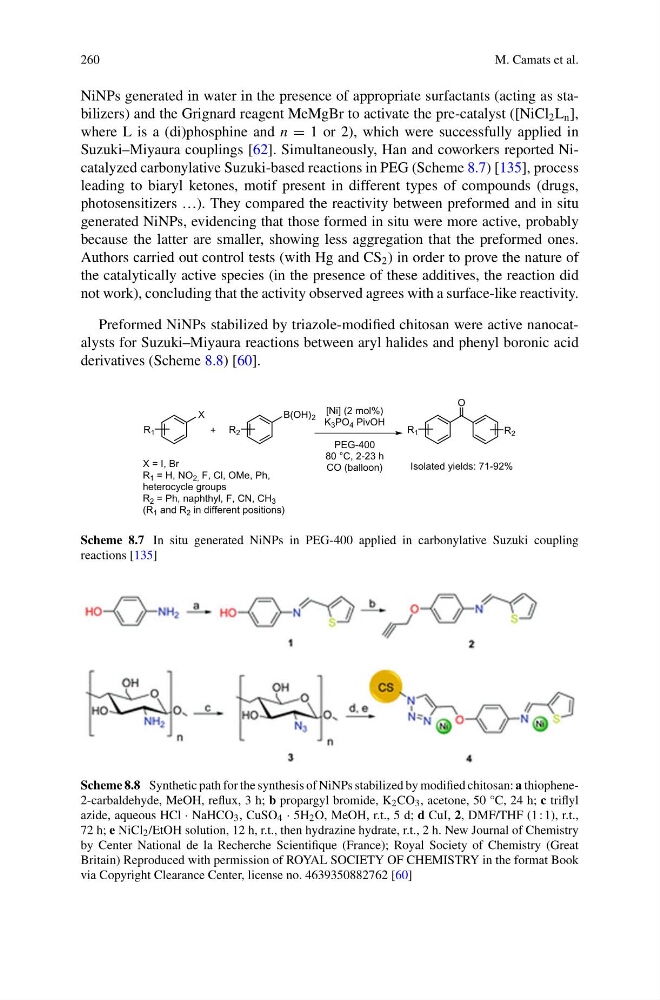
Preformed NiNPs stabilized by triazole-modified chitosan were active nanocatalysts for Suzuki–Miyaura reactions between aryl halides and phenyl boronic acid
derivatives (Scheme 8.8) [60].
R 1
X
X = I, Br
R 1 = H, NO 2, F, Cl, OMe, Ph,
heterocycle groups
R 2 = Ph, naphthyl, F, CN, CH 3
(R 1 and R 2 in different positions)
R 2
B(OH) 2
[Ni] (2 mol%)
K 3 PO 4 PivOH
PEG-400
80 °C, 2-23 h
CO (balloon)
+
R 1
R 2
O
Isolated yields: 71-92%
Scheme 8.7 In situ generated NiNPs in PEG-400 applied in carbonylative Suzuki coupling
reactions [135]
Scheme 8.8 Synthetic path for the synthesis of NiNPs stabilized by modified chitosan: a thiophene2-carbaldehyde, MeOH, reflux, 3 h; b propargyl bromide, K 2 CO 3 , acetone, 50 °C, 24 h; c triflyl
azide, aqueous HCl · NaHCO 3 , CuSO 4 · 5H 2 O, MeOH, r.t., 5 d; d CuI, 2, DMF/THF (1 : 1), r.t.,
72 h; e NiCl 2 /EtOH solution, 12 h, r.t., then hydrazine hydrate, r.t., 2 h. New Journal of Chemistry
by Center National de la Recherche Scientifique (France); Royal Society of Chemistry (Great
Britain) Reproduced with permission of ROYAL SOCIETY OF CHEMISTRY in the format Book
via Copyright Clearance Center, license no. 4639350882762 [60]
M. Camats et al.
NiNPs generated in water in the presence of appropriate surfactants (acting as stabilizers) and the Grignard reagent MeMgBr to activate the pre-catalyst ([NiCl 2 L n ],
where L is a (di)phosphine and n = 1 or 2), which were successfully applied in
Suzuki–Miyaura couplings [62]. Simultaneously, Han and coworkers reported Nicatalyzed carbonylative Suzuki-based reactions in PEG (Scheme 8.7) [135], process
leading to biaryl ketones, motif present in different types of compounds (drugs,
photosensitizers …). They compared the reactivity between preformed and in situ
generated NiNPs, evidencing that those formed in situ were more active, probably
because the latter are smaller, showing less aggregation that the preformed ones.
Authors carried out control tests (with Hg and CS 2 ) in order to prove the nature of
the catalytically active species (in the presence of these additives, the reaction did
not work), concluding that the activity observed agrees with a surface-like reactivity.
Preformed NiNPs stabilized by triazole-modified chitosan were active nanocatalysts for Suzuki–Miyaura reactions between aryl halides and phenyl boronic acid
derivatives (Scheme 8.8) [60].
R 1
X
X = I, Br
R 1 = H, NO 2, F, Cl, OMe, Ph,
heterocycle groups
R 2 = Ph, naphthyl, F, CN, CH 3
(R 1 and R 2 in different positions)
R 2
B(OH) 2
[Ni] (2 mol%)
K 3 PO 4 PivOH
PEG-400
80 °C, 2-23 h
CO (balloon)
+
R 1
R 2
O
Isolated yields: 71-92%
Scheme 8.7 In situ generated NiNPs in PEG-400 applied in carbonylative Suzuki coupling
reactions [135]
Scheme 8.8 Synthetic path for the synthesis of NiNPs stabilized by modified chitosan: a thiophene2-carbaldehyde, MeOH, reflux, 3 h; b propargyl bromide, K 2 CO 3 , acetone, 50 °C, 24 h; c triflyl
azide, aqueous HCl · NaHCO 3 , CuSO 4 · 5H 2 O, MeOH, r.t., 5 d; d CuI, 2, DMF/THF (1 : 1), r.t.,
72 h; e NiCl 2 /EtOH solution, 12 h, r.t., then hydrazine hydrate, r.t., 2 h. New Journal of Chemistry
by Center National de la Recherche Scientifique (France); Royal Society of Chemistry (Great
Britain) Reproduced with permission of ROYAL SOCIETY OF CHEMISTRY in the format Book
via Copyright Clearance Center, license no. 4639350882762 [60]