

14
J. Oliver–Meseguer and A. Leyva–Pérez
0
5
10
15
20
25
0
2 0 0 0
4 0 0 0
6 0 0 0
Au-nCeO 2
Au-ZnO
Au-Al 2 O 3
Au-TiO 2
Au-C
Au-EVOH
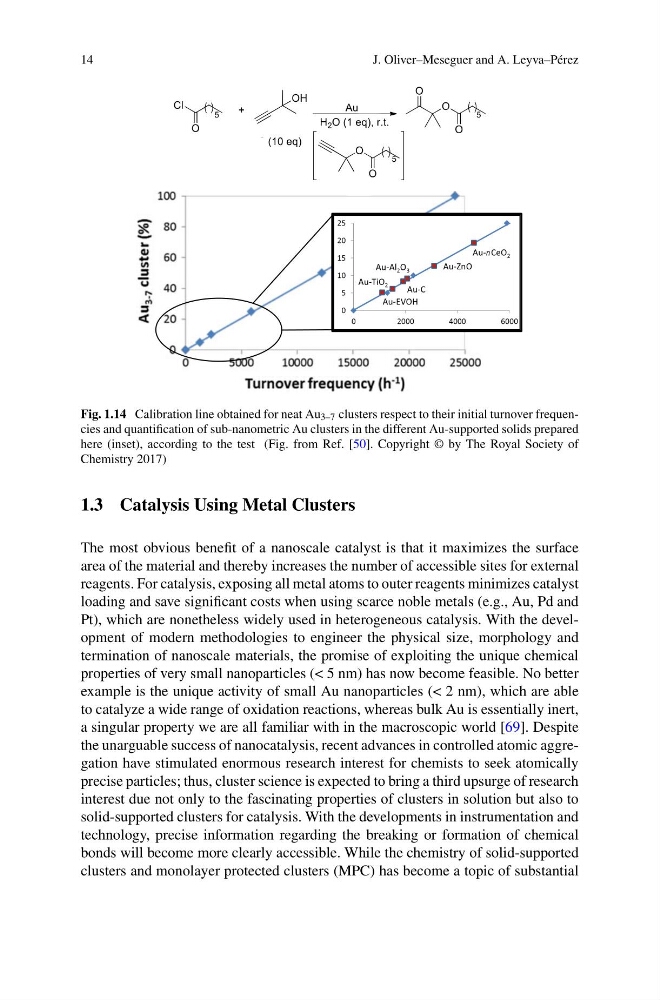
Fig. 1.14 Calibration line obtained for neat Au 3–7 clusters respect to their initial turnover frequencies and quantification of sub-nanometric Au clusters in the different Au-supported solids prepared
here (inset), according to the test (Fig. from Ref. [50]. Copyright © by The Royal Society of
Chemistry 2017)
1.3 Catalysis Using Metal Clusters
The most obvious benefit of a nanoscale catalyst is that it maximizes the surface
area of the material and thereby increases the number of accessible sites for external
reagents. For catalysis, exposing all metal atoms to outer reagents minimizes catalyst
loading and save significant costs when using scarce noble metals (e.g., Au, Pd and
Pt), which are nonetheless widely used in heterogeneous catalysis. With the development of modern methodologies to engineer the physical size, morphology and
termination of nanoscale materials, the promise of exploiting the unique chemical
properties of very small nanoparticles (< 5 nm) has now become feasible. No better
example is the unique activity of small Au nanoparticles (< 2 nm), which are able
to catalyze a wide range of oxidation reactions, whereas bulk Au is essentially inert,
a singular property we are all familiar with in the macroscopic world [69]. Despite
the unarguable success of nanocatalysis, recent advances in controlled atomic aggregation have stimulated enormous research interest for chemists to seek atomically
precise particles; thus, cluster science is expected to bring a third upsurge of research
interest due not only to the fascinating properties of clusters in solution but also to
solid-supported clusters for catalysis. With the developments in instrumentation and
technology, precise information regarding the breaking or formation of chemical
bonds will become more clearly accessible. While the chemistry of solid-supported
clusters and monolayer protected clusters (MPC) has become a topic of substantial
J. Oliver–Meseguer and A. Leyva–Pérez
0
5
10
15
20
25
0
2 0 0 0
4 0 0 0
6 0 0 0
Au-nCeO 2
Au-ZnO
Au-Al 2 O 3
Au-TiO 2
Au-C
Au-EVOH
Fig. 1.14 Calibration line obtained for neat Au 3–7 clusters respect to their initial turnover frequencies and quantification of sub-nanometric Au clusters in the different Au-supported solids prepared
here (inset), according to the test (Fig. from Ref. [50]. Copyright © by The Royal Society of
Chemistry 2017)
1.3 Catalysis Using Metal Clusters
The most obvious benefit of a nanoscale catalyst is that it maximizes the surface
area of the material and thereby increases the number of accessible sites for external
reagents. For catalysis, exposing all metal atoms to outer reagents minimizes catalyst
loading and save significant costs when using scarce noble metals (e.g., Au, Pd and
Pt), which are nonetheless widely used in heterogeneous catalysis. With the development of modern methodologies to engineer the physical size, morphology and
termination of nanoscale materials, the promise of exploiting the unique chemical
properties of very small nanoparticles (< 5 nm) has now become feasible. No better
example is the unique activity of small Au nanoparticles (< 2 nm), which are able
to catalyze a wide range of oxidation reactions, whereas bulk Au is essentially inert,
a singular property we are all familiar with in the macroscopic world [69]. Despite
the unarguable success of nanocatalysis, recent advances in controlled atomic aggregation have stimulated enormous research interest for chemists to seek atomically
precise particles; thus, cluster science is expected to bring a third upsurge of research
interest due not only to the fascinating properties of clusters in solution but also to
solid-supported clusters for catalysis. With the developments in instrumentation and
technology, precise information regarding the breaking or formation of chemical
bonds will become more clearly accessible. While the chemistry of solid-supported
clusters and monolayer protected clusters (MPC) has become a topic of substantial