

1 Ligand-Free Sub-Nanometer Metal Clusters in Catalysis
13
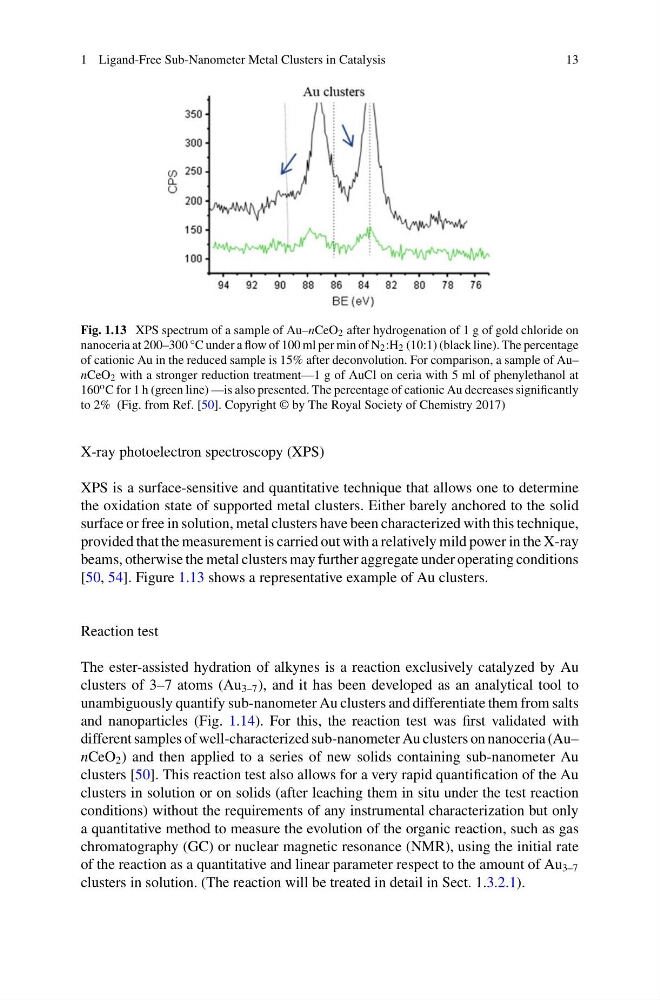
Fig. 1.13 XPS spectrum of a sample of Au–nCeO 2 after hydrogenation of 1 g of gold chloride on
nanoceria at 200–300 °C under a flow of 100 ml per min of N 2 :H 2 (10:1) (black line). The percentage
of cationic Au in the reduced sample is 15% after deconvolution. For comparison, a sample of Au–
nCeO 2 with a stronger reduction treatment—1 g of AuCl on ceria with 5 ml of phenylethanol at
160 o C for 1 h (green line) —is also presented. The percentage of cationic Au decreases significantly
to 2% (Fig. from Ref. [50]. Copyright © by The Royal Society of Chemistry 2017)
X-ray photoelectron spectroscopy (XPS)
XPS is a surface-sensitive and quantitative technique that allows one to determine
the oxidation state of supported metal clusters. Either barely anchored to the solid
surface or free in solution, metal clusters have been characterized with this technique,
provided that the measurement is carried out with a relatively mild power in the X-ray
beams, otherwise the metal clusters may further aggregate under operating conditions
[50, 54]. Figure 1.13 shows a representative example of Au clusters.
Reaction test
The ester-assisted hydration of alkynes is a reaction exclusively catalyzed by Au
clusters of 3–7 atoms (Au 3–7 ), and it has been developed as an analytical tool to
unambiguously quantify sub-nanometer Au clusters and differentiate them from salts
and nanoparticles (Fig. 1.14). For this, the reaction test was first validated with
different samples of well-characterized sub-nanometer Au clusters on nanoceria (Au–
nCeO 2 ) and then applied to a series of new solids containing sub-nanometer Au
clusters [50]. This reaction test also allows for a very rapid quantification of the Au
clusters in solution or on solids (after leaching them in situ under the test reaction
conditions) without the requirements of any instrumental characterization but only
a quantitative method to measure the evolution of the organic reaction, such as gas
chromatography (GC) or nuclear magnetic resonance (NMR), using the initial rate
of the reaction as a quantitative and linear parameter respect to the amount of Au 3–7
clusters in solution. (The reaction will be treated in detail in Sect. 1.3.2.1).
13
Fig. 1.13 XPS spectrum of a sample of Au–nCeO 2 after hydrogenation of 1 g of gold chloride on
nanoceria at 200–300 °C under a flow of 100 ml per min of N 2 :H 2 (10:1) (black line). The percentage
of cationic Au in the reduced sample is 15% after deconvolution. For comparison, a sample of Au–
nCeO 2 with a stronger reduction treatment—1 g of AuCl on ceria with 5 ml of phenylethanol at
160 o C for 1 h (green line) —is also presented. The percentage of cationic Au decreases significantly
to 2% (Fig. from Ref. [50]. Copyright © by The Royal Society of Chemistry 2017)
X-ray photoelectron spectroscopy (XPS)
XPS is a surface-sensitive and quantitative technique that allows one to determine
the oxidation state of supported metal clusters. Either barely anchored to the solid
surface or free in solution, metal clusters have been characterized with this technique,
provided that the measurement is carried out with a relatively mild power in the X-ray
beams, otherwise the metal clusters may further aggregate under operating conditions
[50, 54]. Figure 1.13 shows a representative example of Au clusters.
Reaction test
The ester-assisted hydration of alkynes is a reaction exclusively catalyzed by Au
clusters of 3–7 atoms (Au 3–7 ), and it has been developed as an analytical tool to
unambiguously quantify sub-nanometer Au clusters and differentiate them from salts
and nanoparticles (Fig. 1.14). For this, the reaction test was first validated with
different samples of well-characterized sub-nanometer Au clusters on nanoceria (Au–
nCeO 2 ) and then applied to a series of new solids containing sub-nanometer Au
clusters [50]. This reaction test also allows for a very rapid quantification of the Au
clusters in solution or on solids (after leaching them in situ under the test reaction
conditions) without the requirements of any instrumental characterization but only
a quantitative method to measure the evolution of the organic reaction, such as gas
chromatography (GC) or nuclear magnetic resonance (NMR), using the initial rate
of the reaction as a quantitative and linear parameter respect to the amount of Au 3–7
clusters in solution. (The reaction will be treated in detail in Sect. 1.3.2.1).