

7 Catalysis by Metal Nanoparticles Encapsulated …
235
times used Pd/MOF-5 indicated the presence of Pd(II), thus showing the oxidation
of Pd(0) to Pd(II) under the experimental conditions. Further, TEM analysis of the
reused catalyst clearly showed agglomeration of Pd NPs, thus explaining one of the
reasons of catalyst deactivation. In spite of this lack of stability, Pd/MOF-5 was used
as heterogeneous catalyst for a wide range of substrates showing acceptable yields.
Therefore, it appears that one of the major limitations of this catalyst is the inability
of MOF-5 to preserve the small Pd NP size as Pd undergoes oxidation and agglomeration. It could be that the poor framework stability of MOF-5 is at the origin of the
evolution of Pd NPs.
7.4.4 Heck Cross-Coupling
Together with the Suzuki–Miyaura and Sonogashira cross-couplings, the Heck reaction between a vinylic reagent and aryl halide catalyzed by Pd has become one
of the most important C–C bond forming reactions in modern organic synthesis
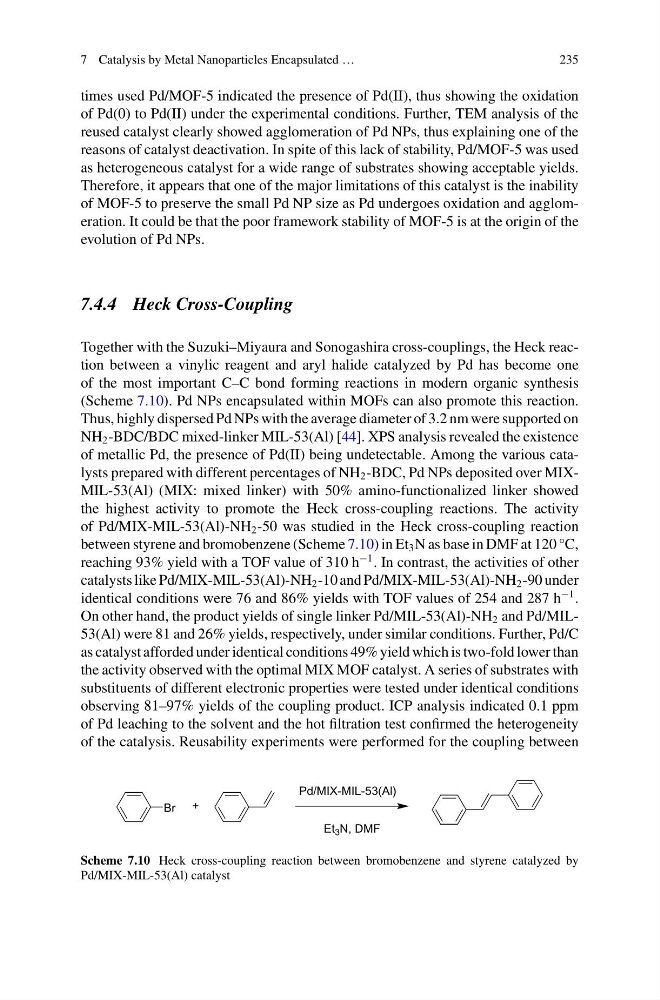
(Scheme 7.10). Pd NPs encapsulated within MOFs can also promote this reaction.
Thus, highly dispersed Pd NPs with the average diameter of 3.2 nm were supported on
NH 2 -BDC/BDC mixed-linker MIL-53(Al) [44]. XPS analysis revealed the existence
of metallic Pd, the presence of Pd(II) being undetectable. Among the various catalysts prepared with different percentages of NH 2 -BDC, Pd NPs deposited over MIXMIL-53(Al) (MIX: mixed linker) with 50% amino-functionalized linker showed
the highest activity to promote the Heck cross-coupling reactions. The activity
of Pd/MIX-MIL-53(Al)-NH 2 -50 was studied in the Heck cross-coupling reaction
between styrene and bromobenzene (Scheme 7.10) in Et 3 N as base in DMF at 120 °C,
reaching 93% yield with a TOF value of 310 h
−1 . In contrast, the activities of other
catalysts like Pd/MIX-MIL-53(Al)-NH 2 -10 and Pd/MIX-MIL-53(Al)-NH 2 -90 under
identical conditions were 76 and 86% yields with TOF values of 254 and 287 h
−1 .
On other hand, the product yields of single linker Pd/MIL-53(Al)-NH 2 and Pd/MIL53(Al) were 81 and 26% yields, respectively, under similar conditions. Further, Pd/C
as catalyst afforded under identical conditions 49% yield which is two-fold lower than
the activity observed with the optimal MIX MOF catalyst. A series of substrates with
substituents of different electronic properties were tested under identical conditions
observing 81–97% yields of the coupling product. ICP analysis indicated 0.1 ppm
of Pd leaching to the solvent and the hot filtration test confirmed the heterogeneity
of the catalysis. Reusability experiments were performed for the coupling between
Br +
Pd/MIX-MIL-53(Al)
Et 3 N, DMF
Scheme 7.10 Heck cross-coupling reaction between bromobenzene and styrene catalyzed by
Pd/MIX-MIL-53(Al) catalyst
235
times used Pd/MOF-5 indicated the presence of Pd(II), thus showing the oxidation
of Pd(0) to Pd(II) under the experimental conditions. Further, TEM analysis of the
reused catalyst clearly showed agglomeration of Pd NPs, thus explaining one of the
reasons of catalyst deactivation. In spite of this lack of stability, Pd/MOF-5 was used
as heterogeneous catalyst for a wide range of substrates showing acceptable yields.
Therefore, it appears that one of the major limitations of this catalyst is the inability
of MOF-5 to preserve the small Pd NP size as Pd undergoes oxidation and agglomeration. It could be that the poor framework stability of MOF-5 is at the origin of the
evolution of Pd NPs.
7.4.4 Heck Cross-Coupling
Together with the Suzuki–Miyaura and Sonogashira cross-couplings, the Heck reaction between a vinylic reagent and aryl halide catalyzed by Pd has become one
of the most important C–C bond forming reactions in modern organic synthesis
(Scheme 7.10). Pd NPs encapsulated within MOFs can also promote this reaction.
Thus, highly dispersed Pd NPs with the average diameter of 3.2 nm were supported on
NH 2 -BDC/BDC mixed-linker MIL-53(Al) [44]. XPS analysis revealed the existence
of metallic Pd, the presence of Pd(II) being undetectable. Among the various catalysts prepared with different percentages of NH 2 -BDC, Pd NPs deposited over MIXMIL-53(Al) (MIX: mixed linker) with 50% amino-functionalized linker showed
the highest activity to promote the Heck cross-coupling reactions. The activity
of Pd/MIX-MIL-53(Al)-NH 2 -50 was studied in the Heck cross-coupling reaction
between styrene and bromobenzene (Scheme 7.10) in Et 3 N as base in DMF at 120 °C,
reaching 93% yield with a TOF value of 310 h
−1 . In contrast, the activities of other
catalysts like Pd/MIX-MIL-53(Al)-NH 2 -10 and Pd/MIX-MIL-53(Al)-NH 2 -90 under
identical conditions were 76 and 86% yields with TOF values of 254 and 287 h
−1 .
On other hand, the product yields of single linker Pd/MIL-53(Al)-NH 2 and Pd/MIL53(Al) were 81 and 26% yields, respectively, under similar conditions. Further, Pd/C
as catalyst afforded under identical conditions 49% yield which is two-fold lower than
the activity observed with the optimal MIX MOF catalyst. A series of substrates with
substituents of different electronic properties were tested under identical conditions
observing 81–97% yields of the coupling product. ICP analysis indicated 0.1 ppm
of Pd leaching to the solvent and the hot filtration test confirmed the heterogeneity
of the catalysis. Reusability experiments were performed for the coupling between
Br +
Pd/MIX-MIL-53(Al)
Et 3 N, DMF
Scheme 7.10 Heck cross-coupling reaction between bromobenzene and styrene catalyzed by
Pd/MIX-MIL-53(Al) catalyst