

234
A. Dhakshinamoorthy and H. Garcia
Cl
MeO
Pd/MIL-101(Cr)
MeO
OMe
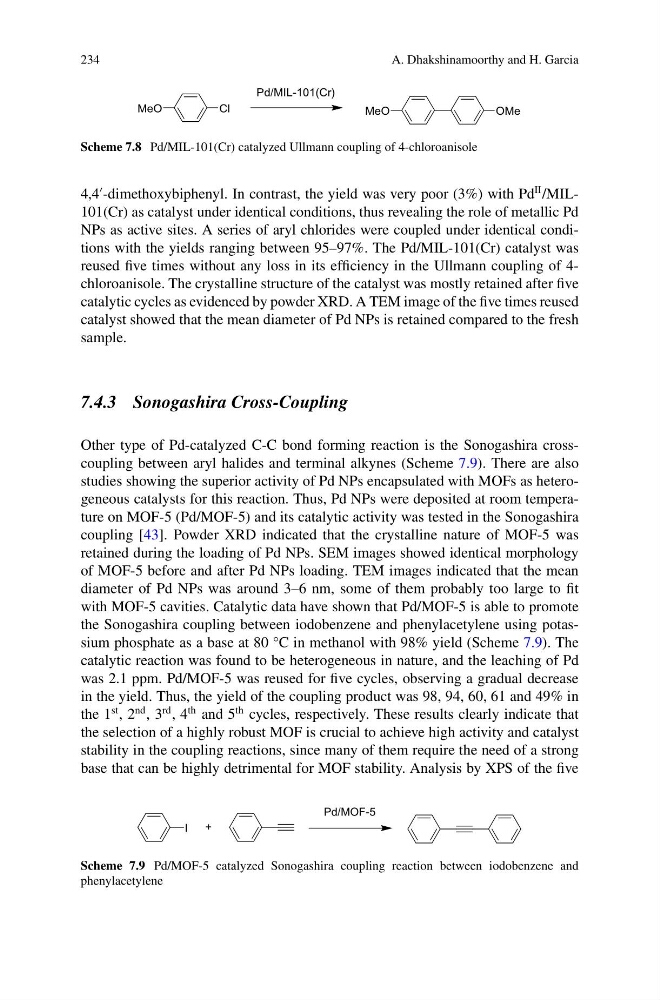
Scheme 7.8 Pd/MIL-101(Cr) catalyzed Ullmann coupling of 4-chloroanisole
4,4
-dimethoxybiphenyl. In contrast, the yield was very poor (3%) with Pd
II /MIL101(Cr) as catalyst under identical conditions, thus revealing the role of metallic Pd
NPs as active sites. A series of aryl chlorides were coupled under identical conditions with the yields ranging between 95–97%. The Pd/MIL-101(Cr) catalyst was
reused five times without any loss in its efficiency in the Ullmann coupling of 4chloroanisole. The crystalline structure of the catalyst was mostly retained after five
catalytic cycles as evidenced by powder XRD. A TEM image of the five times reused
catalyst showed that the mean diameter of Pd NPs is retained compared to the fresh
sample.
7.4.3 Sonogashira Cross-Coupling
Other type of Pd-catalyzed C-C bond forming reaction is the Sonogashira crosscoupling between aryl halides and terminal alkynes (Scheme 7.9). There are also
studies showing the superior activity of Pd NPs encapsulated with MOFs as heterogeneous catalysts for this reaction. Thus, Pd NPs were deposited at room temperature on MOF-5 (Pd/MOF-5) and its catalytic activity was tested in the Sonogashira
coupling [43]. Powder XRD indicated that the crystalline nature of MOF-5 was
retained during the loading of Pd NPs. SEM images showed identical morphology
of MOF-5 before and after Pd NPs loading. TEM images indicated that the mean
diameter of Pd NPs was around 3–6 nm, some of them probably too large to fit
with MOF-5 cavities. Catalytic data have shown that Pd/MOF-5 is able to promote
the Sonogashira coupling between iodobenzene and phenylacetylene using potassium phosphate as a base at 80 °C in methanol with 98% yield (Scheme 7.9). The
catalytic reaction was found to be heterogeneous in nature, and the leaching of Pd
was 2.1 ppm. Pd/MOF-5 was reused for five cycles, observing a gradual decrease
in the yield. Thus, the yield of the coupling product was 98, 94, 60, 61 and 49% in
the 1
st , 2
nd , 3
rd , 4
th and 5
th cycles, respectively. These results clearly indicate that
the selection of a highly robust MOF is crucial to achieve high activity and catalyst
stability in the coupling reactions, since many of them require the need of a strong
base that can be highly detrimental for MOF stability. Analysis by XPS of the five
I
+
Pd/MOF-5
Scheme 7.9 Pd/MOF-5 catalyzed Sonogashira coupling reaction between iodobenzene and
phenylacetylene
A. Dhakshinamoorthy and H. Garcia
Cl
MeO
Pd/MIL-101(Cr)
MeO
OMe
Scheme 7.8 Pd/MIL-101(Cr) catalyzed Ullmann coupling of 4-chloroanisole
4,4
-dimethoxybiphenyl. In contrast, the yield was very poor (3%) with Pd
II /MIL101(Cr) as catalyst under identical conditions, thus revealing the role of metallic Pd
NPs as active sites. A series of aryl chlorides were coupled under identical conditions with the yields ranging between 95–97%. The Pd/MIL-101(Cr) catalyst was
reused five times without any loss in its efficiency in the Ullmann coupling of 4chloroanisole. The crystalline structure of the catalyst was mostly retained after five
catalytic cycles as evidenced by powder XRD. A TEM image of the five times reused
catalyst showed that the mean diameter of Pd NPs is retained compared to the fresh
sample.
7.4.3 Sonogashira Cross-Coupling
Other type of Pd-catalyzed C-C bond forming reaction is the Sonogashira crosscoupling between aryl halides and terminal alkynes (Scheme 7.9). There are also
studies showing the superior activity of Pd NPs encapsulated with MOFs as heterogeneous catalysts for this reaction. Thus, Pd NPs were deposited at room temperature on MOF-5 (Pd/MOF-5) and its catalytic activity was tested in the Sonogashira
coupling [43]. Powder XRD indicated that the crystalline nature of MOF-5 was
retained during the loading of Pd NPs. SEM images showed identical morphology
of MOF-5 before and after Pd NPs loading. TEM images indicated that the mean
diameter of Pd NPs was around 3–6 nm, some of them probably too large to fit
with MOF-5 cavities. Catalytic data have shown that Pd/MOF-5 is able to promote
the Sonogashira coupling between iodobenzene and phenylacetylene using potassium phosphate as a base at 80 °C in methanol with 98% yield (Scheme 7.9). The
catalytic reaction was found to be heterogeneous in nature, and the leaching of Pd
was 2.1 ppm. Pd/MOF-5 was reused for five cycles, observing a gradual decrease
in the yield. Thus, the yield of the coupling product was 98, 94, 60, 61 and 49% in
the 1
st , 2
nd , 3
rd , 4
th and 5
th cycles, respectively. These results clearly indicate that
the selection of a highly robust MOF is crucial to achieve high activity and catalyst
stability in the coupling reactions, since many of them require the need of a strong
base that can be highly detrimental for MOF stability. Analysis by XPS of the five
I
+
Pd/MOF-5
Scheme 7.9 Pd/MOF-5 catalyzed Sonogashira coupling reaction between iodobenzene and
phenylacetylene