

7 Catalysis by Metal Nanoparticles Encapsulated …
231
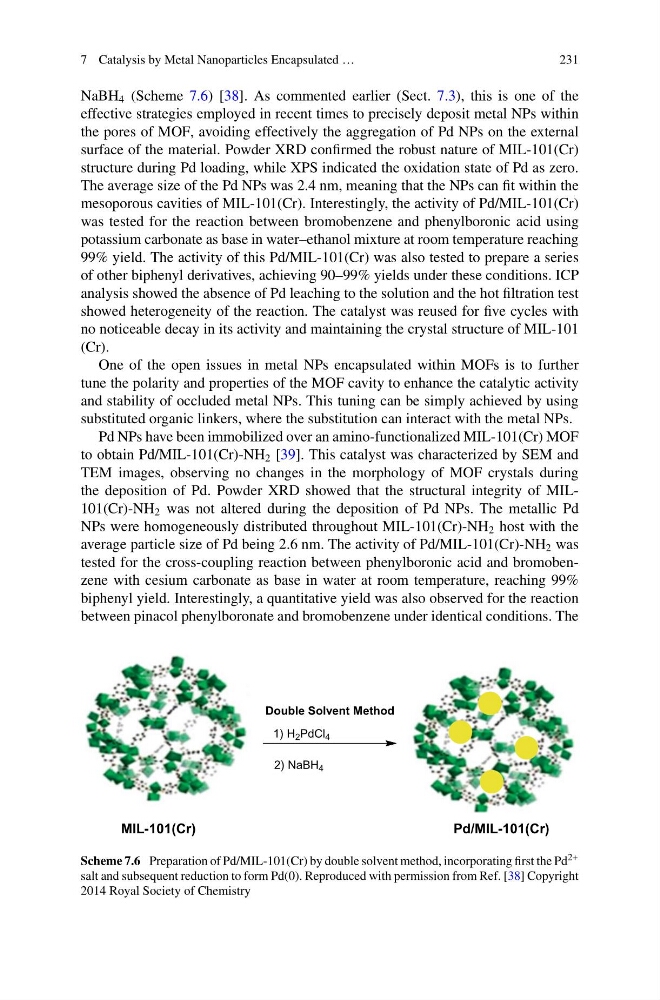
NaBH 4 (Scheme 7.6) [38]. As commented earlier (Sect. 7.3), this is one of the
effective strategies employed in recent times to precisely deposit metal NPs within
the pores of MOF, avoiding effectively the aggregation of Pd NPs on the external
surface of the material. Powder XRD confirmed the robust nature of MIL-101(Cr)
structure during Pd loading, while XPS indicated the oxidation state of Pd as zero.
The average size of the Pd NPs was 2.4 nm, meaning that the NPs can fit within the
mesoporous cavities of MIL-101(Cr). Interestingly, the activity of Pd/MIL-101(Cr)
was tested for the reaction between bromobenzene and phenylboronic acid using
potassium carbonate as base in water–ethanol mixture at room temperature reaching
99% yield. The activity of this Pd/MIL-101(Cr) was also tested to prepare a series
of other biphenyl derivatives, achieving 90–99% yields under these conditions. ICP
analysis showed the absence of Pd leaching to the solution and the hot filtration test
showed heterogeneity of the reaction. The catalyst was reused for five cycles with
no noticeable decay in its activity and maintaining the crystal structure of MIL-101
(Cr).
One of the open issues in metal NPs encapsulated within MOFs is to further
tune the polarity and properties of the MOF cavity to enhance the catalytic activity
and stability of occluded metal NPs. This tuning can be simply achieved by using
substituted organic linkers, where the substitution can interact with the metal NPs.
Pd NPs have been immobilized over an amino-functionalized MIL-101(Cr) MOF
to obtain Pd/MIL-101(Cr)-NH 2 [39]. This catalyst was characterized by SEM and
TEM images, observing no changes in the morphology of MOF crystals during
the deposition of Pd. Powder XRD showed that the structural integrity of MIL101(Cr)-NH 2 was not altered during the deposition of Pd NPs. The metallic Pd
NPs were homogeneously distributed throughout MIL-101(Cr)-NH 2 host with the
average particle size of Pd being 2.6 nm. The activity of Pd/MIL-101(Cr)-NH 2 was
tested for the cross-coupling reaction between phenylboronic acid and bromobenzene with cesium carbonate as base in water at room temperature, reaching 99%
biphenyl yield. Interestingly, a quantitative yield was also observed for the reaction
between pinacol phenylboronate and bromobenzene under identical conditions. The
MIL-101(Cr)
Pd/MIL-101(Cr)
Double Solvent Method
1) H 2 PdCl 4
2) NaBH 4
Scheme 7.6 Preparation of Pd/MIL-101(Cr) by double solvent method, incorporating first the Pd 2+
salt and subsequent reduction to form Pd(0). Reproduced with permission from Ref. [38] Copyright
2014 Royal Society of Chemistry
231
NaBH 4 (Scheme 7.6) [38]. As commented earlier (Sect. 7.3), this is one of the
effective strategies employed in recent times to precisely deposit metal NPs within
the pores of MOF, avoiding effectively the aggregation of Pd NPs on the external
surface of the material. Powder XRD confirmed the robust nature of MIL-101(Cr)
structure during Pd loading, while XPS indicated the oxidation state of Pd as zero.
The average size of the Pd NPs was 2.4 nm, meaning that the NPs can fit within the
mesoporous cavities of MIL-101(Cr). Interestingly, the activity of Pd/MIL-101(Cr)
was tested for the reaction between bromobenzene and phenylboronic acid using
potassium carbonate as base in water–ethanol mixture at room temperature reaching
99% yield. The activity of this Pd/MIL-101(Cr) was also tested to prepare a series
of other biphenyl derivatives, achieving 90–99% yields under these conditions. ICP
analysis showed the absence of Pd leaching to the solution and the hot filtration test
showed heterogeneity of the reaction. The catalyst was reused for five cycles with
no noticeable decay in its activity and maintaining the crystal structure of MIL-101
(Cr).
One of the open issues in metal NPs encapsulated within MOFs is to further
tune the polarity and properties of the MOF cavity to enhance the catalytic activity
and stability of occluded metal NPs. This tuning can be simply achieved by using
substituted organic linkers, where the substitution can interact with the metal NPs.
Pd NPs have been immobilized over an amino-functionalized MIL-101(Cr) MOF
to obtain Pd/MIL-101(Cr)-NH 2 [39]. This catalyst was characterized by SEM and
TEM images, observing no changes in the morphology of MOF crystals during
the deposition of Pd. Powder XRD showed that the structural integrity of MIL101(Cr)-NH 2 was not altered during the deposition of Pd NPs. The metallic Pd
NPs were homogeneously distributed throughout MIL-101(Cr)-NH 2 host with the
average particle size of Pd being 2.6 nm. The activity of Pd/MIL-101(Cr)-NH 2 was
tested for the cross-coupling reaction between phenylboronic acid and bromobenzene with cesium carbonate as base in water at room temperature, reaching 99%
biphenyl yield. Interestingly, a quantitative yield was also observed for the reaction
between pinacol phenylboronate and bromobenzene under identical conditions. The
MIL-101(Cr)
Pd/MIL-101(Cr)
Double Solvent Method
1) H 2 PdCl 4
2) NaBH 4
Scheme 7.6 Preparation of Pd/MIL-101(Cr) by double solvent method, incorporating first the Pd 2+
salt and subsequent reduction to form Pd(0). Reproduced with permission from Ref. [38] Copyright
2014 Royal Society of Chemistry