

230
A. Dhakshinamoorthy and H. Garcia
encapsulated within MOFs (metal NPs/MOFs) as heterogeneous catalysts. The reader
is also referred to the existing literature for a complete coverage on this field.
7.4 Catalysis by Metal NPs@MOFs
7.4.1 Suzuki–Miyaura Cross-Coupling
C-C bond forming reactions are important because their application as synthetic
routes in organic transformations. One of these reactions that has become quite
useful due to the high yields and mild conditions to form asymmetrically substituted
biaryls is the Suzuki–Miyaura cross-coupling of aryl halides and arylboronic acids
catalyzed by Pd NPs.
In one of the seminal contributions using metal NPs/MOFs as heterogeneous catalysts, Pd NPs were supported over a highly robust MOF, namely MIL-101(Cr), and
the resulting Pd/MIL-101(Cr) was used as a heterogeneous catalyst for the Suzuki–
Miyaura cross-coupling reaction in aqueous medium [37]. Characterization of the
material showed that Pd NPs were distributed homogenously throughout the MIL101(Cr) particle. The mean diameter of Pd NPs was 1.9 ± 0.7 nm as evidenced by
TEM measurements. Further, powder XRD revealed that the crystalline nature of
MIL-101(Cr) was maintained during the deposition of Pd NPs. XPS analysis indicated the existence of Pd in its metallic form. The Suzuki–Miyaura cross-coupling
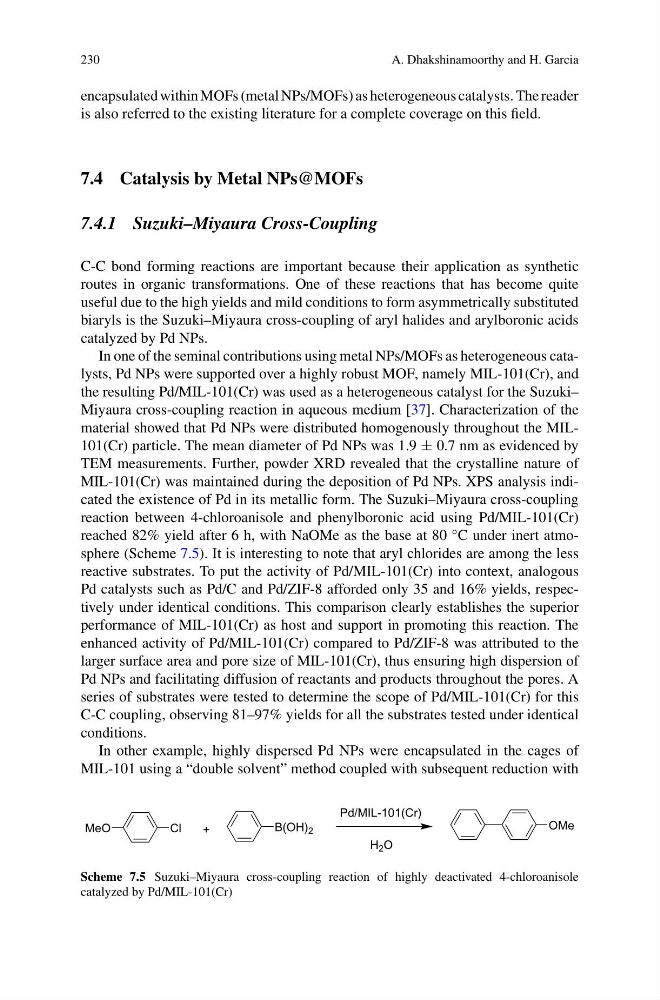
reaction between 4-chloroanisole and phenylboronic acid using Pd/MIL-101(Cr)
reached 82% yield after 6 h, with NaOMe as the base at 80 °C under inert atmosphere (Scheme 7.5). It is interesting to note that aryl chlorides are among the less
reactive substrates. To put the activity of Pd/MIL-101(Cr) into context, analogous
Pd catalysts such as Pd/C and Pd/ZIF-8 afforded only 35 and 16% yields, respectively under identical conditions. This comparison clearly establishes the superior
performance of MIL-101(Cr) as host and support in promoting this reaction. The
enhanced activity of Pd/MIL-101(Cr) compared to Pd/ZIF-8 was attributed to the
larger surface area and pore size of MIL-101(Cr), thus ensuring high dispersion of
Pd NPs and facilitating diffusion of reactants and products throughout the pores. A
series of substrates were tested to determine the scope of Pd/MIL-101(Cr) for this
C-C coupling, observing 81–97% yields for all the substrates tested under identical
conditions.
In other example, highly dispersed Pd NPs were encapsulated in the cages of
MIL-101 using a “double solvent” method coupled with subsequent reduction with
Cl
MeO
B(OH) 2
+
Pd/MIL-101(Cr)
H 2 O
OMe
Scheme 7.5 Suzuki–Miyaura cross-coupling reaction of highly deactivated 4-chloroanisole
catalyzed by Pd/MIL-101(Cr)
A. Dhakshinamoorthy and H. Garcia
encapsulated within MOFs (metal NPs/MOFs) as heterogeneous catalysts. The reader
is also referred to the existing literature for a complete coverage on this field.
7.4 Catalysis by Metal NPs@MOFs
7.4.1 Suzuki–Miyaura Cross-Coupling
C-C bond forming reactions are important because their application as synthetic
routes in organic transformations. One of these reactions that has become quite
useful due to the high yields and mild conditions to form asymmetrically substituted
biaryls is the Suzuki–Miyaura cross-coupling of aryl halides and arylboronic acids
catalyzed by Pd NPs.
In one of the seminal contributions using metal NPs/MOFs as heterogeneous catalysts, Pd NPs were supported over a highly robust MOF, namely MIL-101(Cr), and
the resulting Pd/MIL-101(Cr) was used as a heterogeneous catalyst for the Suzuki–
Miyaura cross-coupling reaction in aqueous medium [37]. Characterization of the
material showed that Pd NPs were distributed homogenously throughout the MIL101(Cr) particle. The mean diameter of Pd NPs was 1.9 ± 0.7 nm as evidenced by
TEM measurements. Further, powder XRD revealed that the crystalline nature of
MIL-101(Cr) was maintained during the deposition of Pd NPs. XPS analysis indicated the existence of Pd in its metallic form. The Suzuki–Miyaura cross-coupling
reaction between 4-chloroanisole and phenylboronic acid using Pd/MIL-101(Cr)
reached 82% yield after 6 h, with NaOMe as the base at 80 °C under inert atmosphere (Scheme 7.5). It is interesting to note that aryl chlorides are among the less
reactive substrates. To put the activity of Pd/MIL-101(Cr) into context, analogous
Pd catalysts such as Pd/C and Pd/ZIF-8 afforded only 35 and 16% yields, respectively under identical conditions. This comparison clearly establishes the superior
performance of MIL-101(Cr) as host and support in promoting this reaction. The
enhanced activity of Pd/MIL-101(Cr) compared to Pd/ZIF-8 was attributed to the
larger surface area and pore size of MIL-101(Cr), thus ensuring high dispersion of
Pd NPs and facilitating diffusion of reactants and products throughout the pores. A
series of substrates were tested to determine the scope of Pd/MIL-101(Cr) for this
C-C coupling, observing 81–97% yields for all the substrates tested under identical
conditions.
In other example, highly dispersed Pd NPs were encapsulated in the cages of
MIL-101 using a “double solvent” method coupled with subsequent reduction with
Cl
MeO
B(OH) 2
+
Pd/MIL-101(Cr)
H 2 O
OMe
Scheme 7.5 Suzuki–Miyaura cross-coupling reaction of highly deactivated 4-chloroanisole
catalyzed by Pd/MIL-101(Cr)