

214
R. V. Jagadeesh
1. Stir, DMF, 150 o C
2. Addition of Vulcan XC 72R
3. Stir, DMF, 150 o C
4. Evaporation of DMF
and drying
Pyrolysis
800
o C, Ar, 2h
Co-DABCO-TPA MOF
template on carbon
Co(NO 3 ) 2 · 6H 2 O
N
N
OH
O
HO
N-doped graphitic shell
encapsulated cobalt-nanoparticles
and single atoms supported
on carbon
O
DABCO
TPA
Fig. 6.4 Preparation of cobalt nanoparticles and single atom-based catalysts by the pyrousls of
Co-MOF on carbon
source. In 1 mL of isopropanol, the reaction gave selectively benzyl amine as the
desired product. However, in 4 mL of isopropanol, the secondary imine was majorly
formed, which is the intermediate or side product formed during the hydrogenation
of nitriles. Thus, in 1 mL of isopropanol solvent Co@NC-900 works more efficiently
than its reaction in 4 mL of isopropanol [30].
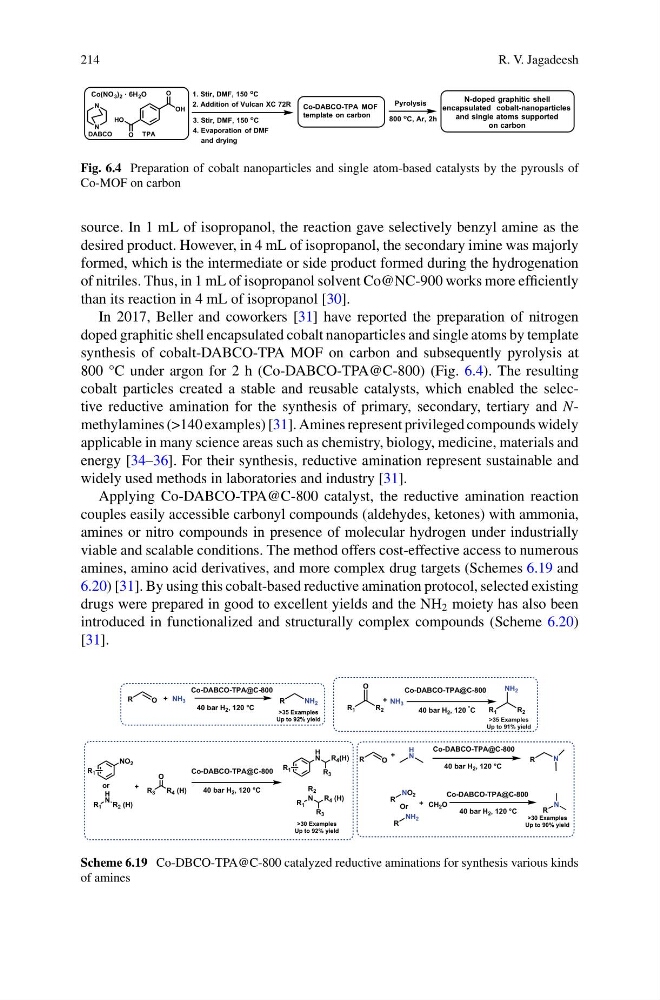
In 2017, Beller and coworkers [31] have reported the preparation of nitrogen
doped graphitic shell encapsulated cobalt nanoparticles and single atoms by template
synthesis of cobalt-DABCO-TPA MOF on carbon and subsequently pyrolysis at
800 °C under argon for 2 h (Co-DABCO-TPA@C-800) (Fig. 6.4). The resulting
cobalt particles created a stable and reusable catalysts, which enabled the selective reductive amination for the synthesis of primary, secondary, tertiary and Nmethylamines (>140 examples) [31]. Amines represent privileged compounds widely
applicable in many science areas such as chemistry, biology, medicine, materials and
energy [34–36]. For their synthesis, reductive amination represent sustainable and
widely used methods in laboratories and industry [31].
Applying Co-DABCO-TPA@C-800 catalyst, the reductive amination reaction
couples easily accessible carbonyl compounds (aldehydes, ketones) with ammonia,
amines or nitro compounds in presence of molecular hydrogen under industrially
viable and scalable conditions. The method offers cost-effective access to numerous
amines, amino acid derivatives, and more complex drug targets (Schemes 6.19 and
6.20) [31]. By using this cobalt-based reductive amination protocol, selected existing
drugs were prepared in good to excellent yields and the NH 2 moiety has also been
introduced in functionalized and structurally complex compounds (Scheme 6.20)
[31].
Co-DABCO-TPA@C-800
40 bar H 2 , 120 °C
+
R
O
R
NH 2
NH 3
40 bar H 2 , 120
° C
+ NH 3
R 1
O
R 2
R 1
NH 2
R 2
Co-DABCO-TPA@C-800
R 1
H
N
+ R 3
R 4 (H)
O
R 1
N
R 2 (H)
R 2
R 4 (H)
R 3
40 bar H 2 , 120 °C
NO 2
R 1
or
H
N
R 1
R 4 (H)
R 3
Co-DABCO-TPA@C-800
40 bar H 2 , 120 °C
+
R
O
H
N
R
N
Co-DABCO-TPA@C-800
40 bar H 2 , 120 °C
+
R
NO 2
R
NH 2
Or
R
N
CH 2 O
Co-DABCO-TPA@C-800
>35 Examples
Up to 92% yield
>35 Examples
Up to 91% yield
>30 Examples
Up to 92% yield
>30 Examples
Up to 90% yield
Scheme 6.19 Co-DBCO-TPA@C-800 catalyzed reductive aminations for synthesis various kinds
of amines
R. V. Jagadeesh
1. Stir, DMF, 150 o C
2. Addition of Vulcan XC 72R
3. Stir, DMF, 150 o C
4. Evaporation of DMF
and drying
Pyrolysis
800
o C, Ar, 2h
Co-DABCO-TPA MOF
template on carbon
Co(NO 3 ) 2 · 6H 2 O
N
N
OH
O
HO
N-doped graphitic shell
encapsulated cobalt-nanoparticles
and single atoms supported
on carbon
O
DABCO
TPA
Fig. 6.4 Preparation of cobalt nanoparticles and single atom-based catalysts by the pyrousls of
Co-MOF on carbon
source. In 1 mL of isopropanol, the reaction gave selectively benzyl amine as the
desired product. However, in 4 mL of isopropanol, the secondary imine was majorly
formed, which is the intermediate or side product formed during the hydrogenation
of nitriles. Thus, in 1 mL of isopropanol solvent Co@NC-900 works more efficiently
than its reaction in 4 mL of isopropanol [30].
In 2017, Beller and coworkers [31] have reported the preparation of nitrogen
doped graphitic shell encapsulated cobalt nanoparticles and single atoms by template
synthesis of cobalt-DABCO-TPA MOF on carbon and subsequently pyrolysis at
800 °C under argon for 2 h (Co-DABCO-TPA@C-800) (Fig. 6.4). The resulting
cobalt particles created a stable and reusable catalysts, which enabled the selective reductive amination for the synthesis of primary, secondary, tertiary and Nmethylamines (>140 examples) [31]. Amines represent privileged compounds widely
applicable in many science areas such as chemistry, biology, medicine, materials and
energy [34–36]. For their synthesis, reductive amination represent sustainable and
widely used methods in laboratories and industry [31].
Applying Co-DABCO-TPA@C-800 catalyst, the reductive amination reaction
couples easily accessible carbonyl compounds (aldehydes, ketones) with ammonia,
amines or nitro compounds in presence of molecular hydrogen under industrially
viable and scalable conditions. The method offers cost-effective access to numerous
amines, amino acid derivatives, and more complex drug targets (Schemes 6.19 and
6.20) [31]. By using this cobalt-based reductive amination protocol, selected existing
drugs were prepared in good to excellent yields and the NH 2 moiety has also been
introduced in functionalized and structurally complex compounds (Scheme 6.20)
[31].
Co-DABCO-TPA@C-800
40 bar H 2 , 120 °C
+
R
O
R
NH 2
NH 3
40 bar H 2 , 120
° C
+ NH 3
R 1
O
R 2
R 1
NH 2
R 2
Co-DABCO-TPA@C-800
R 1
H
N
+ R 3
R 4 (H)
O
R 1
N
R 2 (H)
R 2
R 4 (H)
R 3
40 bar H 2 , 120 °C
NO 2
R 1
or
H
N
R 1
R 4 (H)
R 3
Co-DABCO-TPA@C-800
40 bar H 2 , 120 °C
+
R
O
H
N
R
N
Co-DABCO-TPA@C-800
40 bar H 2 , 120 °C
+
R
NO 2
R
NH 2
Or
R
N
CH 2 O
Co-DABCO-TPA@C-800
>35 Examples
Up to 92% yield
>35 Examples
Up to 91% yield
>30 Examples
Up to 92% yield
>30 Examples
Up to 90% yield
Scheme 6.19 Co-DBCO-TPA@C-800 catalyzed reductive aminations for synthesis various kinds
of amines