

210
R. V. Jagadeesh
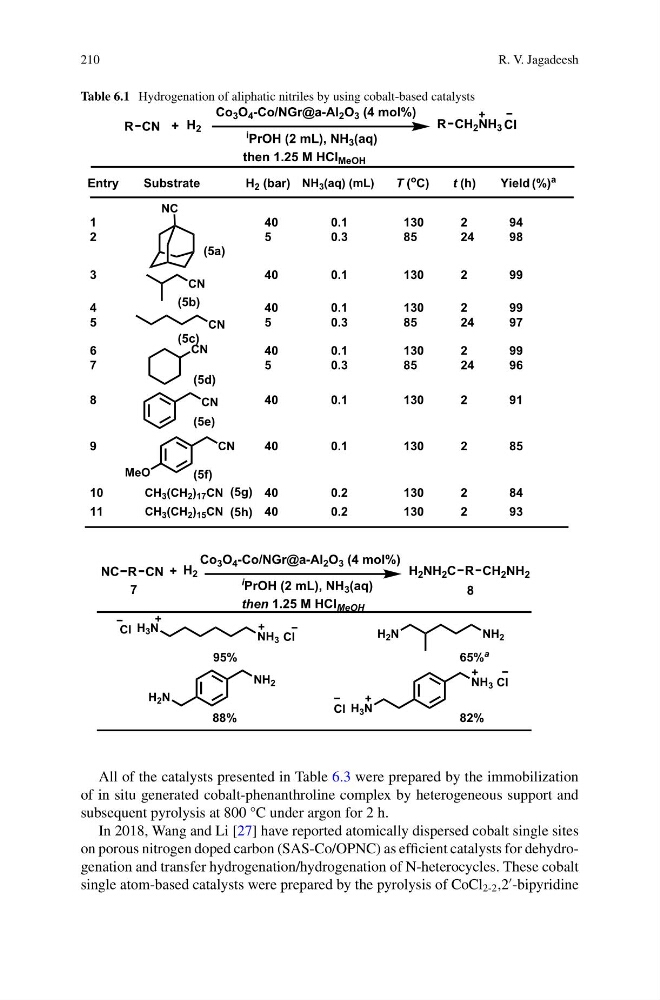
Table 6.1 Hydrogenation of aliphatic nitriles by using cobalt-based catalysts
R CN
Co 3 O 4 -Co/NGr@a-Al 2 O 3 (4 mol%)
i
PrOH (2 mL), NH 3 (aq)
+ H 2
R CH 2 NH 3
H 2 (bar) NH 3 (aq) (mL)
Substrate
Yield (%)
a
Entry
T (
o C)
t (h)
NC
94
1
40
0.1
130
2
98
2
5
0.3
85
24
CN
CN
99
3
40
0.1
130
2
99
4
40
0.1
130
2
97
5
5
0.3
85
24
CN
99
6
40
0.1
130
2
96
7
5
0.3
85
24
CN
91
8
40
0.1
130
2
CN
MeO
85
9
40
0.1
130
2
CH 3 (CH 2 ) 17 CN
CH 3 (CH 2 ) 15 CN
84
10
40
0.2
130
2
93
11
40
0.2
130
2
(5a)
(5b)
(5c)
(5d)
(5e)
(5f)
(5g)
(5h)
Cl
then 1.25 M HCl MeOH
R CN
Co 3 O 4 -Co/NGr@a-Al 2 O 3 (4 mol%)
i
PrOH (2 mL), NH 3 (aq)
then 1.25 M HCl MeOH
+ H 2
R CH 2 NH 2
7
8
NC
H 2 NH 2 C
H 3 N
NH 3
95%
Cl
Cl
H 2 N
NH 2
65%
a
NH 2
H 2 N
88%
NH 3
82%
H 3 N
Cl
Cl
All of the catalysts presented in Table 6.3 were prepared by the immobilization
of in situ generated cobalt-phenanthroline complex by heterogeneous support and
subsequent pyrolysis at 800 °C under argon for 2 h.
In 2018, Wang and Li [27] have reported atomically dispersed cobalt single sites
on porous nitrogen doped carbon (SAS-Co/OPNC) as efficient catalysts for dehydrogenation and transfer hydrogenation/hydrogenation of N-heterocycles. These cobalt
single atom-based catalysts were prepared by the pyrolysis of CoCl 2-2 ,2
-bipyridine
R. V. Jagadeesh
Table 6.1 Hydrogenation of aliphatic nitriles by using cobalt-based catalysts
R CN
Co 3 O 4 -Co/NGr@a-Al 2 O 3 (4 mol%)
i
PrOH (2 mL), NH 3 (aq)
+ H 2
R CH 2 NH 3
H 2 (bar) NH 3 (aq) (mL)
Substrate
Yield (%)
a
Entry
T (
o C)
t (h)
NC
94
1
40
0.1
130
2
98
2
5
0.3
85
24
CN
CN
99
3
40
0.1
130
2
99
4
40
0.1
130
2
97
5
5
0.3
85
24
CN
99
6
40
0.1
130
2
96
7
5
0.3
85
24
CN
91
8
40
0.1
130
2
CN
MeO
85
9
40
0.1
130
2
CH 3 (CH 2 ) 17 CN
CH 3 (CH 2 ) 15 CN
84
10
40
0.2
130
2
93
11
40
0.2
130
2
(5a)
(5b)
(5c)
(5d)
(5e)
(5f)
(5g)
(5h)
Cl
then 1.25 M HCl MeOH
R CN
Co 3 O 4 -Co/NGr@a-Al 2 O 3 (4 mol%)
i
PrOH (2 mL), NH 3 (aq)
then 1.25 M HCl MeOH
+ H 2
R CH 2 NH 2
7
8
NC
H 2 NH 2 C
H 3 N
NH 3
95%
Cl
Cl
H 2 N
NH 2
65%
a
NH 2
H 2 N
88%
NH 3
82%
H 3 N
Cl
Cl
All of the catalysts presented in Table 6.3 were prepared by the immobilization
of in situ generated cobalt-phenanthroline complex by heterogeneous support and
subsequent pyrolysis at 800 °C under argon for 2 h.
In 2018, Wang and Li [27] have reported atomically dispersed cobalt single sites
on porous nitrogen doped carbon (SAS-Co/OPNC) as efficient catalysts for dehydrogenation and transfer hydrogenation/hydrogenation of N-heterocycles. These cobalt
single atom-based catalysts were prepared by the pyrolysis of CoCl 2-2 ,2
-bipyridine