

6 Catalysis with MNPs on N-Doped Carbon
201
NO 2
NH 2
50 bar H 2 , 120
o C, 12-26h
H 2 O-THF (1:1)
R
R
Fe 2 O 3 / NGr@C (4.5 mol% Fe)
Cl
NH 2
Cl
Cl
Cl
Cl
Yield= 96%
I
Cl
NH 2
94%
NH 2
Br
92%
F
F
F
NH 2
NH 2
Br
93%
NH 2
CHO
97%
NH 2
F
O
90%
NH 2
H 2 N
N
Br 89%
N
O
O
H
NH 2
Cl
89%
NH 2
75%
NH 2
96%
O
NH 2
97%
NH 2
S
CN 90%
NH 2
N
H
O
F
F
F
97%
NH 2
N
O
O
O
97%
NH 2
O
F
F
F
S
O
O
98%
NH 2
B
O
O
NH 2
89%
(in t-amyl alcohol)
NH 2
N
H
O
O
O
O
O
96%
NH 2
N
HN
O
O
F
F
F
98%
NH 2
Cl
N
H
O
OH
Cl
92%
NH 2
Cl
N
H
95%
NH 2
S
N
H 2 N
89%
N
NH 2
NH 2
Br
89%
NH 2
N
O
O 94%
N
NH 2
O
H
91%
O
O
NH 2
O
98%
N
S
N
96%
NH 2
O
O
NH 2
CHO
88%
NH 2
N
N
O
H 2 N
88%
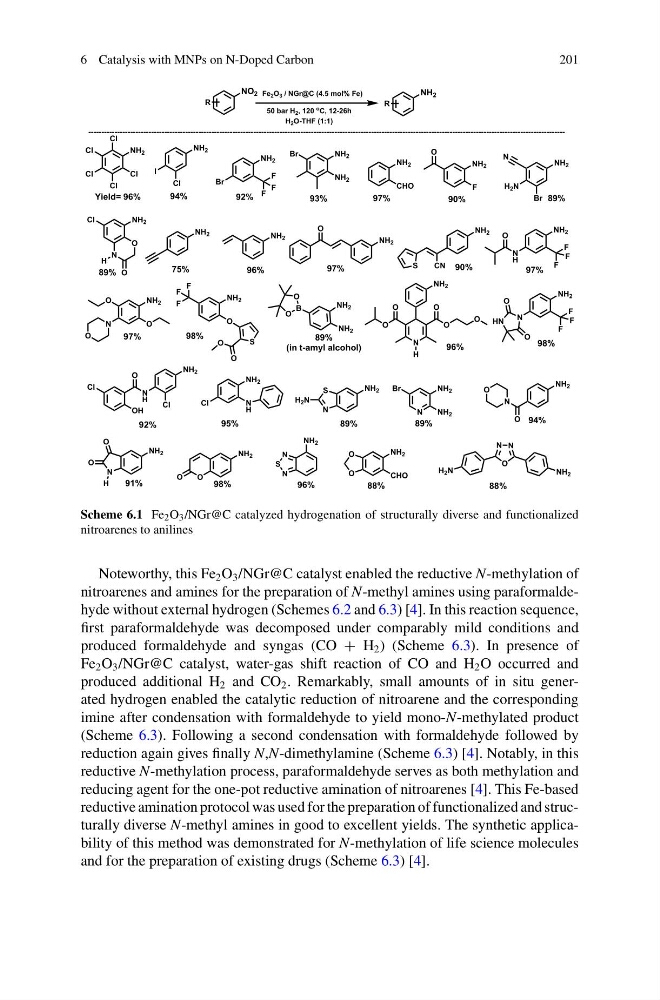
-------------------------------------------------------------------------------------------------------------------------------------------------------------------------------------Scheme 6.1 Fe 2 O 3 /NGr@C catalyzed hydrogenation of structurally diverse and functionalized
nitroarenes to anilines
Noteworthy, this Fe 2 O 3 /NGr@C catalyst enabled the reductive N-methylation of
nitroarenes and amines for the preparation of N-methyl amines using paraformaldehyde without external hydrogen (Schemes 6.2 and 6.3) [4]. In this reaction sequence,
first paraformaldehyde was decomposed under comparably mild conditions and
produced formaldehyde and syngas (CO + H 2 ) (Scheme 6.3). In presence of
Fe 2 O 3 /NGr@C catalyst, water-gas shift reaction of CO and H 2 O occurred and
produced additional H 2 and CO 2 . Remarkably, small amounts of in situ generated hydrogen enabled the catalytic reduction of nitroarene and the corresponding
imine after condensation with formaldehyde to yield mono-N-methylated product
(Scheme 6.3). Following a second condensation with formaldehyde followed by
reduction again gives finally N,N-dimethylamine (Scheme 6.3) [4]. Notably, in this
reductive N-methylation process, paraformaldehyde serves as both methylation and
reducing agent for the one-pot reductive amination of nitroarenes [4]. This Fe-based
reductive amination protocol was used for the preparation of functionalized and structurally diverse N-methyl amines in good to excellent yields. The synthetic applicability of this method was demonstrated for N-methylation of life science molecules
and for the preparation of existing drugs (Scheme 6.3) [4].
201
NO 2
NH 2
50 bar H 2 , 120
o C, 12-26h
H 2 O-THF (1:1)
R
R
Fe 2 O 3 / NGr@C (4.5 mol% Fe)
Cl
NH 2
Cl
Cl
Cl
Cl
Yield= 96%
I
Cl
NH 2
94%
NH 2
Br
92%
F
F
F
NH 2
NH 2
Br
93%
NH 2
CHO
97%
NH 2
F
O
90%
NH 2
H 2 N
N
Br 89%
N
O
O
H
NH 2
Cl
89%
NH 2
75%
NH 2
96%
O
NH 2
97%
NH 2
S
CN 90%
NH 2
N
H
O
F
F
F
97%
NH 2
N
O
O
O
97%
NH 2
O
F
F
F
S
O
O
98%
NH 2
B
O
O
NH 2
89%
(in t-amyl alcohol)
NH 2
N
H
O
O
O
O
O
96%
NH 2
N
HN
O
O
F
F
F
98%
NH 2
Cl
N
H
O
OH
Cl
92%
NH 2
Cl
N
H
95%
NH 2
S
N
H 2 N
89%
N
NH 2
NH 2
Br
89%
NH 2
N
O
O 94%
N
NH 2
O
H
91%
O
O
NH 2
O
98%
N
S
N
96%
NH 2
O
O
NH 2
CHO
88%
NH 2
N
N
O
H 2 N
88%
-------------------------------------------------------------------------------------------------------------------------------------------------------------------------------------Scheme 6.1 Fe 2 O 3 /NGr@C catalyzed hydrogenation of structurally diverse and functionalized
nitroarenes to anilines
Noteworthy, this Fe 2 O 3 /NGr@C catalyst enabled the reductive N-methylation of
nitroarenes and amines for the preparation of N-methyl amines using paraformaldehyde without external hydrogen (Schemes 6.2 and 6.3) [4]. In this reaction sequence,
first paraformaldehyde was decomposed under comparably mild conditions and
produced formaldehyde and syngas (CO + H 2 ) (Scheme 6.3). In presence of
Fe 2 O 3 /NGr@C catalyst, water-gas shift reaction of CO and H 2 O occurred and
produced additional H 2 and CO 2 . Remarkably, small amounts of in situ generated hydrogen enabled the catalytic reduction of nitroarene and the corresponding
imine after condensation with formaldehyde to yield mono-N-methylated product
(Scheme 6.3). Following a second condensation with formaldehyde followed by
reduction again gives finally N,N-dimethylamine (Scheme 6.3) [4]. Notably, in this
reductive N-methylation process, paraformaldehyde serves as both methylation and
reducing agent for the one-pot reductive amination of nitroarenes [4]. This Fe-based
reductive amination protocol was used for the preparation of functionalized and structurally diverse N-methyl amines in good to excellent yields. The synthetic applicability of this method was demonstrated for N-methylation of life science molecules
and for the preparation of existing drugs (Scheme 6.3) [4].