

1 Ligand-Free Sub-Nanometer Metal Clusters in Catalysis
7
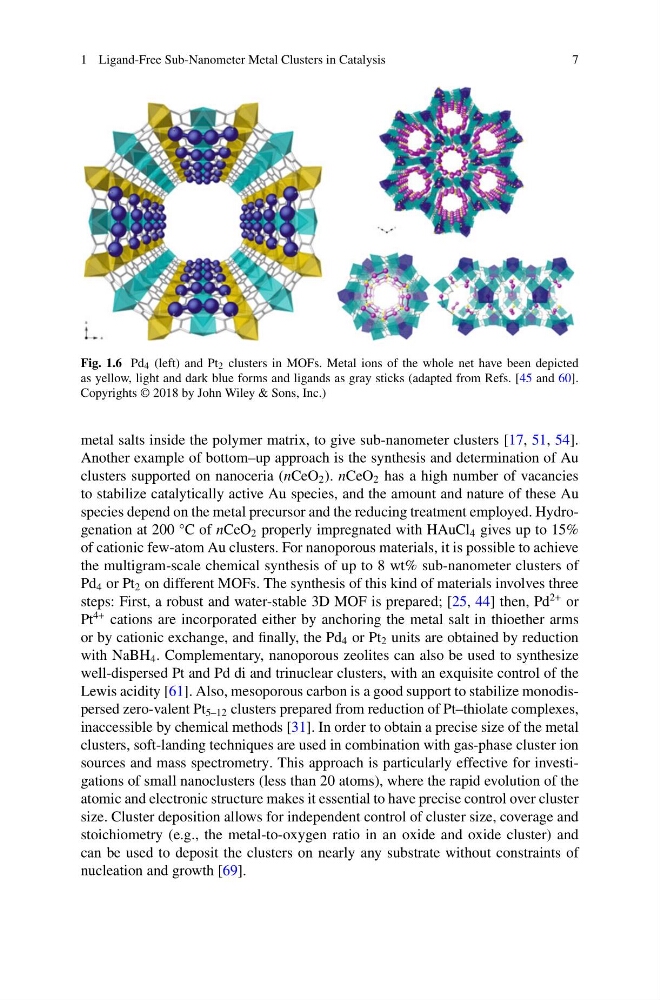
Fig. 1.6 Pd 4 (left) and Pt 2 clusters in MOFs. Metal ions of the whole net have been depicted
as yellow, light and dark blue forms and ligands as gray sticks (adapted from Refs. [45 and 60].
Copyrights © 2018 by John Wiley & Sons, Inc.)
metal salts inside the polymer matrix, to give sub-nanometer clusters [17, 51, 54].
Another example of bottom–up approach is the synthesis and determination of Au
clusters supported on nanoceria (nCeO 2 ). nCeO 2 has a high number of vacancies
to stabilize catalytically active Au species, and the amount and nature of these Au
species depend on the metal precursor and the reducing treatment employed. Hydrogenation at 200 °C of nCeO 2 properly impregnated with HAuCl 4 gives up to 15%
of cationic few-atom Au clusters. For nanoporous materials, it is possible to achieve
the multigram-scale chemical synthesis of up to 8 wt% sub-nanometer clusters of
Pd 4 or Pt 2 on different MOFs. The synthesis of this kind of materials involves three
steps: First, a robust and water-stable 3D MOF is prepared; [25, 44] then, Pd
2+ or
Pt
4+ cations are incorporated either by anchoring the metal salt in thioether arms
or by cationic exchange, and finally, the Pd 4 or Pt 2 units are obtained by reduction
with NaBH 4 . Complementary, nanoporous zeolites can also be used to synthesize
well-dispersed Pt and Pd di and trinuclear clusters, with an exquisite control of the
Lewis acidity [61]. Also, mesoporous carbon is a good support to stabilize monodispersed zero-valent Pt 5–12 clusters prepared from reduction of Pt–thiolate complexes,
inaccessible by chemical methods [31]. In order to obtain a precise size of the metal
clusters, soft-landing techniques are used in combination with gas-phase cluster ion
sources and mass spectrometry. This approach is particularly effective for investigations of small nanoclusters (less than 20 atoms), where the rapid evolution of the
atomic and electronic structure makes it essential to have precise control over cluster
size. Cluster deposition allows for independent control of cluster size, coverage and
stoichiometry (e.g., the metal-to-oxygen ratio in an oxide and oxide cluster) and
can be used to deposit the clusters on nearly any substrate without constraints of
nucleation and growth [69].
7
Fig. 1.6 Pd 4 (left) and Pt 2 clusters in MOFs. Metal ions of the whole net have been depicted
as yellow, light and dark blue forms and ligands as gray sticks (adapted from Refs. [45 and 60].
Copyrights © 2018 by John Wiley & Sons, Inc.)
metal salts inside the polymer matrix, to give sub-nanometer clusters [17, 51, 54].
Another example of bottom–up approach is the synthesis and determination of Au
clusters supported on nanoceria (nCeO 2 ). nCeO 2 has a high number of vacancies
to stabilize catalytically active Au species, and the amount and nature of these Au
species depend on the metal precursor and the reducing treatment employed. Hydrogenation at 200 °C of nCeO 2 properly impregnated with HAuCl 4 gives up to 15%
of cationic few-atom Au clusters. For nanoporous materials, it is possible to achieve
the multigram-scale chemical synthesis of up to 8 wt% sub-nanometer clusters of
Pd 4 or Pt 2 on different MOFs. The synthesis of this kind of materials involves three
steps: First, a robust and water-stable 3D MOF is prepared; [25, 44] then, Pd
2+ or
Pt
4+ cations are incorporated either by anchoring the metal salt in thioether arms
or by cationic exchange, and finally, the Pd 4 or Pt 2 units are obtained by reduction
with NaBH 4 . Complementary, nanoporous zeolites can also be used to synthesize
well-dispersed Pt and Pd di and trinuclear clusters, with an exquisite control of the
Lewis acidity [61]. Also, mesoporous carbon is a good support to stabilize monodispersed zero-valent Pt 5–12 clusters prepared from reduction of Pt–thiolate complexes,
inaccessible by chemical methods [31]. In order to obtain a precise size of the metal
clusters, soft-landing techniques are used in combination with gas-phase cluster ion
sources and mass spectrometry. This approach is particularly effective for investigations of small nanoclusters (less than 20 atoms), where the rapid evolution of the
atomic and electronic structure makes it essential to have precise control over cluster
size. Cluster deposition allows for independent control of cluster size, coverage and
stoichiometry (e.g., the metal-to-oxygen ratio in an oxide and oxide cluster) and
can be used to deposit the clusters on nearly any substrate without constraints of
nucleation and growth [69].