

6
J. Oliver–Meseguer and A. Leyva–Pérez
Au colloid
Au solution
+ HCl
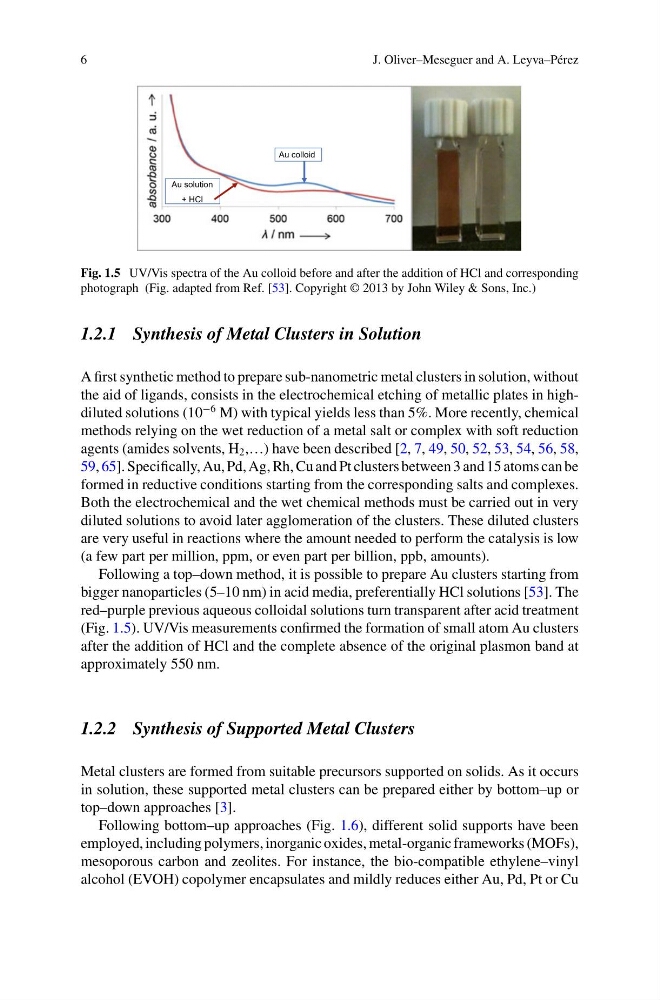
Fig. 1.5 UV/Vis spectra of the Au colloid before and after the addition of HCl and corresponding
photograph (Fig. adapted from Ref. [53]. Copyright © 2013 by John Wiley & Sons, Inc.)
1.2.1 Synthesis of Metal Clusters in Solution
A first synthetic method to prepare sub-nanometric metal clusters in solution, without
the aid of ligands, consists in the electrochemical etching of metallic plates in highdiluted solutions (10
−6 M) with typical yields less than 5%. More recently, chemical
methods relying on the wet reduction of a metal salt or complex with soft reduction
agents (amides solvents, H 2 ,…) have been described [2, 7, 49, 50, 52, 53, 54, 56, 58,
59, 65]. Specifically, Au, Pd, Ag, Rh, Cu and Pt clusters between 3 and 15 atoms can be
formed in reductive conditions starting from the corresponding salts and complexes.
Both the electrochemical and the wet chemical methods must be carried out in very
diluted solutions to avoid later agglomeration of the clusters. These diluted clusters
are very useful in reactions where the amount needed to perform the catalysis is low
(a few part per million, ppm, or even part per billion, ppb, amounts).
Following a top–down method, it is possible to prepare Au clusters starting from
bigger nanoparticles (5–10 nm) in acid media, preferentially HCl solutions [53]. The
red–purple previous aqueous colloidal solutions turn transparent after acid treatment
(Fig. 1.5). UV/Vis measurements confirmed the formation of small atom Au clusters
after the addition of HCl and the complete absence of the original plasmon band at
approximately 550 nm.
1.2.2 Synthesis of Supported Metal Clusters
Metal clusters are formed from suitable precursors supported on solids. As it occurs
in solution, these supported metal clusters can be prepared either by bottom–up or
top–down approaches [3].
Following bottom–up approaches (Fig. 1.6), different solid supports have been
employed, including polymers, inorganic oxides, metal-organic frameworks (MOFs),
mesoporous carbon and zeolites. For instance, the bio-compatible ethylene–vinyl
alcohol (EVOH) copolymer encapsulates and mildly reduces either Au, Pd, Pt or Cu
J. Oliver–Meseguer and A. Leyva–Pérez
Au colloid
Au solution
+ HCl
Fig. 1.5 UV/Vis spectra of the Au colloid before and after the addition of HCl and corresponding
photograph (Fig. adapted from Ref. [53]. Copyright © 2013 by John Wiley & Sons, Inc.)
1.2.1 Synthesis of Metal Clusters in Solution
A first synthetic method to prepare sub-nanometric metal clusters in solution, without
the aid of ligands, consists in the electrochemical etching of metallic plates in highdiluted solutions (10
−6 M) with typical yields less than 5%. More recently, chemical
methods relying on the wet reduction of a metal salt or complex with soft reduction
agents (amides solvents, H 2 ,…) have been described [2, 7, 49, 50, 52, 53, 54, 56, 58,
59, 65]. Specifically, Au, Pd, Ag, Rh, Cu and Pt clusters between 3 and 15 atoms can be
formed in reductive conditions starting from the corresponding salts and complexes.
Both the electrochemical and the wet chemical methods must be carried out in very
diluted solutions to avoid later agglomeration of the clusters. These diluted clusters
are very useful in reactions where the amount needed to perform the catalysis is low
(a few part per million, ppm, or even part per billion, ppb, amounts).
Following a top–down method, it is possible to prepare Au clusters starting from
bigger nanoparticles (5–10 nm) in acid media, preferentially HCl solutions [53]. The
red–purple previous aqueous colloidal solutions turn transparent after acid treatment
(Fig. 1.5). UV/Vis measurements confirmed the formation of small atom Au clusters
after the addition of HCl and the complete absence of the original plasmon band at
approximately 550 nm.
1.2.2 Synthesis of Supported Metal Clusters
Metal clusters are formed from suitable precursors supported on solids. As it occurs
in solution, these supported metal clusters can be prepared either by bottom–up or
top–down approaches [3].
Following bottom–up approaches (Fig. 1.6), different solid supports have been
employed, including polymers, inorganic oxides, metal-organic frameworks (MOFs),
mesoporous carbon and zeolites. For instance, the bio-compatible ethylene–vinyl
alcohol (EVOH) copolymer encapsulates and mildly reduces either Au, Pd, Pt or Cu