

178
Y. Min et al.
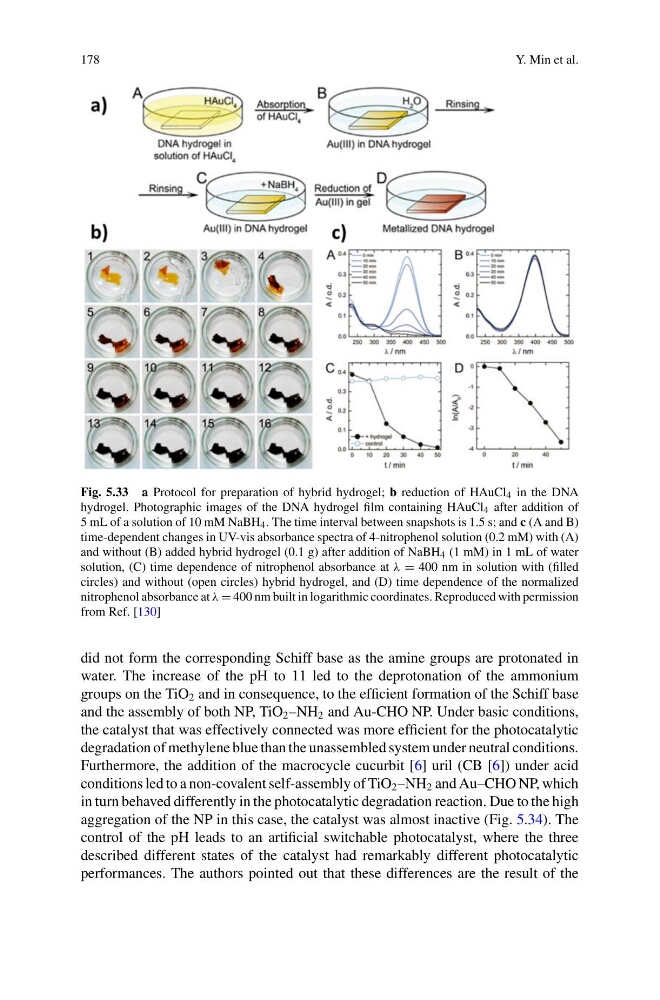
Fig. 5.33 a Protocol for preparation of hybrid hydrogel; b reduction of HAuCl 4 in the DNA
hydrogel. Photographic images of the DNA hydrogel film containing HAuCl 4 after addition of
5 mL of a solution of 10 mM NaBH 4 . The time interval between snapshots is 1.5 s; and c (A and B)
time-dependent changes in UV-vis absorbance spectra of 4-nitrophenol solution (0.2 mM) with (A)
and without (B) added hybrid hydrogel (0.1 g) after addition of NaBH 4 (1 mM) in 1 mL of water
solution, (C) time dependence of nitrophenol absorbance at λ = 400 nm in solution with (filled
circles) and without (open circles) hybrid hydrogel, and (D) time dependence of the normalized
nitrophenol absorbance at λ = 400 nm built in logarithmic coordinates. Reproduced with permission
from Ref. [130]
did not form the corresponding Schiff base as the amine groups are protonated in
water. The increase of the pH to 11 led to the deprotonation of the ammonium
groups on the TiO 2 and in consequence, to the efficient formation of the Schiff base
and the assembly of both NP, TiO 2 –NH 2 and Au-CHO NP. Under basic conditions,
the catalyst that was effectively connected was more efficient for the photocatalytic
degradation of methylene blue than the unassembled system under neutral conditions.
Furthermore, the addition of the macrocycle cucurbit [6] uril (CB [6]) under acid
conditions led to a non-covalent self-assembly of TiO 2 –NH 2 and Au–CHO NP, which
in turn behaved differently in the photocatalytic degradation reaction. Due to the high
aggregation of the NP in this case, the catalyst was almost inactive (Fig. 5.34). The
control of the pH leads to an artificial switchable photocatalyst, where the three
described different states of the catalyst had remarkably different photocatalytic
performances. The authors pointed out that these differences are the result of the
Y. Min et al.
Fig. 5.33 a Protocol for preparation of hybrid hydrogel; b reduction of HAuCl 4 in the DNA
hydrogel. Photographic images of the DNA hydrogel film containing HAuCl 4 after addition of
5 mL of a solution of 10 mM NaBH 4 . The time interval between snapshots is 1.5 s; and c (A and B)
time-dependent changes in UV-vis absorbance spectra of 4-nitrophenol solution (0.2 mM) with (A)
and without (B) added hybrid hydrogel (0.1 g) after addition of NaBH 4 (1 mM) in 1 mL of water
solution, (C) time dependence of nitrophenol absorbance at λ = 400 nm in solution with (filled
circles) and without (open circles) hybrid hydrogel, and (D) time dependence of the normalized
nitrophenol absorbance at λ = 400 nm built in logarithmic coordinates. Reproduced with permission
from Ref. [130]
did not form the corresponding Schiff base as the amine groups are protonated in
water. The increase of the pH to 11 led to the deprotonation of the ammonium
groups on the TiO 2 and in consequence, to the efficient formation of the Schiff base
and the assembly of both NP, TiO 2 –NH 2 and Au-CHO NP. Under basic conditions,
the catalyst that was effectively connected was more efficient for the photocatalytic
degradation of methylene blue than the unassembled system under neutral conditions.
Furthermore, the addition of the macrocycle cucurbit [6] uril (CB [6]) under acid
conditions led to a non-covalent self-assembly of TiO 2 –NH 2 and Au–CHO NP, which
in turn behaved differently in the photocatalytic degradation reaction. Due to the high
aggregation of the NP in this case, the catalyst was almost inactive (Fig. 5.34). The
control of the pH leads to an artificial switchable photocatalyst, where the three
described different states of the catalyst had remarkably different photocatalytic
performances. The authors pointed out that these differences are the result of the