

5 Covalent Assemblies of Metal Nanoparticles—Strategies …
177
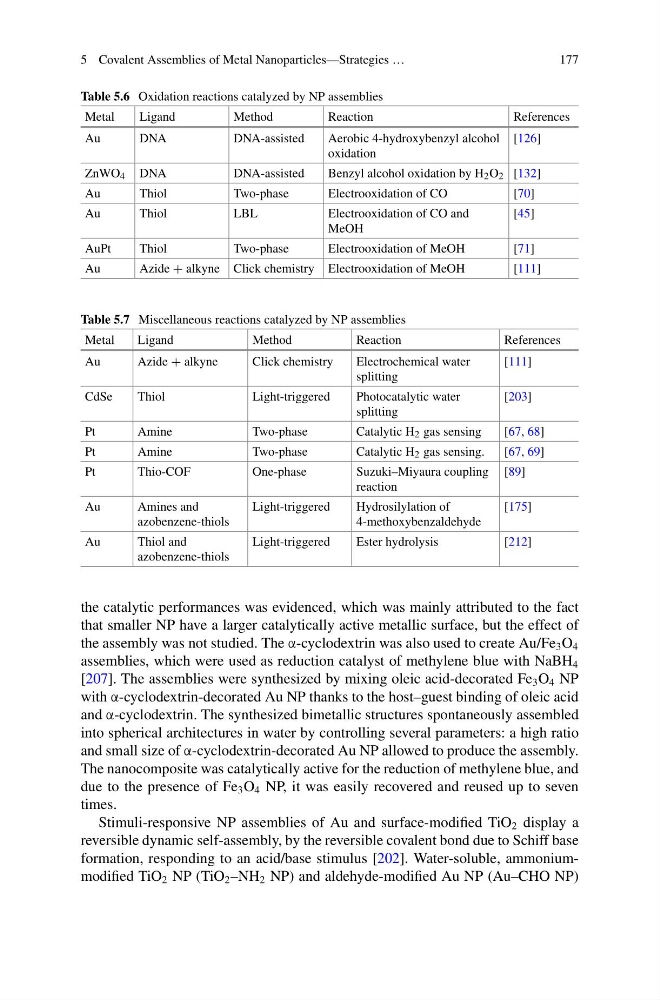
Table 5.6 Oxidation reactions catalyzed by NP assemblies
Metal
Ligand
Method
Reaction
References
Au
DNA
DNA-assisted
Aerobic 4-hydroxybenzyl alcohol
oxidation
[126]
ZnWO 4 DNA
DNA-assisted
Benzyl alcohol oxidation by H 2 O 2 [132]
Au
Thiol
Two-phase
Electrooxidation of CO
[70]
Au
Thiol
LBL
Electrooxidation of CO and
MeOH
[45]
AuPt
Thiol
Two-phase
Electrooxidation of MeOH
[71]
Au
Azide + alkyne Click chemistry Electrooxidation of MeOH
[111]
Table 5.7 Miscellaneous reactions catalyzed by NP assemblies
Metal
Ligand
Method
Reaction
References
Au
Azide + alkyne
Click chemistry
Electrochemical water
splitting
[111]
CdSe
Thiol
Light-triggered
Photocatalytic water
splitting
[203]
Pt
Amine
Two-phase
Catalytic H 2 gas sensing
[67, 68]
Pt
Amine
Two-phase
Catalytic H 2 gas sensing.
[67, 69]
Pt
Thio-COF
One-phase
Suzuki–Miyaura coupling
reaction
[89]
Au
Amines and
azobenzene-thiols
Light-triggered
Hydrosilylation of
4-methoxybenzaldehyde
[175]
Au
Thiol and
azobenzene-thiols
Light-triggered
Ester hydrolysis
[212]
the catalytic performances was evidenced, which was mainly attributed to the fact
that smaller NP have a larger catalytically active metallic surface, but the effect of
the assembly was not studied. The α-cyclodextrin was also used to create Au/Fe 3 O 4
assemblies, which were used as reduction catalyst of methylene blue with NaBH 4
[207]. The assemblies were synthesized by mixing oleic acid-decorated Fe 3 O 4 NP
with α-cyclodextrin-decorated Au NP thanks to the host–guest binding of oleic acid
and α-cyclodextrin. The synthesized bimetallic structures spontaneously assembled
into spherical architectures in water by controlling several parameters: a high ratio
and small size of α-cyclodextrin-decorated Au NP allowed to produce the assembly.
The nanocomposite was catalytically active for the reduction of methylene blue, and
due to the presence of Fe 3 O 4 NP, it was easily recovered and reused up to seven
times.
Stimuli-responsive NP assemblies of Au and surface-modified TiO 2 display a
reversible dynamic self-assembly, by the reversible covalent bond due to Schiff base
formation, responding to an acid/base stimulus [202]. Water-soluble, ammoniummodified TiO 2 NP (TiO 2 –NH 2 NP) and aldehyde-modified Au NP (Au–CHO NP)
177
Table 5.6 Oxidation reactions catalyzed by NP assemblies
Metal
Ligand
Method
Reaction
References
Au
DNA
DNA-assisted
Aerobic 4-hydroxybenzyl alcohol
oxidation
[126]
ZnWO 4 DNA
DNA-assisted
Benzyl alcohol oxidation by H 2 O 2 [132]
Au
Thiol
Two-phase
Electrooxidation of CO
[70]
Au
Thiol
LBL
Electrooxidation of CO and
MeOH
[45]
AuPt
Thiol
Two-phase
Electrooxidation of MeOH
[71]
Au
Azide + alkyne Click chemistry Electrooxidation of MeOH
[111]
Table 5.7 Miscellaneous reactions catalyzed by NP assemblies
Metal
Ligand
Method
Reaction
References
Au
Azide + alkyne
Click chemistry
Electrochemical water
splitting
[111]
CdSe
Thiol
Light-triggered
Photocatalytic water
splitting
[203]
Pt
Amine
Two-phase
Catalytic H 2 gas sensing
[67, 68]
Pt
Amine
Two-phase
Catalytic H 2 gas sensing.
[67, 69]
Pt
Thio-COF
One-phase
Suzuki–Miyaura coupling
reaction
[89]
Au
Amines and
azobenzene-thiols
Light-triggered
Hydrosilylation of
4-methoxybenzaldehyde
[175]
Au
Thiol and
azobenzene-thiols
Light-triggered
Ester hydrolysis
[212]
the catalytic performances was evidenced, which was mainly attributed to the fact
that smaller NP have a larger catalytically active metallic surface, but the effect of
the assembly was not studied. The α-cyclodextrin was also used to create Au/Fe 3 O 4
assemblies, which were used as reduction catalyst of methylene blue with NaBH 4
[207]. The assemblies were synthesized by mixing oleic acid-decorated Fe 3 O 4 NP
with α-cyclodextrin-decorated Au NP thanks to the host–guest binding of oleic acid
and α-cyclodextrin. The synthesized bimetallic structures spontaneously assembled
into spherical architectures in water by controlling several parameters: a high ratio
and small size of α-cyclodextrin-decorated Au NP allowed to produce the assembly.
The nanocomposite was catalytically active for the reduction of methylene blue, and
due to the presence of Fe 3 O 4 NP, it was easily recovered and reused up to seven
times.
Stimuli-responsive NP assemblies of Au and surface-modified TiO 2 display a
reversible dynamic self-assembly, by the reversible covalent bond due to Schiff base
formation, responding to an acid/base stimulus [202]. Water-soluble, ammoniummodified TiO 2 NP (TiO 2 –NH 2 NP) and aldehyde-modified Au NP (Au–CHO NP)