

170
Y. Min et al.
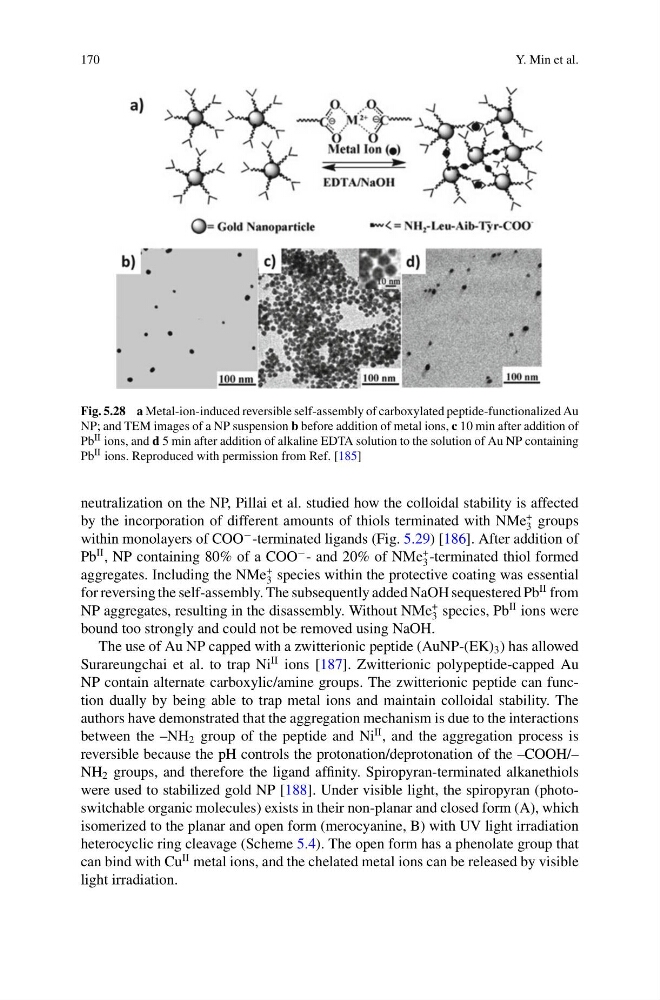
Fig. 5.28 a Metal-ion-induced reversible self-assembly of carboxylated peptide-functionalized Au
NP; and TEM images of a NP suspension b before addition of metal ions, c 10 min after addition of
Pb II ions, and d 5 min after addition of alkaline EDTA solution to the solution of Au NP containing
Pb II ions. Reproduced with permission from Ref. [185]
neutralization on the NP, Pillai et al. studied how the colloidal stability is affected
by the incorporation of different amounts of thiols terminated with NMe
+
3 groups
within monolayers of COO
− -terminated ligands (Fig. 5.29) [186]. After addition of
Pb
II , NP containing 80% of a COO
− - and 20% of NMe
+
3 -terminated thiol formed
aggregates. Including the NMe
+
3 species within the protective coating was essential
for reversing the self-assembly. The subsequently added NaOH sequestered Pb
II from
NP aggregates, resulting in the disassembly. Without NMe
+
3 species, Pb
II ions were
bound too strongly and could not be removed using NaOH.
The use of Au NP capped with a zwitterionic peptide (AuNP-(EK) 3 ) has allowed
Surareungchai et al. to trap Ni
II ions [187]. Zwitterionic polypeptide-capped Au
NP contain alternate carboxylic/amine groups. The zwitterionic peptide can function dually by being able to trap metal ions and maintain colloidal stability. The
authors have demonstrated that the aggregation mechanism is due to the interactions
between the –NH 2 group of the peptide and Ni
II , and the aggregation process is
reversible because the pH controls the protonation/deprotonation of the –COOH/–
NH 2 groups, and therefore the ligand affinity. Spiropyran-terminated alkanethiols
were used to stabilized gold NP [188]. Under visible light, the spiropyran (photoswitchable organic molecules) exists in their non-planar and closed form (A), which
isomerized to the planar and open form (merocyanine, B) with UV light irradiation
heterocyclic ring cleavage (Scheme 5.4). The open form has a phenolate group that
can bind with Cu
II metal ions, and the chelated metal ions can be released by visible
light irradiation.
Y. Min et al.
Fig. 5.28 a Metal-ion-induced reversible self-assembly of carboxylated peptide-functionalized Au
NP; and TEM images of a NP suspension b before addition of metal ions, c 10 min after addition of
Pb II ions, and d 5 min after addition of alkaline EDTA solution to the solution of Au NP containing
Pb II ions. Reproduced with permission from Ref. [185]
neutralization on the NP, Pillai et al. studied how the colloidal stability is affected
by the incorporation of different amounts of thiols terminated with NMe
+
3 groups
within monolayers of COO
− -terminated ligands (Fig. 5.29) [186]. After addition of
Pb
II , NP containing 80% of a COO
− - and 20% of NMe
+
3 -terminated thiol formed
aggregates. Including the NMe
+
3 species within the protective coating was essential
for reversing the self-assembly. The subsequently added NaOH sequestered Pb
II from
NP aggregates, resulting in the disassembly. Without NMe
+
3 species, Pb
II ions were
bound too strongly and could not be removed using NaOH.
The use of Au NP capped with a zwitterionic peptide (AuNP-(EK) 3 ) has allowed
Surareungchai et al. to trap Ni
II ions [187]. Zwitterionic polypeptide-capped Au
NP contain alternate carboxylic/amine groups. The zwitterionic peptide can function dually by being able to trap metal ions and maintain colloidal stability. The
authors have demonstrated that the aggregation mechanism is due to the interactions
between the –NH 2 group of the peptide and Ni
II , and the aggregation process is
reversible because the pH controls the protonation/deprotonation of the –COOH/–
NH 2 groups, and therefore the ligand affinity. Spiropyran-terminated alkanethiols
were used to stabilized gold NP [188]. Under visible light, the spiropyran (photoswitchable organic molecules) exists in their non-planar and closed form (A), which
isomerized to the planar and open form (merocyanine, B) with UV light irradiation
heterocyclic ring cleavage (Scheme 5.4). The open form has a phenolate group that
can bind with Cu
II metal ions, and the chelated metal ions can be released by visible
light irradiation.