

5 Covalent Assemblies of Metal Nanoparticles—Strategies …
167
5.2.3.1 Dynamic Covalent Chemistry
Dynamic covalent chemistry usually relates to chemical reactions carried out
reversibly under conditions of equilibrium control, which are employed by chemists
to make complex supramolecular assemblies from discrete molecular building blocks
[180].
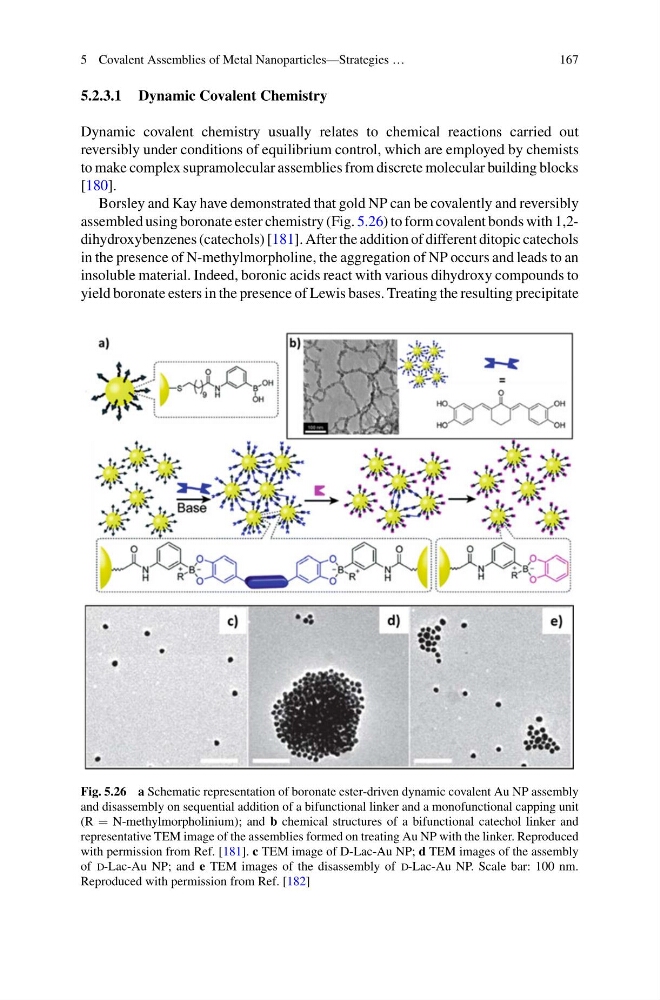
Borsley and Kay have demonstrated that gold NP can be covalently and reversibly
assembled using boronate ester chemistry (Fig. 5.26) to form covalent bonds with 1,2dihydroxybenzenes (catechols) [181]. After the addition of different ditopic catechols
in the presence of N-methylmorpholine, the aggregation of NP occurs and leads to an
insoluble material. Indeed, boronic acids react with various dihydroxy compounds to
yield boronate esters in the presence of Lewis bases. Treating the resulting precipitate
Fig. 5.26 a Schematic representation of boronate ester-driven dynamic covalent Au NP assembly
and disassembly on sequential addition of a bifunctional linker and a monofunctional capping unit
(R = N-methylmorpholinium); and b chemical structures of a bifunctional catechol linker and
representative TEM image of the assemblies formed on treating Au NP with the linker. Reproduced
with permission from Ref. [181]. c TEM image of D-Lac-Au NP; d TEM images of the assembly
of d-Lac-Au NP; and e TEM images of the disassembly of d-Lac-Au NP. Scale bar: 100 nm.
Reproduced with permission from Ref. [182]
167
5.2.3.1 Dynamic Covalent Chemistry
Dynamic covalent chemistry usually relates to chemical reactions carried out
reversibly under conditions of equilibrium control, which are employed by chemists
to make complex supramolecular assemblies from discrete molecular building blocks
[180].
Borsley and Kay have demonstrated that gold NP can be covalently and reversibly
assembled using boronate ester chemistry (Fig. 5.26) to form covalent bonds with 1,2dihydroxybenzenes (catechols) [181]. After the addition of different ditopic catechols
in the presence of N-methylmorpholine, the aggregation of NP occurs and leads to an
insoluble material. Indeed, boronic acids react with various dihydroxy compounds to
yield boronate esters in the presence of Lewis bases. Treating the resulting precipitate
Fig. 5.26 a Schematic representation of boronate ester-driven dynamic covalent Au NP assembly
and disassembly on sequential addition of a bifunctional linker and a monofunctional capping unit
(R = N-methylmorpholinium); and b chemical structures of a bifunctional catechol linker and
representative TEM image of the assemblies formed on treating Au NP with the linker. Reproduced
with permission from Ref. [181]. c TEM image of D-Lac-Au NP; d TEM images of the assembly
of d-Lac-Au NP; and e TEM images of the disassembly of d-Lac-Au NP. Scale bar: 100 nm.
Reproduced with permission from Ref. [182]