

166
Y. Min et al.
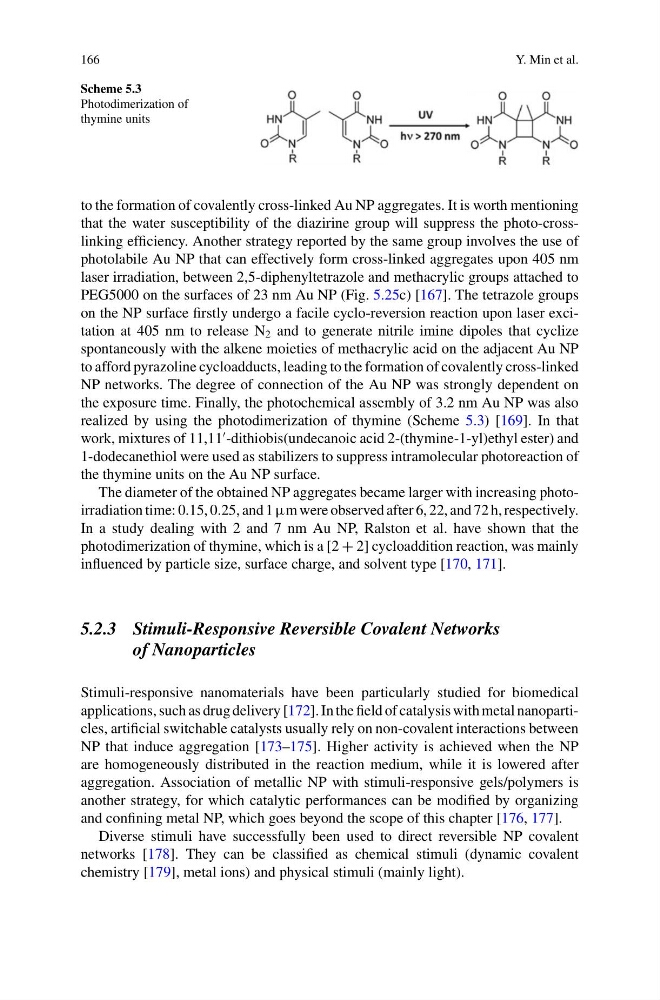
Scheme 5.3
Photodimerization of
thymine units
to the formation of covalently cross-linked Au NP aggregates. It is worth mentioning
that the water susceptibility of the diazirine group will suppress the photo-crosslinking efficiency. Another strategy reported by the same group involves the use of
photolabile Au NP that can effectively form cross-linked aggregates upon 405 nm
laser irradiation, between 2,5-diphenyltetrazole and methacrylic groups attached to
PEG5000 on the surfaces of 23 nm Au NP (Fig. 5.25c) [167]. The tetrazole groups
on the NP surface firstly undergo a facile cyclo-reversion reaction upon laser excitation at 405 nm to release N 2 and to generate nitrile imine dipoles that cyclize
spontaneously with the alkene moieties of methacrylic acid on the adjacent Au NP
to afford pyrazoline cycloadducts, leading to the formation of covalently cross-linked
NP networks. The degree of connection of the Au NP was strongly dependent on
the exposure time. Finally, the photochemical assembly of 3.2 nm Au NP was also
realized by using the photodimerization of thymine (Scheme 5.3) [169]. In that
work, mixtures of 11,11
-dithiobis(undecanoic acid 2-(thymine-1-yl)ethyl ester) and
1-dodecanethiol were used as stabilizers to suppress intramolecular photoreaction of
the thymine units on the Au NP surface.
The diameter of the obtained NP aggregates became larger with increasing photoirradiation time: 0.15, 0.25, and 1 μm were observed after 6, 22, and 72 h, respectively.
In a study dealing with 2 and 7 nm Au NP, Ralston et al. have shown that the
photodimerization of thymine, which is a [2 + 2] cycloaddition reaction, was mainly
influenced by particle size, surface charge, and solvent type [170, 171].
5.2.3 Stimuli-Responsive Reversible Covalent Networks
of Nanoparticles
Stimuli-responsive nanomaterials have been particularly studied for biomedical
applications, such as drug delivery [172]. In the field of catalysis with metal nanoparticles, artificial switchable catalysts usually rely on non-covalent interactions between
NP that induce aggregation [173–175]. Higher activity is achieved when the NP
are homogeneously distributed in the reaction medium, while it is lowered after
aggregation. Association of metallic NP with stimuli-responsive gels/polymers is
another strategy, for which catalytic performances can be modified by organizing
and confining metal NP, which goes beyond the scope of this chapter [176, 177].
Diverse stimuli have successfully been used to direct reversible NP covalent
networks [178]. They can be classified as chemical stimuli (dynamic covalent
chemistry [179], metal ions) and physical stimuli (mainly light).
Y. Min et al.
Scheme 5.3
Photodimerization of
thymine units
to the formation of covalently cross-linked Au NP aggregates. It is worth mentioning
that the water susceptibility of the diazirine group will suppress the photo-crosslinking efficiency. Another strategy reported by the same group involves the use of
photolabile Au NP that can effectively form cross-linked aggregates upon 405 nm
laser irradiation, between 2,5-diphenyltetrazole and methacrylic groups attached to
PEG5000 on the surfaces of 23 nm Au NP (Fig. 5.25c) [167]. The tetrazole groups
on the NP surface firstly undergo a facile cyclo-reversion reaction upon laser excitation at 405 nm to release N 2 and to generate nitrile imine dipoles that cyclize
spontaneously with the alkene moieties of methacrylic acid on the adjacent Au NP
to afford pyrazoline cycloadducts, leading to the formation of covalently cross-linked
NP networks. The degree of connection of the Au NP was strongly dependent on
the exposure time. Finally, the photochemical assembly of 3.2 nm Au NP was also
realized by using the photodimerization of thymine (Scheme 5.3) [169]. In that
work, mixtures of 11,11
-dithiobis(undecanoic acid 2-(thymine-1-yl)ethyl ester) and
1-dodecanethiol were used as stabilizers to suppress intramolecular photoreaction of
the thymine units on the Au NP surface.
The diameter of the obtained NP aggregates became larger with increasing photoirradiation time: 0.15, 0.25, and 1 μm were observed after 6, 22, and 72 h, respectively.
In a study dealing with 2 and 7 nm Au NP, Ralston et al. have shown that the
photodimerization of thymine, which is a [2 + 2] cycloaddition reaction, was mainly
influenced by particle size, surface charge, and solvent type [170, 171].
5.2.3 Stimuli-Responsive Reversible Covalent Networks
of Nanoparticles
Stimuli-responsive nanomaterials have been particularly studied for biomedical
applications, such as drug delivery [172]. In the field of catalysis with metal nanoparticles, artificial switchable catalysts usually rely on non-covalent interactions between
NP that induce aggregation [173–175]. Higher activity is achieved when the NP
are homogeneously distributed in the reaction medium, while it is lowered after
aggregation. Association of metallic NP with stimuli-responsive gels/polymers is
another strategy, for which catalytic performances can be modified by organizing
and confining metal NP, which goes beyond the scope of this chapter [176, 177].
Diverse stimuli have successfully been used to direct reversible NP covalent
networks [178]. They can be classified as chemical stimuli (dynamic covalent
chemistry [179], metal ions) and physical stimuli (mainly light).