

5 Covalent Assemblies of Metal Nanoparticles—Strategies …
161
organization of Au NP has also been reported by wrapping them in flower-shaped
DNA origami structures [143].
5.2.2.4 Metal-Ion-Induced Nanoparticle Assembly
Modification of NP with metal coordination compounds [144, 145] offers the possibility of their assembly on surfaces [146], but also to create metal NP networks with
coordination bonds connecting the NP. This strategy has been mainly employed for
the development of plasmon-based colorimetric sensors for ultrasensitive molecular
diagnostics [147]. The technique is based on controlled aggregation of NP in the
presence of metal ions. Aggregation of metal NP in the presence of analyte ions
changes the color of the NP solution. Covalent assemblies have been built with
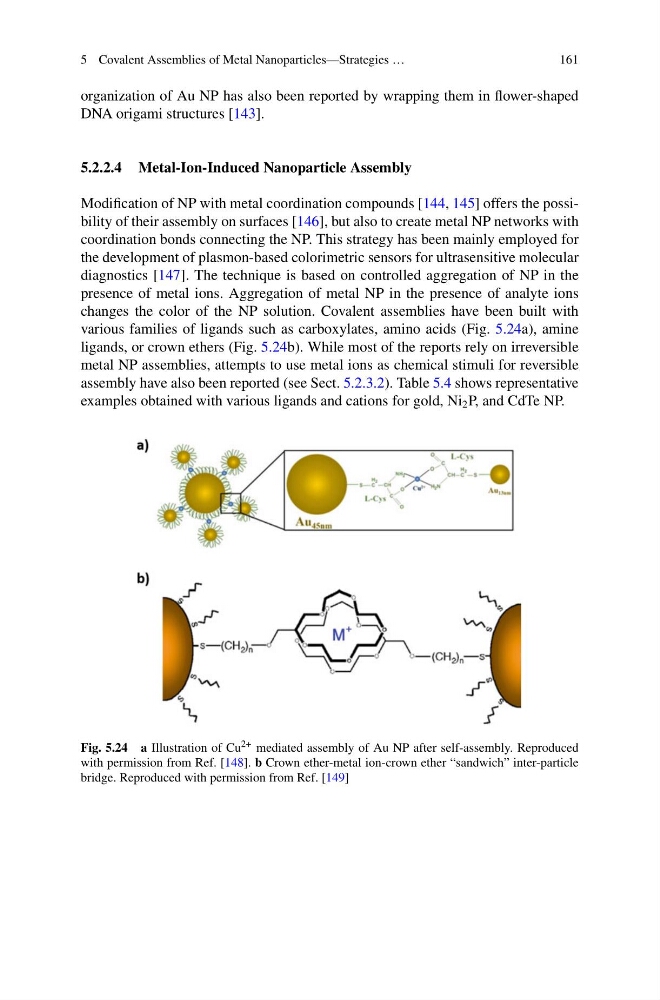
various families of ligands such as carboxylates, amino acids (Fig. 5.24a), amine
ligands, or crown ethers (Fig. 5.24b). While most of the reports rely on irreversible
metal NP assemblies, attempts to use metal ions as chemical stimuli for reversible
assembly have also been reported (see Sect. 5.2.3.2). Table 5.4 shows representative
examples obtained with various ligands and cations for gold, Ni 2 P, and CdTe NP.
Fig. 5.24 a Illustration of Cu 2+ mediated assembly of Au NP after self-assembly. Reproduced
with permission from Ref. [148]. b Crown ether-metal ion-crown ether “sandwich” inter-particle
bridge. Reproduced with permission from Ref. [149]
161
organization of Au NP has also been reported by wrapping them in flower-shaped
DNA origami structures [143].
5.2.2.4 Metal-Ion-Induced Nanoparticle Assembly
Modification of NP with metal coordination compounds [144, 145] offers the possibility of their assembly on surfaces [146], but also to create metal NP networks with
coordination bonds connecting the NP. This strategy has been mainly employed for
the development of plasmon-based colorimetric sensors for ultrasensitive molecular
diagnostics [147]. The technique is based on controlled aggregation of NP in the
presence of metal ions. Aggregation of metal NP in the presence of analyte ions
changes the color of the NP solution. Covalent assemblies have been built with
various families of ligands such as carboxylates, amino acids (Fig. 5.24a), amine
ligands, or crown ethers (Fig. 5.24b). While most of the reports rely on irreversible
metal NP assemblies, attempts to use metal ions as chemical stimuli for reversible
assembly have also been reported (see Sect. 5.2.3.2). Table 5.4 shows representative
examples obtained with various ligands and cations for gold, Ni 2 P, and CdTe NP.
Fig. 5.24 a Illustration of Cu 2+ mediated assembly of Au NP after self-assembly. Reproduced
with permission from Ref. [148]. b Crown ether-metal ion-crown ether “sandwich” inter-particle
bridge. Reproduced with permission from Ref. [149]