

5 Covalent Assemblies of Metal Nanoparticles—Strategies …
141
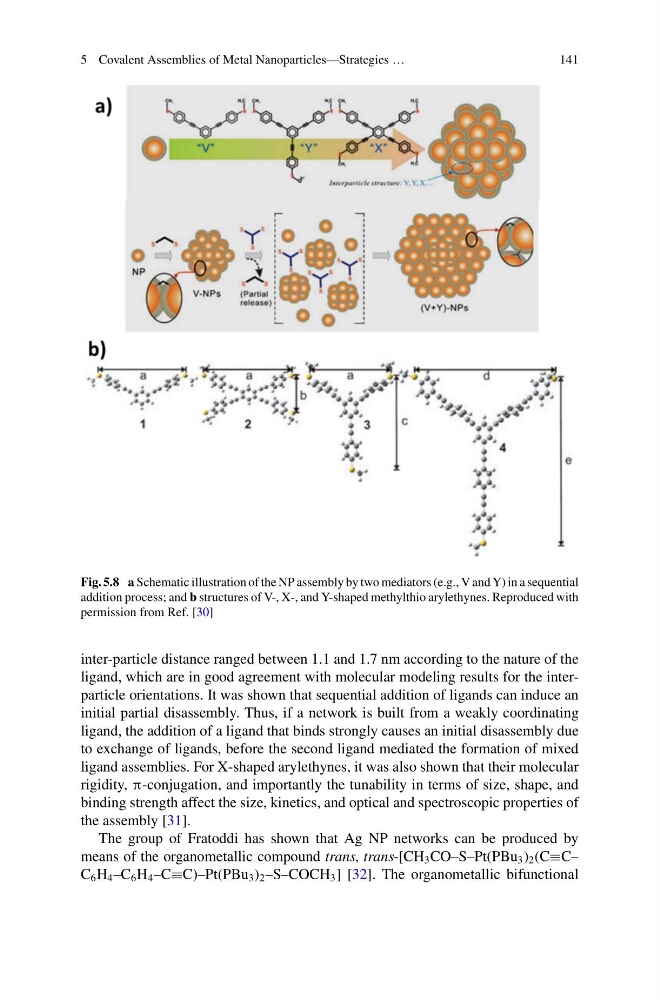
Fig. 5.8 a Schematic illustration of the NP assembly by two mediators (e.g., V and Y) in a sequential
addition process; and b structures of V-, X-, and Y-shaped methylthio arylethynes. Reproduced with
permission from Ref. [30]
inter-particle distance ranged between 1.1 and 1.7 nm according to the nature of the
ligand, which are in good agreement with molecular modeling results for the interparticle orientations. It was shown that sequential addition of ligands can induce an
initial partial disassembly. Thus, if a network is built from a weakly coordinating
ligand, the addition of a ligand that binds strongly causes an initial disassembly due
to exchange of ligands, before the second ligand mediated the formation of mixed
ligand assemblies. For X-shaped arylethynes, it was also shown that their molecular
rigidity, π-conjugation, and importantly the tunability in terms of size, shape, and
binding strength affect the size, kinetics, and optical and spectroscopic properties of
the assembly [31].
The group of Fratoddi has shown that Ag NP networks can be produced by
means of the organometallic compound trans, trans-[CH 3 CO–S–Pt(PBu 3 ) 2 (C≡C–
C 6 H 4 –C 6 H 4 –C≡C)–Pt(PBu 3 ) 2 –S–COCH 3 ] [32]. The organometallic bifunctional
141
Fig. 5.8 a Schematic illustration of the NP assembly by two mediators (e.g., V and Y) in a sequential
addition process; and b structures of V-, X-, and Y-shaped methylthio arylethynes. Reproduced with
permission from Ref. [30]
inter-particle distance ranged between 1.1 and 1.7 nm according to the nature of the
ligand, which are in good agreement with molecular modeling results for the interparticle orientations. It was shown that sequential addition of ligands can induce an
initial partial disassembly. Thus, if a network is built from a weakly coordinating
ligand, the addition of a ligand that binds strongly causes an initial disassembly due
to exchange of ligands, before the second ligand mediated the formation of mixed
ligand assemblies. For X-shaped arylethynes, it was also shown that their molecular
rigidity, π-conjugation, and importantly the tunability in terms of size, shape, and
binding strength affect the size, kinetics, and optical and spectroscopic properties of
the assembly [31].
The group of Fratoddi has shown that Ag NP networks can be produced by
means of the organometallic compound trans, trans-[CH 3 CO–S–Pt(PBu 3 ) 2 (C≡C–
C 6 H 4 –C 6 H 4 –C≡C)–Pt(PBu 3 ) 2 –S–COCH 3 ] [32]. The organometallic bifunctional