

140
Y. Min et al.
structures of the 3-D networks were characterized by small-angle X-ray scattering
(SAXS), dynamic light scattering (DLS), and UV-vis extinction spectroscopy. These
analyses have revealed that a large fraction of Au NP network can only be obtained
when the number of styrene units between two anchoring sites in RAFT oligomers
is below a crucial threshold, which is probably due to the formation of loops that
may sterically impede cross-linking with different NP. Their work provided useful
information to build self-assembled NP networks with respect to the degrees of
polymerization of polymers. It was also shown in the case of hyperbranched polymerAu NP assemblies that the degree of branching of the linker polymer, in addition
to the concentration and number of anchoring groups, has a strong influence on the
self-assembly process [62].
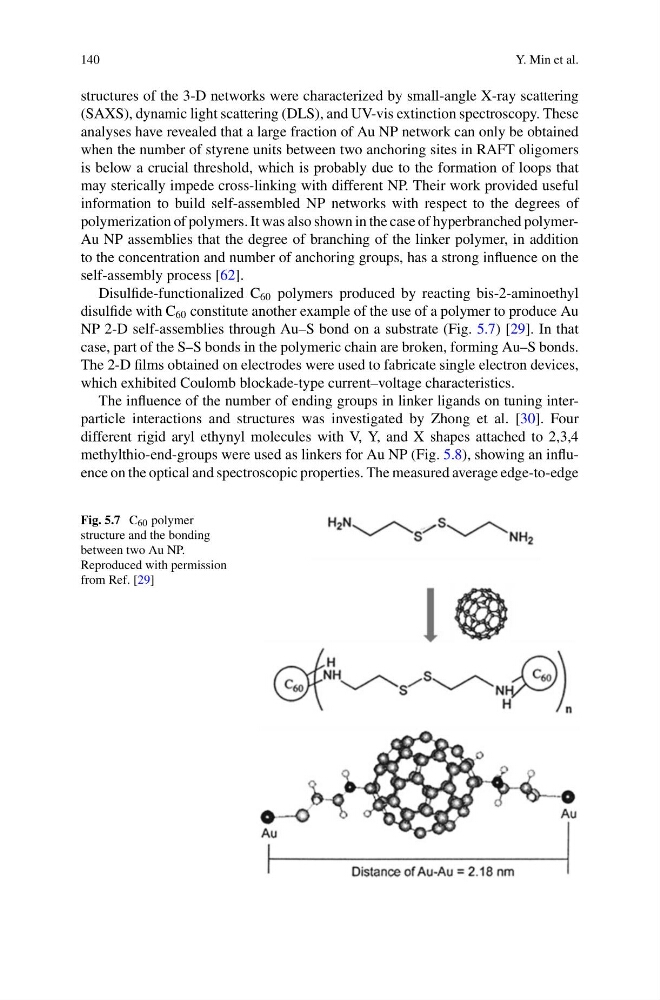
Disulfide-functionalized C 60 polymers produced by reacting bis-2-aminoethyl
disulfide with C 60 constitute another example of the use of a polymer to produce Au
NP 2-D self-assemblies through Au–S bond on a substrate (Fig. 5.7) [29]. In that
case, part of the S–S bonds in the polymeric chain are broken, forming Au–S bonds.
The 2-D films obtained on electrodes were used to fabricate single electron devices,
which exhibited Coulomb blockade-type current–voltage characteristics.
The influence of the number of ending groups in linker ligands on tuning interparticle interactions and structures was investigated by Zhong et al. [30]. Four
different rigid aryl ethynyl molecules with V, Y, and X shapes attached to 2,3,4
methylthio-end-groups were used as linkers for Au NP (Fig. 5.8), showing an influence on the optical and spectroscopic properties. The measured average edge-to-edge
Fig. 5.7 C 60 polymer
structure and the bonding
between two Au NP.
Reproduced with permission
from Ref. [29]
Y. Min et al.
structures of the 3-D networks were characterized by small-angle X-ray scattering
(SAXS), dynamic light scattering (DLS), and UV-vis extinction spectroscopy. These
analyses have revealed that a large fraction of Au NP network can only be obtained
when the number of styrene units between two anchoring sites in RAFT oligomers
is below a crucial threshold, which is probably due to the formation of loops that
may sterically impede cross-linking with different NP. Their work provided useful
information to build self-assembled NP networks with respect to the degrees of
polymerization of polymers. It was also shown in the case of hyperbranched polymerAu NP assemblies that the degree of branching of the linker polymer, in addition
to the concentration and number of anchoring groups, has a strong influence on the
self-assembly process [62].
Disulfide-functionalized C 60 polymers produced by reacting bis-2-aminoethyl
disulfide with C 60 constitute another example of the use of a polymer to produce Au
NP 2-D self-assemblies through Au–S bond on a substrate (Fig. 5.7) [29]. In that
case, part of the S–S bonds in the polymeric chain are broken, forming Au–S bonds.
The 2-D films obtained on electrodes were used to fabricate single electron devices,
which exhibited Coulomb blockade-type current–voltage characteristics.
The influence of the number of ending groups in linker ligands on tuning interparticle interactions and structures was investigated by Zhong et al. [30]. Four
different rigid aryl ethynyl molecules with V, Y, and X shapes attached to 2,3,4
methylthio-end-groups were used as linkers for Au NP (Fig. 5.8), showing an influence on the optical and spectroscopic properties. The measured average edge-to-edge
Fig. 5.7 C 60 polymer
structure and the bonding
between two Au NP.
Reproduced with permission
from Ref. [29]