

124
M. I. Qadir et al.
a quaternary ammonium-based IL (N,N-dimethyl-N-(2-(2-methoxyethoxy)ethyl)-Nethyl)ammonium methanesulfonate) in the hydroformylation of 1-octene, 1-decene,
1-dodecene and cyclohexene, yielding aldehydes at above 98% with 99% conversion
[33].
The hydrogenation of CO, known as Fischer-Tropsch synthesis (FTS), is a
promising route to valuable chemicals and fuels. Co-, Ru- and Fe-based nanocatalysts have been successfully applied in FTS [87–90]. Cobalt-based catalysts are
considered the best candidates owing to their wide availability and high activity. Not
much work has been performed involving ILs. Dupont et al. demonstrated that Co
NPs (4.7 ± 1.2 nm) immobilised in BMIm.NTf 2 IL under 20 atm of syngas (CO/H 2 ,
1:2) at 210 °C produced mainly higher hydrocarbons (HCs) in liquid phase [86].
The reaction followed the Anderson-Schulz-Flory (AFS) type of distribution, where
a 0.90 ASF factor was estimated for the products (C 8 –C 30 ).
A possible way to facilitate more benign FTS reactions is to use nontoxic, abundant and inexpensive CO 2 as reactant in place of CO. Catalytic hydrogenation of CO 2
to higher hydrocarbons follows two consecutive processes, in which CO generated
via the reverse water gas shift (RWGS) reaction [91, 92] undergoes the FischerTropsch process to yield methane [93], or heavier HC/oxygenates [94]. Iron-based
catalysts are considered to be ideal candidates for CO 2 hydrogenation due to their
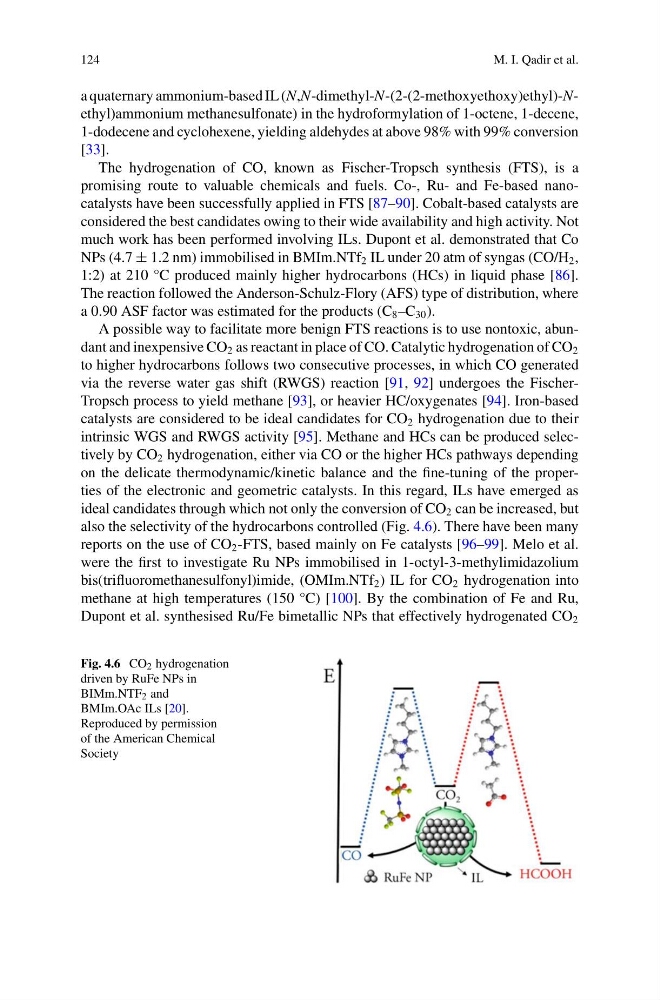
intrinsic WGS and RWGS activity [95]. Methane and HCs can be produced selectively by CO 2 hydrogenation, either via CO or the higher HCs pathways depending
on the delicate thermodynamic/kinetic balance and the fine-tuning of the properties of the electronic and geometric catalysts. In this regard, ILs have emerged as
ideal candidates through which not only the conversion of CO 2 can be increased, but
also the selectivity of the hydrocarbons controlled (Fig. 4.6). There have been many
reports on the use of CO 2 -FTS, based mainly on Fe catalysts [96–99]. Melo et al.
were the first to investigate Ru NPs immobilised in 1-octyl-3-methylimidazolium
bis(trifluoromethanesulfonyl)imide, (OMIm.NTf 2 ) IL for CO 2 hydrogenation into
methane at high temperatures (150 °C) [100]. By the combination of Fe and Ru,
Dupont et al. synthesised Ru/Fe bimetallic NPs that effectively hydrogenated CO 2
Fig. 4.6 CO 2 hydrogenation
driven by RuFe NPs in
BIMm.NTF 2 and
BMIm.OAc ILs [20].
Reproduced by permission
of the American Chemical
Society
M. I. Qadir et al.
a quaternary ammonium-based IL (N,N-dimethyl-N-(2-(2-methoxyethoxy)ethyl)-Nethyl)ammonium methanesulfonate) in the hydroformylation of 1-octene, 1-decene,
1-dodecene and cyclohexene, yielding aldehydes at above 98% with 99% conversion
[33].
The hydrogenation of CO, known as Fischer-Tropsch synthesis (FTS), is a
promising route to valuable chemicals and fuels. Co-, Ru- and Fe-based nanocatalysts have been successfully applied in FTS [87–90]. Cobalt-based catalysts are
considered the best candidates owing to their wide availability and high activity. Not
much work has been performed involving ILs. Dupont et al. demonstrated that Co
NPs (4.7 ± 1.2 nm) immobilised in BMIm.NTf 2 IL under 20 atm of syngas (CO/H 2 ,
1:2) at 210 °C produced mainly higher hydrocarbons (HCs) in liquid phase [86].
The reaction followed the Anderson-Schulz-Flory (AFS) type of distribution, where
a 0.90 ASF factor was estimated for the products (C 8 –C 30 ).
A possible way to facilitate more benign FTS reactions is to use nontoxic, abundant and inexpensive CO 2 as reactant in place of CO. Catalytic hydrogenation of CO 2
to higher hydrocarbons follows two consecutive processes, in which CO generated
via the reverse water gas shift (RWGS) reaction [91, 92] undergoes the FischerTropsch process to yield methane [93], or heavier HC/oxygenates [94]. Iron-based
catalysts are considered to be ideal candidates for CO 2 hydrogenation due to their
intrinsic WGS and RWGS activity [95]. Methane and HCs can be produced selectively by CO 2 hydrogenation, either via CO or the higher HCs pathways depending
on the delicate thermodynamic/kinetic balance and the fine-tuning of the properties of the electronic and geometric catalysts. In this regard, ILs have emerged as
ideal candidates through which not only the conversion of CO 2 can be increased, but
also the selectivity of the hydrocarbons controlled (Fig. 4.6). There have been many
reports on the use of CO 2 -FTS, based mainly on Fe catalysts [96–99]. Melo et al.
were the first to investigate Ru NPs immobilised in 1-octyl-3-methylimidazolium
bis(trifluoromethanesulfonyl)imide, (OMIm.NTf 2 ) IL for CO 2 hydrogenation into
methane at high temperatures (150 °C) [100]. By the combination of Fe and Ru,
Dupont et al. synthesised Ru/Fe bimetallic NPs that effectively hydrogenated CO 2
Fig. 4.6 CO 2 hydrogenation
driven by RuFe NPs in
BIMm.NTF 2 and
BMIm.OAc ILs [20].
Reproduced by permission
of the American Chemical
Society