

3 Catalysts via Atomic Layer Deposition
95
on the carbon nanocoils templates as shown in Fig. 3.10c [38]. The confined Ni catalyst showed enhanced activity and stability for the hydrogenations of cinnamaldehyde
and nitrobenzene compared to unconfined catalysts. Their group also developed many
confined structures with nanotubes as templates. The multiple interfaces (Ni/Al 2 O 3
and Pt/TiO 2 ) were fabricated by template-assisted ALD as shown in Fig. 3.10d [79].
The synergistic effect of the two interfaces accelerated the catalytic reaction, and the
confined space of the catalysts could adjust the transport of reactants that tuned the
reaction paths. The ALD method has been proved to be a powerful tool for the design
and fabrication of metal NPs. The size, shape, and composition of the catalysts could
be precisely tuned by the ALD process [148].
3.4 ALD Reactor for Catalysts Preparation
As the catalysts are usually in the form of nanoparticles or microparticles with larger
specific surface area than planar substrates, their synthesis by the ALD method
generally requires powder reactors with unique structures. Until now, several new
types of powder reactors have been developed for ALD on the surface of catalytic
particles. Three typical types of ALD reactors are the fluidized bed reactor (FBR),
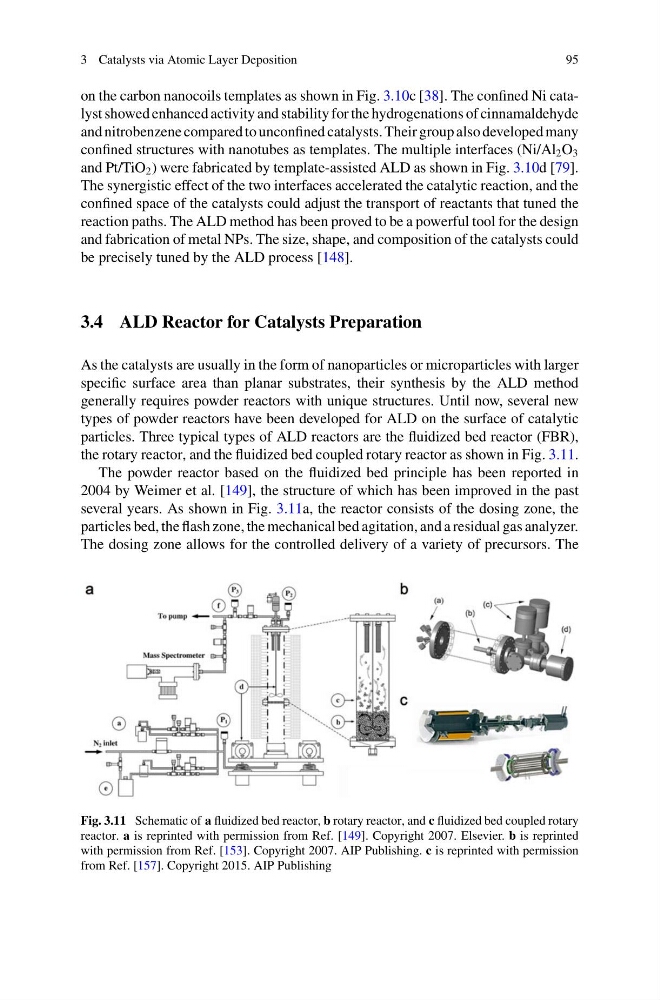
the rotary reactor, and the fluidized bed coupled rotary reactor as shown in Fig. 3.11.
The powder reactor based on the fluidized bed principle has been reported in
2004 by Weimer et al. [149], the structure of which has been improved in the past
several years. As shown in Fig. 3.11a, the reactor consists of the dosing zone, the
particles bed, the flash zone, the mechanical bed agitation, and a residual gas analyzer.
The dosing zone allows for the controlled delivery of a variety of precursors. The
Fig. 3.11 Schematic of a fluidized bed reactor, b rotary reactor, and c fluidized bed coupled rotary
reactor. a is reprinted with permission from Ref. [149]. Copyright 2007. Elsevier. b is reprinted
with permission from Ref. [153]. Copyright 2007. AIP Publishing. c is reprinted with permission
from Ref. [157]. Copyright 2015. AIP Publishing
95
on the carbon nanocoils templates as shown in Fig. 3.10c [38]. The confined Ni catalyst showed enhanced activity and stability for the hydrogenations of cinnamaldehyde
and nitrobenzene compared to unconfined catalysts. Their group also developed many
confined structures with nanotubes as templates. The multiple interfaces (Ni/Al 2 O 3
and Pt/TiO 2 ) were fabricated by template-assisted ALD as shown in Fig. 3.10d [79].
The synergistic effect of the two interfaces accelerated the catalytic reaction, and the
confined space of the catalysts could adjust the transport of reactants that tuned the
reaction paths. The ALD method has been proved to be a powerful tool for the design
and fabrication of metal NPs. The size, shape, and composition of the catalysts could
be precisely tuned by the ALD process [148].
3.4 ALD Reactor for Catalysts Preparation
As the catalysts are usually in the form of nanoparticles or microparticles with larger
specific surface area than planar substrates, their synthesis by the ALD method
generally requires powder reactors with unique structures. Until now, several new
types of powder reactors have been developed for ALD on the surface of catalytic
particles. Three typical types of ALD reactors are the fluidized bed reactor (FBR),
the rotary reactor, and the fluidized bed coupled rotary reactor as shown in Fig. 3.11.
The powder reactor based on the fluidized bed principle has been reported in
2004 by Weimer et al. [149], the structure of which has been improved in the past
several years. As shown in Fig. 3.11a, the reactor consists of the dosing zone, the
particles bed, the flash zone, the mechanical bed agitation, and a residual gas analyzer.
The dosing zone allows for the controlled delivery of a variety of precursors. The
Fig. 3.11 Schematic of a fluidized bed reactor, b rotary reactor, and c fluidized bed coupled rotary
reactor. a is reprinted with permission from Ref. [149]. Copyright 2007. Elsevier. b is reprinted
with permission from Ref. [153]. Copyright 2007. AIP Publishing. c is reprinted with permission
from Ref. [157]. Copyright 2015. AIP Publishing