

94
R. Chen et al.
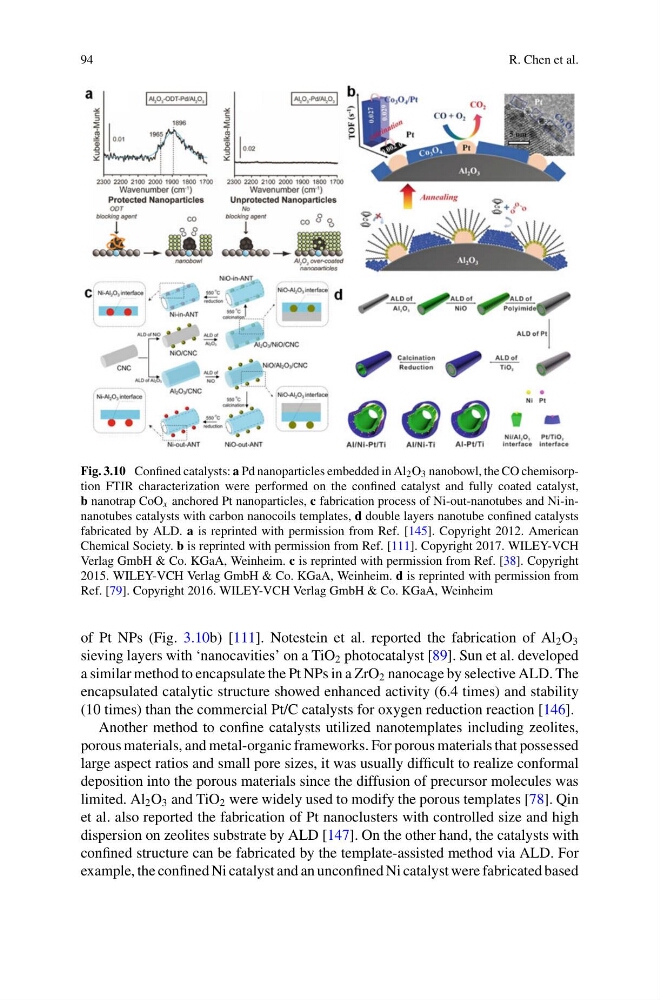
Fig. 3.10 Confined catalysts: a Pd nanoparticles embedded in Al 2 O 3 nanobowl, the CO chemisorption FTIR characterization were performed on the confined catalyst and fully coated catalyst,
b nanotrap CoO x anchored Pt nanoparticles, c fabrication process of Ni-out-nanotubes and Ni-innanotubes catalysts with carbon nanocoils templates, d double layers nanotube confined catalysts
fabricated by ALD. a is reprinted with permission from Ref. [145]. Copyright 2012. American
Chemical Society. b is reprinted with permission from Ref. [111]. Copyright 2017. WILEY-VCH
Verlag GmbH & Co. KGaA, Weinheim. c is reprinted with permission from Ref. [38]. Copyright
2015. WILEY-VCH Verlag GmbH & Co. KGaA, Weinheim. d is reprinted with permission from
Ref. [79]. Copyright 2016. WILEY-VCH Verlag GmbH & Co. KGaA, Weinheim
of Pt NPs (Fig. 3.10b) [111]. Notestein et al. reported the fabrication of Al 2 O 3
sieving layers with ‘nanocavities’ on a TiO 2 photocatalyst [89]. Sun et al. developed
a similar method to encapsulate the Pt NPs in a ZrO 2 nanocage by selective ALD. The
encapsulated catalytic structure showed enhanced activity (6.4 times) and stability
(10 times) than the commercial Pt/C catalysts for oxygen reduction reaction [146].
Another method to confine catalysts utilized nanotemplates including zeolites,
porous materials, and metal-organic frameworks. For porous materials that possessed
large aspect ratios and small pore sizes, it was usually difficult to realize conformal
deposition into the porous materials since the diffusion of precursor molecules was
limited. Al 2 O 3 and TiO 2 were widely used to modify the porous templates [78]. Qin
et al. also reported the fabrication of Pt nanoclusters with controlled size and high
dispersion on zeolites substrate by ALD [147]. On the other hand, the catalysts with
confined structure can be fabricated by the template-assisted method via ALD. For
example, the confined Ni catalyst and an unconfined Ni catalyst were fabricated based
R. Chen et al.
Fig. 3.10 Confined catalysts: a Pd nanoparticles embedded in Al 2 O 3 nanobowl, the CO chemisorption FTIR characterization were performed on the confined catalyst and fully coated catalyst,
b nanotrap CoO x anchored Pt nanoparticles, c fabrication process of Ni-out-nanotubes and Ni-innanotubes catalysts with carbon nanocoils templates, d double layers nanotube confined catalysts
fabricated by ALD. a is reprinted with permission from Ref. [145]. Copyright 2012. American
Chemical Society. b is reprinted with permission from Ref. [111]. Copyright 2017. WILEY-VCH
Verlag GmbH & Co. KGaA, Weinheim. c is reprinted with permission from Ref. [38]. Copyright
2015. WILEY-VCH Verlag GmbH & Co. KGaA, Weinheim. d is reprinted with permission from
Ref. [79]. Copyright 2016. WILEY-VCH Verlag GmbH & Co. KGaA, Weinheim
of Pt NPs (Fig. 3.10b) [111]. Notestein et al. reported the fabrication of Al 2 O 3
sieving layers with ‘nanocavities’ on a TiO 2 photocatalyst [89]. Sun et al. developed
a similar method to encapsulate the Pt NPs in a ZrO 2 nanocage by selective ALD. The
encapsulated catalytic structure showed enhanced activity (6.4 times) and stability
(10 times) than the commercial Pt/C catalysts for oxygen reduction reaction [146].
Another method to confine catalysts utilized nanotemplates including zeolites,
porous materials, and metal-organic frameworks. For porous materials that possessed
large aspect ratios and small pore sizes, it was usually difficult to realize conformal
deposition into the porous materials since the diffusion of precursor molecules was
limited. Al 2 O 3 and TiO 2 were widely used to modify the porous templates [78]. Qin
et al. also reported the fabrication of Pt nanoclusters with controlled size and high
dispersion on zeolites substrate by ALD [147]. On the other hand, the catalysts with
confined structure can be fabricated by the template-assisted method via ALD. For
example, the confined Ni catalyst and an unconfined Ni catalyst were fabricated based