

362
the initiation also led to the formation of very reactive end -OSiMeH 2 chains. There
was branching at the initiation and termination steps, followed by the liberation of
gaseous MeSiH 3 (Chojnowski et al. 2012).
The Piers-Rubinsztajn reaction was useful for the synthesis of siloxanetriarylamine hybrids functionalized with Si-H groups (Kamino et al. 2010; Gretton
et al. 2011, 2013). In reaction of MM
H
with methoxy-substituted triarylamines at
RT and using B(C 6 F 5 ) 3 as a catalyst, free-flowing liquids exhibiting low T g values
(−63 to −45 °C) were obtained (Kamino et al. 2010). In reactions of N-(3,4dimethylphenyl)-N-(4-methoxyphenyl)-biphenyl-4-amine with M 2 D
H
and PMHS
homopolymer or its PDMS-PMHS copolymers (having different MWs and ratios of
D:D
H
units: 3:1, 4:1 and 5:1), different types of a novel charge transporting materials were prepared: a viscous oil, a waxy solid or a glass material (Gretton et al. 2013).
By polycondensation of M
H 2 D n or PMHS with TEOS, TMOS or tetrapropyl
orthosilicate, catalyzed by B(C 6 F 5 ) 3 were produced silicone foams (SFs) of different
densities (0.08–0.46 g/cm
3
), due to an evolution of gasous alkanes: methane, ethane
or propane, respectively (Grande et al. 2012).
Polysiloxanes with cyclotetrasiloxane subunits were prepared by the B(C 6 F 5 ) 3 -
catalyzed condensation of tris(dimethylsiloxy)silanes (RSi(OSiMe 2 H) 3 (R = Vi or
Ph)) and various (trimethoxy)silanes (Yu and Liu 2017). Similar polycondensation
of 1,4-(HMe 2 Si) 2 C 6 H 4 with vinylmethyldimethoxysilane (VMDMS) gave a colorless viscous liquid vinylsubstituted silphenylene-siloxane copolymer (M w = 8688,
and M w /M n = 1.71) with 75% yield and a good thermostability up to 400 °C. Their
microstructure did not alternate perfectly, and a randomization reached 20%
(Xunjun et al. 2007).
14.5.4 Dehydrocondensation Reaction of H-Silanes
and H-Siloxanes With Silanols
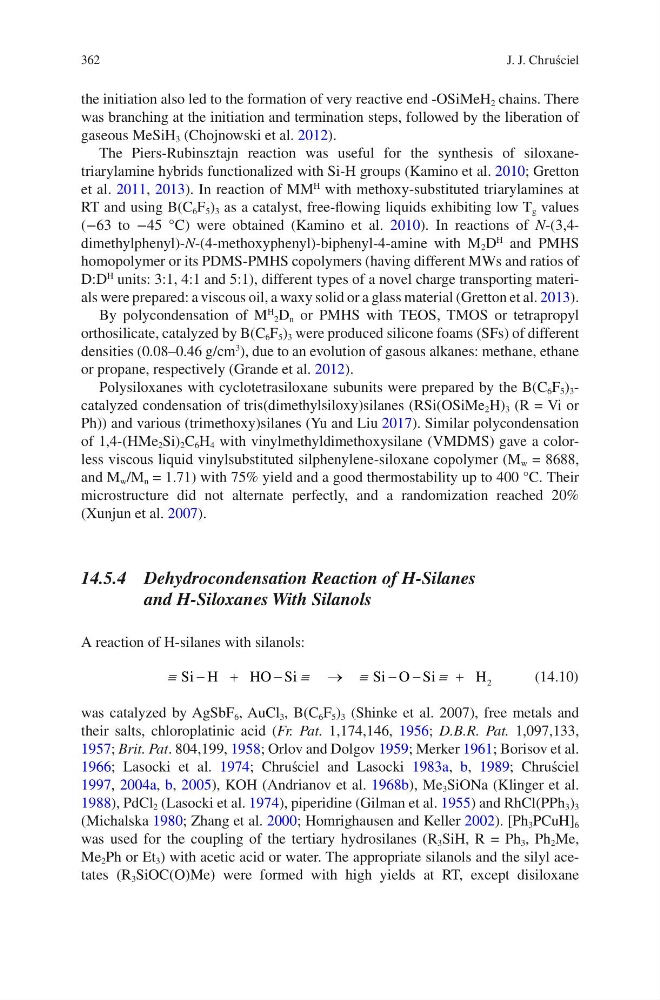
A reaction of H-silanes with silanols:
≡
≡
≡
≡
Si H
HO Si
S i O Si
H
−
−
− −
+
→
+
2
(14.10)
was catalyzed by AgSbF 6 , AuCl 3 , B(C 6 F 5 ) 3 (Shinke et al. 2007), free metals and
their salts, chloroplatinic acid (Fr. Pat. 1,174,146, 1956; D.B.R. Pat. 1,097,133,
1957; Brit. Pat. 804,199, 1958; Orlov and Dolgov 1959; Merker 1961; Borisov et al.
1966; Lasocki et al. 1974; Chruściel and Lasocki 1983a, b, 1989; Chruściel
1997, 2004a, b, 2005), KOH (Andrianov et al. 1968b), Me 3 SiONa (Klinger et al.
1988), PdCl 2 (Lasocki et al. 1974), piperidine (Gilman et al. 1955) and RhCl(PPh 3 ) 3
(Michalska 1980; Zhang et al. 2000; Homrighausen and Keller 2002). [Ph 3 PCuH] 6
was used for the coupling of the tertiary hydrosilanes (R 3 SiH, R = Ph 3 , Ph 2 Me,
Me 2 Ph or Et 3 ) with acetic acid or water. The appropriate silanols and the silyl acetates (R 3 SiOC(O)Me) were formed with high yields at RT, except disiloxane
J. J. Chruściel