

361
14.5.3 Synthesis of Polysiloxanes by
Dehydrocarbocondensation of H-Silanes
and H-Siloxanes with Alkoxysilanes
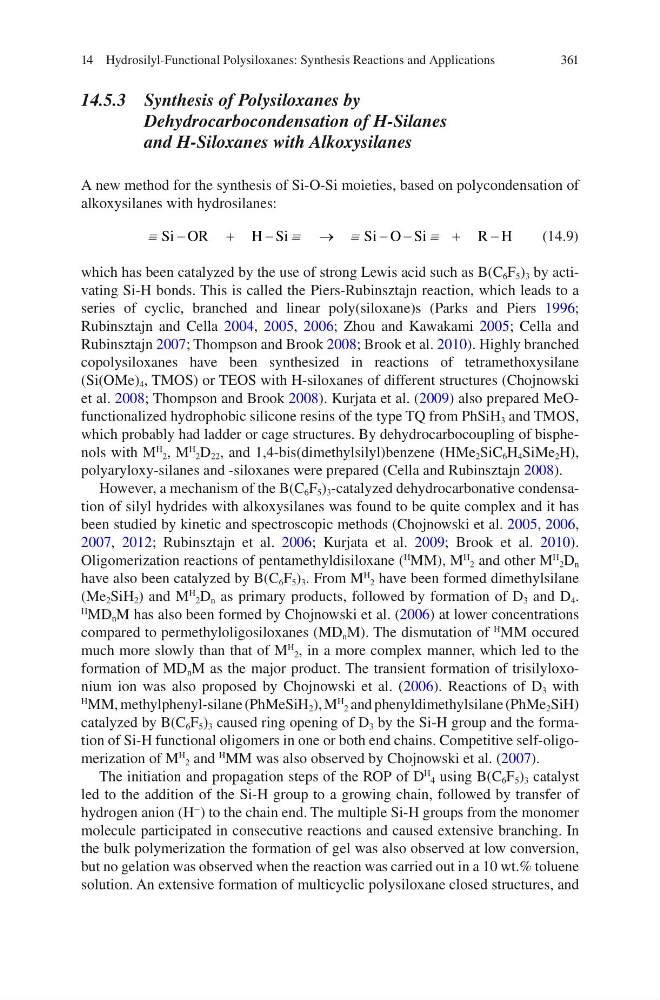
A new method for the synthesis of Si-O-Si moieties, based on polycondensation of
alkoxysilanes with hydrosilanes:
≡
≡
≡
≡
Si OR
H Si
S i O Si
R H
−
−
− −
−
+
→
+
(14.9)
which has been catalyzed by the use of strong Lewis acid such as B(C 6 F 5 ) 3 by activating Si-H bonds. This is called the Piers-Rubinsztajn reaction, which leads to a
series of cyclic, branched and linear poly(siloxane)s (Parks and Piers 1996;
Rubinsztajn and Cella 2004, 2005, 2006; Zhou and Kawakami 2005; Cella and
Rubinsztajn 2007; Thompson and Brook 2008; Brook et al. 2010). Highly branched
copolysiloxanes have been synthesized in reactions of tetramethoxysilane
(Si(OMe) 4 , TMOS) or TEOS with H-siloxanes of different structures (Chojnowski
et al. 2008; Thompson and Brook 2008). Kurjata et al. (2009) also prepared MeOfunctionalized hydrophobic silicone resins of the type TQ from PhSiH 3 and TMOS,
which probably had ladder or cage structures. By dehydrocarbocoupling of bisphenols with M
H 2 , M
H 2 D 22 , and 1,4-bis(dimethylsilyl)benzene (HMe 2 SiC 6 H 4 SiMe 2 H),
polyaryloxy- silanes and -siloxanes were prepared (Cella and Rubinsztajn 2008).
However, a mechanism of the B(C 6 F 5 ) 3 -catalyzed dehydrocarbonative condensation of silyl hydrides with alkoxysilanes was found to be quite complex and it has
been studied by kinetic and spectroscopic methods (Chojnowski et al. 2005, 2006,
2007, 2012; Rubinsztajn et al. 2006; Kurjata et al. 2009; Brook et al. 2010).
Oligomerization reactions of pentamethyldisiloxane (
H
MM), M
H 2 and other M
H 2 D n
have also been catalyzed by B(C 6 F 5 ) 3 . From M
H 2 have been formed dimethylsilane
(Me 2 SiH 2 ) and M
H 2 D n as primary products, followed by formation of D 3 and D 4 .
H
MD n M has also been formed by Chojnowski et al. (2006) at lower concentrations
compared to permethyloligosiloxanes (MD n M). The dismutation of
H
MM occured
much more slowly than that of M
H 2 , in a more complex manner, which led to the
formation of MD n M as the major product. The transient formation of trisilyloxonium ion was also proposed by Chojnowski et al. (2006). Reactions of D 3 with
H
MM, methylphenyl- silane (PhMeSiH 2 ), M
H 2 and phenyldimethylsilane (PhMe 2 SiH)
catalyzed by B(C 6 F 5 ) 3 caused ring opening of D 3 by the Si-H group and the formation of Si-H functional oligomers in one or both end chains. Competitive self-oligomerization of M
H 2 and
H
MM was also observed by Chojnowski et al. (2007).
The initiation and propagation steps of the ROP of D
H 4 using B(C 6 F 5 ) 3 catalyst
led to the addition of the Si-H group to a growing chain, followed by transfer of
hydrogen anion (H
−
) to the chain end. The multiple Si-H groups from the monomer
molecule participated in consecutive reactions and caused extensive branching. In
the bulk polymerization the formation of gel was also observed at low conversion,
but no gelation was observed when the reaction was carried out in a 10 wt.% toluene
solution. An extensive formation of multicyclic polysiloxane closed structures, and
14 Hydrosilyl-Functional Polysiloxanes: Synthesis Reactions and Applications